Up Helly Aa: A Thousand Torches and a Burning Galley
How a Victorian temperance stunt became Shetland's fire night
Contents
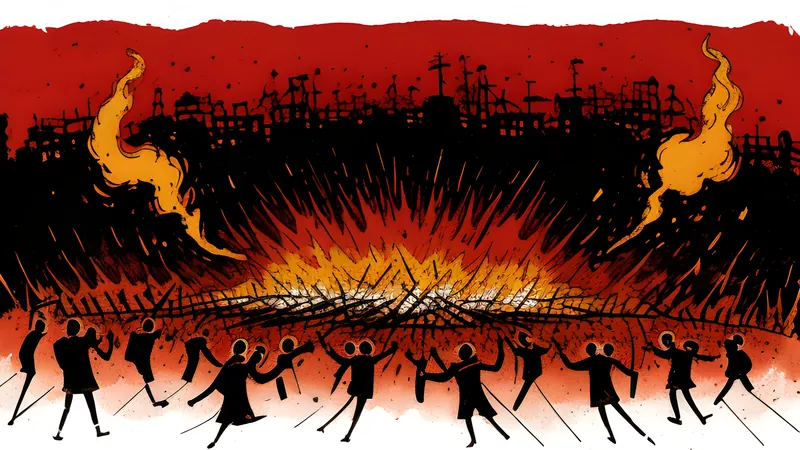
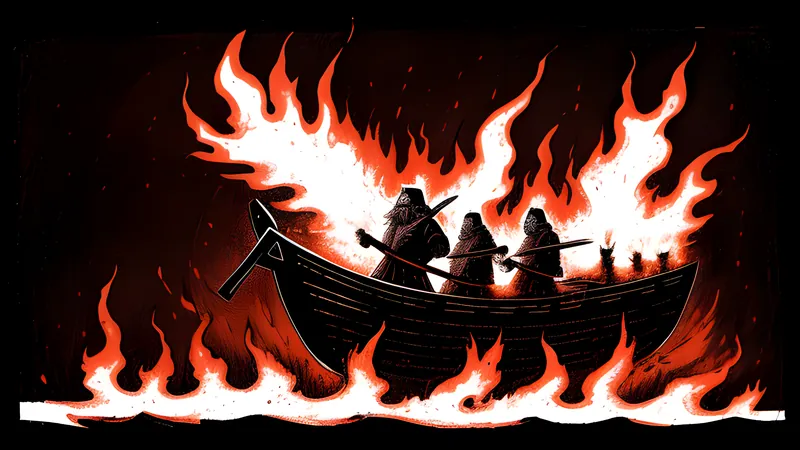
The last Tuesday of January, when the North Atlantic has spent weeks trying to peel the roofs off Lerwick, up to a thousand men march through the town carrying flaming torches over their heads. At the front walks a man dressed as a Norse chieftain, in a raven-winged helmet and a mail shirt he has spent a year and a fortune assembling. Behind him, a full-size wooden longship rolls on wheels. The procession spirals in on a marked burning site, the torch-bearers form a ring, and on a bugle signal they hurl a thousand burning brands into the galley at once. The thing goes up like a struck match. Sixty seconds later it is a bonfire the size of a house, and Shetland stands in the orange dark, singing, while the wind carries the sparks out over the harbour.
It looks like the oldest thing in Europe. It looks like a rite the Vikings left behind when they stopped raiding and started farming, a genuine unbroken line back to a longship funeral on some ninth-century beach. That is exactly what it is designed to look like, and it is almost entirely wrong. Up Helly Aa is younger than the bicycle. The Viking costume, the galley, the whole magnificent Norse theatre of it was assembled by Victorian townsmen inside living memory, and the honest history is better than the myth, because it is a story about a small place deciding, deliberately, to invent a tradition big enough to get it through the darkest week of the year.
What actually happens
Shetland is closer to Bergen than to Edinburgh, and in late January the day is a rumour — a few grey hours bookended by dark. Lerwick, the islands’ only town, is a place of under 7,000 people. Up Helly Aa is the thing that empties every hall and packs every street.
The day starts before the day does. At six in the morning, in the pitch black under a scatter of torches, a small party carries a painted billboard to the Market Cross and erects it there. This is the Bill, a Lerwick fixture since 1899: a huge hand-lettered proclamation, densely cartooned, that skewers the year’s local scandals and national follies in a torrent of Shetland dialect and filthy puns, signing off with the Guizer Jarl’s own motto. It stays up all day, and it sets the register for everything that follows — reverent about the fire, merciless about everyone in charge of anything.
The central figure is the Guizer Jarl, the chief guizer, who leads the largest and grandest of the costumed squads — the Jarl Squad, forty or fifty strong, all of them in matching hand-made Viking kit built to a shared design of helmets, shields, axes and burnished mail. Everyone else in the procession is a guizer too, in a squad of their own, and the numbers run to around a thousand torch-bearers — in a recent year some forty-six squads formed up behind the Jarl Squad, a whole town’s worth of costume. Through the day the Jarl Squad tours the town, the schools, the care homes. The Jarl himself has earned the role the long way: a man who wants it stands for election to the Up Helly Aa committee and then serves it for around fifteen years, working up a queue booked so far ahead he knows roughly which future January will be his while his children are still small.
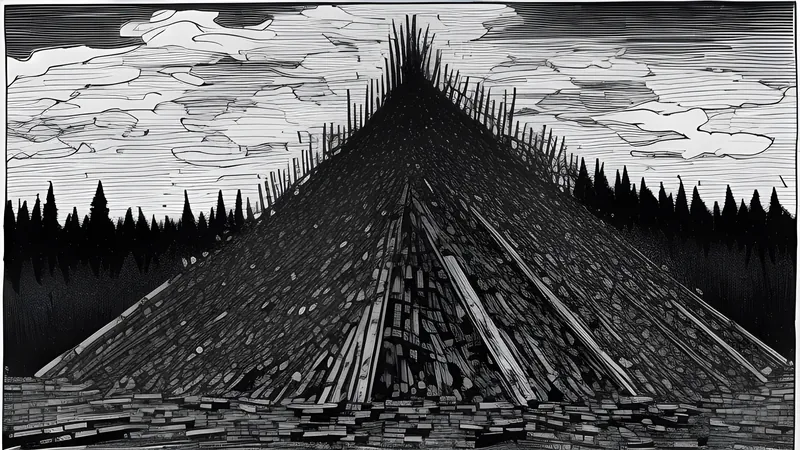
The procession forms after dark, and the choreography of a thousand torches is a serious business. The torches are paraffin-soaked and genuinely dangerous, which is rather the point, and the marshals who run the thing have the whole choreography down to a drilled science. The galley — a purpose-built replica longship, oak-ribbed and dragon-prowed, constructed over the preceding months specifically to be destroyed — is dragged to the burning site. The guizers ring it. The signal comes. In it goes.
And then the fire is only the start. Because after the galley collapses, the squads spend the entire night touring the halls.
The halls, and the longest night
This is the part outsiders miss, the part you cannot photograph. Up Helly Aa is an all-night moving party, and the engine of it is the “act.” Every squad, having spent months on costume, has also rehearsed a turn — a comedy sketch, a song, a piece of choreographed daftness, usually skewering some local scandal or national absurdity from the past year. Through the night the squads rotate around a dozen or more halls across the town, and at each hall they perform their act, then dance with whoever is there, then move on to the next while the next squad arrives behind them.
The halls are hosted and stocked by the community, and the guizers keep going until dawn and beyond. The Wednesday after is a public holiday in Lerwick, which tells you everything about how seriously the town takes its recovery. A stranger with the right invitation can end up dancing at four in the morning with a man dressed as a Viking who fixes boilers for a living, both of you long past speech, the fiddle still going in the corner. It is one of the great communal nights in Europe and hardly anyone outside Shetland knows it exists.
Eleven fires, not one
The Lerwick spectacle is the one that reaches the news wires, and it is the biggest, but it is one node in a season. Across Shetland, roughly eleven separate Up Helly Aas burn between January and March, each run by its own community with its own Jarl, galley and hall circuit. Scalloway, the old capital a few miles west, lights up on the second Friday of January, before Lerwick even goes. Nesting and Girlsta hold theirs about ten days after the town does; Uyeasound, up on the island of Unst at the very top of Britain, goes on the third Friday of February. More festivals follow in Northmavine, the South Mainland and beyond, strung right through the dead of winter so the fire never quite goes out of the islands until spring is in sight.
That matters to how you read the whole thing. This is a distributed folk practice a scattered, storm-battered archipelago performs village by village for two solid months, each community building its own boat to burn. The Lerwick edition is the flagship because the others make it an ordinary Shetland habit — the whole place agreeing, every winter, that the answer to the dark is to build something beautiful and set it alight.
The Victorian truth under the Norse dress
Here is where the record and the imagery part company, and the record is worth telling straight.
There was midwinter fire in Lerwick long before there were Vikings in it, but it was rowdier and dumber. Young men rolled barrels of burning tar through the narrow lanes on sledges — “tar-barrelling” — a chaotic, filthy, dangerous business that terrorised the respectable and periodically set things alight that weren’t meant to burn. By the mid-nineteenth century the town authorities had had enough, and tar-barrelling was suppressed.
What replaced it was a conscious tidy-up. Through the 1870s and 1880s a group of Lerwick men reorganised the midwinter revels into something processional, torch-lit and governed by committee. The Total Abstinence Society was in the mix — part of the drive was to give young men a spectacle grand enough to keep them out of the pub — which is a delicious irony given what the halls have become. The name “Up Helly Aa,” roughly the end of the holy days, the close of Yule, attached itself in this period.
The Viking layer came last, and came from a book. Shetland in the late Victorian era was rediscovering its Norse inheritance with enormous romantic enthusiasm; the islands had been Norwegian until the fifteenth century and the old language, Norn, was within a few generations of living memory. The local author Haldane Burgess published The Viking Path in 1894, and the Norse theme took hold hard. The first galley was built and burned in 1889. The role of the Jarl, the costumed chieftain who now anchors the whole thing, was formalised in the early twentieth century. Within a couple of decades the festival had assembled every element a visitor now reads as ancient — and every one of them has a date attached.
So the reverence is real and the antiquity is theatre. Up Helly Aa is a genuine folk tradition that happens to be a designed one, built by named people in a documented span to answer a real need: how does a tiny, dark, wind-battered town hold itself together through the worst month, and give its young men something to pour a year of effort into? The answer was to invent a fire.
The reform that took a century
For most of that history Up Helly Aa in Lerwick was a men-only affair on the street. Women and girls did colossal amounts of the work — the costumes, the food, the hosting of the halls — but they could not march in a main squad, could not carry a torch in the procession, and could not be the Jarl. Women hosted; men burned. For a modern visitor it was the one note in the whole festival that jarred.
That changed, and recently. From the 2023 festival, the rules barring women and girls from the main Lerwick squads were dropped, and women marched and carried torches in the procession for the first time. It arrived after years of local argument, and it arrived without wrecking anything the reformers’ opponents had feared for; the galley still burned, the halls still filled, the acts were still filthy about the council. A tradition that had proved it could be invented in the 1880s proved, 140 years on, that it could be amended too. For an event so wrapped in the language of unbroken heritage, that is the most Shetland thing about it: the willingness, twice now, to decide what the tradition is going to be.
Why a burning boat is worth taking seriously
There is a lazy way to read Up Helly Aa — grown men playing Vikings, a tourist-board fever dream, cosplay with fire regulations. Spend any time with the record and that reading collapses. The costume is hand-made and worn once. The galley takes months and lasts a minute. The Jarl waits a decade for a single night. None of it is efficient, none of it is for profit, and the community pours a staggering quantity of unpaid labour into a thing whose entire purpose is to be set on fire and then danced away by dawn.
That is what fire festivals are for, and Shetland is not alone in knowing it. The Danes gather round midsummer bonfires on the beaches for Sankt Hans, burning the dark back at the opposite end of the year. Even the pyro-drenched spectacle of a festival like Copenhell runs on a cousin of the same instinct — a community builds something enormous and temporary together precisely so it can gather round the flames and feel the ordinary year fall away. Up Helly Aa is the northern, midwinter, everything-is-black-by-four version of that impulse, dressed in a costume it borrowed from a novel.
Go if you ever get the chance, which is harder than it sounds — Lerwick is a boat or a small plane away, the town is full to the rafters that week, and the halls run on invitation. But stand in that ring when the bugle sounds and a thousand torches arc into the galley at once, and the heat hits your face from thirty feet, and you understand instantly why a place at the edge of the map decided, in the 1880s, that it needed exactly this. The Vikings have nothing to do with it. The dark is long, and a town survives it better with a fire it built on purpose.
Sources: the Up Helly Aa organisation’s own history and the Wikipedia overview for the Victorian origins, the 1889 first galley, the 1899 Bill and Burgess’s 1894 The Viking Path; Shetland.org for the wider network of roughly eleven island fire festivals from January to March and the fifteen-year committee path to Guizer Jarl; the Scotsman for the 2023 admission of women to the Lerwick squads.
Related Content