Turbonegro: Denim, Deathpunk and Devotion
How an Oslo band turned sailor caps and denim jackets into a global army
Contents
There is no other band quite like Turbonegro, and there probably could not be. The Oslo group spent three decades turning provocation into a genre, denim into a uniform and their own audience into a devoted worldwide army. They coined a word for what they do — deathpunk — and they built around it a spectacle of sailor caps, greasepaint and gleeful bad taste that no other band has come close to matching. This is the story of the denim demons, told from the record.
Turbonegro have long been part of the furniture of Scandinavian loud music, a band whose reputation and iconography travel far beyond anyone who has caught them live. I write this as a Copenhagen punter who has watched the Nordic rock world for two decades, and who counts Turbonegro among the most singular acts the region has produced — a read from their catalogue and their extraordinary cultural footprint rather than a claim on any particular gig.
The birth of deathpunk
Turbonegro formed in Oslo in 1989, coming up through the same punk underground that produced a lot of harder-edged Scandinavian rock. From the start they were a provocation. The name alone was designed to make people uncomfortable, and the band leaned into transgression as a core principle — camp, homoerotic imagery deployed as a weapon against rock’s macho posturing, lyrics engineered to offend, a whole aesthetic built on refusing to be respectable.
Underneath the provocation was a serious band. The sound they landed on drew on the raw Detroit proto-punk of the Stooges and the MC5, the glam swagger of the 1970s, and the speed and aggression of hardcore, and they gave it a name of their own: deathpunk. It was punk played with metal muscle and glam theatricality, and it was funnier and smarter than the shock-value surface suggested. The early records — Hot Cars and Spent Contraceptives (1992), Never Is Forever (1994) and the cult favourite Ass Cobra (1996) — laid this out in increasingly confident fashion, Ass Cobra in particular becoming an underground touchstone for its raw, riotous energy.
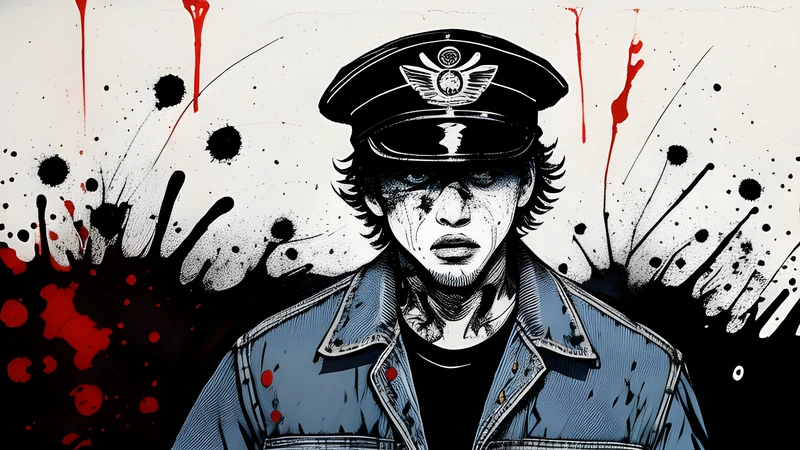
The visual identity was inseparable from the music. Denim jackets, sailor caps, moustaches, greasepaint — the band presented as a gang, a unit with a look you could spot across a festival field. In a rock landscape full of bands trying to seem authentic and tortured, Turbonegro understood that theatre and commitment to a bit could be their own kind of authenticity.
Collapse and resurrection
The first act ended abruptly. In 1998, at what should have been a high point, the band fell apart when their frontman Hank von Helvete — the stage name of Hans Erik Dyvik Husby — became too seriously unwell to continue. Turbonegro dissolved, and for a few years it looked like the story was over, another cult band burning out before it fully broke through.
What happened next is the remarkable part. During the years the band was inactive, its legend actually grew. The records kept circulating, the fanbase kept expanding, and by the early 2000s there was a genuine groundswell of demand for a return. In 2002 Turbonegro reformed, with Hank recovered and back at the microphone, and in 2003 they released Scandinavian Leather — a triumphant comeback that was bigger and more polished than anything they had done before, and which turned the cult act into a proper international touring force.
Party Animals (2005) pushed the momentum further, packed with the kind of huge, anthemic, deliberately dumb-smart singalongs that had become the band’s stock in trade. This was Turbonegro at their commercial peak, headlining festivals, filling large venues, the sailor caps suddenly everywhere. The resurrection had worked so completely that the collapse of 1998 became just another chapter in the myth.
The Turbojugend
The single most extraordinary thing Turbonegro created is the Turbojugend — the band’s fan organisation, and one of the most committed and structured fanbases in all of music. Members wear customised denim jackets emblazoned with a back patch bearing their local chapter’s name, and chapters exist in cities all over the world, from Oslo to Tokyo to towns you have never heard of. It is part fan club, part social movement, part running joke taken further than any joke has a right to go.
To see a festival crowd thick with Turbojugend jackets is to understand that Turbonegro built something closer to a subculture than a fanbase. The denim jacket functions like a football shirt or a biker’s colours — a declaration of allegiance, a way of finding your people in a crowd. Annual gatherings bring thousands of denim-clad devotees together, and the whole apparatus runs on a mixture of genuine devotion and knowing absurdity that is entirely in keeping with the band that inspired it. Very few artists inspire that kind of organised, self-perpetuating loyalty. Turbonegro turned their audience into a global institution.
The later years and a loss
The band’s story continued to twist. Hank von Helvete left Turbonegro in 2010, and rather than fold, the group recruited an English vocalist, Tony Sylvester, who fronted the band from 2011 through a further run of albums and tours. The transition was divisive among the faithful — replacing a frontman as iconic as Hank was always going to be — but it kept the machine running and the denim army marching.
Then came the sad coda. Hank von Helvete died in November 2021, at the age of 49. For a generation of Scandinavian rock fans he was one of the great frontmen, a charismatic, fearless performer who embodied everything Turbonegro stood for, and his death was mourned across the Nordic music world. Throughout every line-up change, the constant has been Happy-Tom — Thomas Seltzer — the bassist and principal songwriter who has steered the band from the beginning and remains its guiding intelligence.
The Nordic rock lineage
Turbonegro belong to a specific tradition of Scandinavian bands who understood that rock and roll is partly theatre, that showmanship and songcraft are not opposites, and that a band can be deadly serious about being ridiculous. You can draw a line from their denim spectacle to Denmark’s own D-A-D, the cowboy-hatted Danish showmen who worked a similar seam of larger-than-life rock theatre a little earlier and a little to the south.
You can draw another line forward, to Kvelertak, the younger Norwegians who inherited the same instinct that heavy music is allowed to be a celebration rather than a funeral. The Turbonegro influence runs through a whole strand of Scandinavian rock that prizes energy, humour and communal joy, and any Copenhell crowd contains people who learned from Turbonegro that the best gigs are the ones where everyone is in on the joke together. When they have rolled through Copenhagen rooms like VEGA over the years, they have brought that whole apparatus of denim and devotion with them.
Why they matter
Turbonegro matter because they proved that a band can build an entire world — a genre, a look, a language, an army — out of commitment to a vision most people would have been too self-conscious to pursue. They took provocation and made it joyful, took bad taste and made it art, took an audience and made it a movement. The music holds up on its own: Ass Cobra and Scandinavian Leather are genuinely great records, full of riffs and hooks that would be the envy of far more respectable bands.
But the achievement is bigger than the songs. Turbonegro created a piece of living culture, a self-sustaining subculture of denim and devotion that has outlasted line-up changes, a break-up, a triumphant return and the loss of its greatest frontman. Somewhere in the world tonight, someone is stitching a chapter patch onto a denim jacket, and that is the most durable monument a rock band could hope to leave behind.
The show as ritual
To understand the devotion you have to understand the show. A Turbonegro gig in the classic era was pure ringmaster theatre — Hank von Helvete working the crowd like a demented cabaret host, the band a tight glam-punk machine behind him, the whole thing pitched somewhere between a rock concert and a variety act that had gone gloriously off the rails. The songs were built for it: enormous, chant-along choruses designed so that a field of denim demons could roar every word back, arms aloft, jackets on show.
That participatory quality is the engine of the Turbojugend phenomenon. A Turbonegro song is something you join rather than something you watch, and the band engineered their whole catalogue around communal singalong. It is why the live reputation towers over the studio one, and why the crowd at a Turbonegro show has always felt less like an audience and more like a congregation that happens to be wearing denim.
Where to start
For the curious, Ass Cobra is the raw, essential document of the early band — fast, filthy, funny, the deathpunk idea in its purest form. Scandinavian Leather is the comeback that shows the fuller, more anthemic version of the band, and Party Animals is the one packed with the huge singles that soundtracked their commercial peak. Play them in that order and you hear the whole arc: cult provocateurs, then a triumphant return, then a festival-headlining force.
What ties it all together is a refusal to be embarrassed. Plenty of bands have been transgressive, plenty have been theatrical, plenty have built devoted fanbases. Turbonegro did all three at once and committed so totally that the joke became a genuine culture. Three decades on, through every loss and every reinvention, the denim army is still marching — proof that the most ridiculous idea in rock, pursued without a shred of shame, can outlast almost everything more serious around it.
Related Content