Tons of Rock: How Oslo Learned to Throw a Proper Metal Party
From a Halden fortress to Norway's biggest festival on the Ekeberg plateau above the fjord
Contents
For most of my festival life Oslo was the neighbour that didn’t have one. Norway had the money, the bands and one of the deepest metal scenes on the planet, and yet if you wanted to see a big loud outdoor bill you flew to Sweden Rock or drove to Copenhell. Then Tons of Rock arrived, and within a decade it had become the largest music festival in the whole country. That is a genuinely strange thing to have happened, and it is worth walking through how.
I have never actually been. The dates are the reason — Tons of Rock lands in late June, and late June is Roskilde week for me, and a man cannot be in two fields at once. So this is a read from the outside, from the record and from every Dane and Norwegian I know who has made the trip. But the story of the thing is clear enough from here, and it is a good one: a festival that started on a castle wall in a border town and ended up on a hill above the capital, packing in more people than anything else Norway puts on.
From a Halden fortress to the capital
Tons of Rock began in 2014, and it did not begin in Oslo at all. The first five editions ran at Fredriksten Fortress in Halden, a genuine seventeenth-century star fort down on the Swedish border, the kind of place with stone ramparts and cannon and a commanding view over the town. As a setting for heavy music it is almost too on the nose — a fortress that actually withstood sieges, now hosting bands who sing about exactly that sort of thing. The early editions built a reputation fast. Norway had the appetite; what it had lacked was somebody willing to put on a dedicated rock and metal weekend at scale, and Tons of Rock filled the hole.
The catch with Halden was that a historic fortress can only hold so many bodies before the fire marshals start shaking their heads. By 2018 the festival had outgrown the walls. So in 2019 it moved north to Ekebergsletta, the big open recreation ground on the Ekeberg plateau on the east side of Oslo, high enough that on a clear day you look out over the whole city and the inner fjord. That same year Live Nation Norway took a majority stake, 51 per cent, and the trajectory changed gears. The little fortress festival was now a properly capitalised operation on the doorstep of a city of a million people with a metro line running to it.
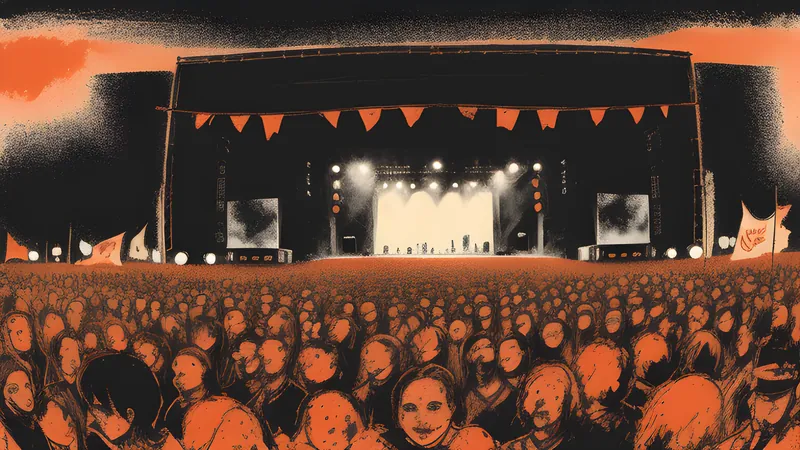
The growth after the move was steep. By 2023 Tons of Rock had become the biggest festival in Norway by attendance, pulling around 100,000 visitors across the weekend. In 2024 that climbed to something like 150,000. For a festival barely ten years old, in a country whose entire population is around five and a half million, those are remarkable numbers. Oslo had gone from having no flagship rock festival to having the country’s single largest one, in the space of a decade.
What the corporate takeover actually bought
I want to be careful here, because “Live Nation bought it and it got huge” is the kind of sentence that usually comes with a sneer, and I try to earn my sneers rather than issue them reflexively. The honest read is more interesting. The corporate money is exactly what let Tons of Rock book the headliners that turned it from a strong regional festival into a national event. Guns N’ Roses topped the bill in 2023 — the sort of name that sells out a field on its own and drags in the once-a-year crowd who otherwise never buy a festival ticket. You do not get a band at that price without a promoter with that kind of chequebook.
That is the trade every festival on earth is now making, and I have written about the flattening effect it has — how the same handful of headliners rotate through every field in Europe until one summer blurs into the next. Tons of Rock is squarely inside that machine now. The bill in any given year will share a lot of names with a dozen other European festivals, because the touring economy funnels the big acts along the same circuit.
What saves it, from everything I can tell, is the location and the domestic depth. Ekebergsletta is a genuinely good site — open, elevated, a short hop from central Oslo by tram, which means people can sleep in their own beds or a cheap hotel rather than a mud field, and it means the city itself is part of the weekend. And the Norwegian and Nordic underbill is where the festival keeps its character. This is the country that gave the world its most notorious extreme-metal scene, and a Norwegian rock festival that ignored that heritage would be committing a kind of malpractice. The domestic bookings are how Tons of Rock stays Norwegian while the headline slots go global.
The scene it plugged into
The thing outsiders miss about a festival like this is that it did not create an audience — it inherited one. Norway has been a heavy-music country for thirty-odd years, since the black metal explosion out of Oslo and Bergen in the early 1990s made a small cold nation improbably central to the whole global genre. That scene never went away; it professionalised, aged, had children, and those children grew up in a country where liking metal is close to a default cultural setting rather than a subculture you have to defend.
So when Tons of Rock offered a big, well-run, easy-to-reach summer festival, the audience was already there and already large. Oslo also has the Inferno Metal Festival at Easter, the indoor extreme-metal institution that has run since 2001, and down in Vestfold there is Midgardsblot staging Viking and atmospheric metal literally among the burial mounds. Tons of Rock is the mainstream summer anchor of that ecosystem — the big-tent event that a Guns N’ Roses fan and an Enslaved fan can both find a reason to attend. It sits on top of a scene rather than inventing one, and that foundation is why the growth stuck instead of collapsing the way over-funded new festivals so often do.
The site, and the city around it
Ekebergsletta is worth dwelling on, because the site is half the reason the festival works. It is a broad open recreation ground on the Ekeberg plateau, on the eastern rim of Oslo, high enough that the view runs out over the city rooftops and the inner Oslofjord. The Ekebergparken sculpture park sits just alongside, and the whole plateau has a green, elevated, slightly out-of-town feel while still being a short tram ride from the centre. For a festival, that combination is close to ideal: enough space to build proper stages and campsites, enough elevation to give the thing a view, and a public-transport link straight into a functioning European capital.
That last part changes the character of the weekend completely. Most big metal festivals are a self-contained mud republic — you arrive, you camp, you do not leave until it is over, and the nearest real town is an hour away. Tons of Rock is different because Oslo is right there. You can do the festival from a hotel bed, eat breakfast in a café, ride the tram up to the plateau for the afternoon and evening, and treat the city as part of the experience. There is a festival camp on Ekeberg for those who want the traditional full-immersion version, but the option to sleep in a proper bed in a walkable Nordic capital is a genuine draw, and it is exactly the sort of thing that pulls in the once-a-year attendee who would never sign up for a field.
The trade-off is cost, because Oslo is one of the most expensive cities in Europe and a beer will remind you of that with every round. But for a certain kind of festival-goer — older, with money, wanting the big bands without the endurance-test camping — that convenience is precisely the appeal, and it is a large part of why the attendance numbers climbed as fast as they did once the festival moved to the plateau.
Would I actually go
Here is my problem, and it is a scheduling problem more than anything. Late June is when the money runs out, because that is Roskilde week, and Roskilde has a first claim on my summer that predates Tons of Rock’s existence by a decade. Every year the Oslo bill goes up and every year I look at it, do the maths on the dates, and stay in Denmark. That is the honest reason I have never stood on the Ekeberg plateau watching the fjord go pink behind a mainstage.
If your calendar is freer than mine, the case is strong. Oslo is one of the easiest big cities in Europe to spend a few days in, the site is a tram ride from a proper hotel breakfast, and the surrounding scene gives you an excuse to build a longer trip — hit the festival, then go find the studios and record shops and small venues that the black metal generation came out of. You are getting the global-headliner spectacle with a genuinely deep local underbill and a host city that is worth the airfare on its own.
What Tons of Rock proves, more than anything, is that a festival can be built fast if the audience is already waiting. Norway had the scene, the money and the appetite for thirty years and just lacked the field to put it in. Somebody finally built the field, moved it to a hill above the capital, and the country showed up in numbers nobody quite predicted. The next time a Copenhagen mate tells me Oslo doesn’t do festivals, I have a hundred and fifty thousand people to point at.
Related Content