The World Stone Skimming Championships, Easdale
A flooded Hebridean slate quarry, three throws each, and a sport with no run-up allowed
Contents
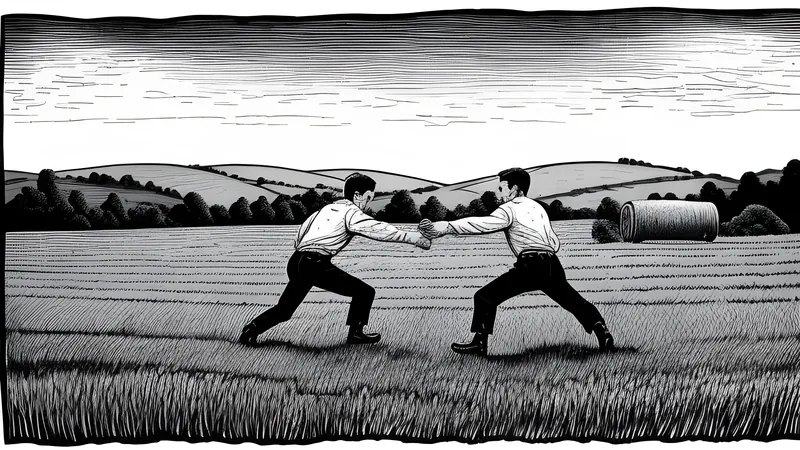
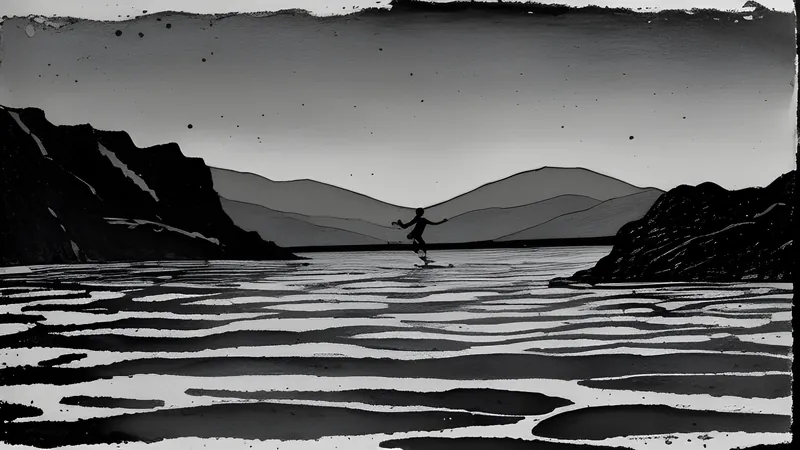
Easdale is the smallest permanently inhabited island in the Inner Hebrides, and for one Sunday every September its population multiplies several times over for a sport with a rulebook stricter than most professional athletics. Competitors get three throws each. The stone must be quarried locally, must not exceed three inches at its widest point, must bounce at least twice before it sinks, and the thrower’s feet may not leave a small stone platform at any point in the delivery. No run-up, no wind-up beyond what your shoulders can manage from a standing position. Whoever’s stone travels furthest before it disappears under the water wins. That is the entire sport, and somehow it has been enough to draw entrants from six continents to a former slate quarry on an island roughly the size of a large city park.
I cover this from Copenhagen with the honesty a cultural read demands: I have never stood on that platform. This is a piece built from the public record of a genuinely small, genuinely remote championship. But an island reinventing its own abandoned industrial scar as a world championship venue is exactly the kind of story that pulls me away from my usual beat of loud rooms and festival fields.
A quarry that stopped producing slate and started producing sport
Easdale’s whole reason for existing is slate. From the 1600s through to the end of the 1800s the island was one of the beating hearts of Scotland’s slate industry, quarried and shipped out to roof half of the country and plenty beyond it. A storm in 1881 flooded the main workings and effectively ended large-scale extraction, and Easdale spent the following century as a much quieter place, its abandoned quarries slowly filling with rainwater and settling into the landscape as flooded pits rather than working holes in the ground.
One of those flooded quarries turned out to be, by pure accident of geometry and geology, close to the perfect arena for throwing flat stones across open water. It is roughly circular, walled on most sides by rock, with a narrow throwing platform positioned to give every competitor the same sightline down the water. Nobody designed it for sport. Industry abandoned a hole, weather filled it, and decades later somebody looked at the result and thought: that’s a stadium.
The stones are the strictest part of the rules
What separates competitive stone skimming from what you or I might do idly at a beach is the insistence that the stone itself must come from the island. Easdale slate has a particular quality — it splits along natural fault lines into thin, flat, often near-perfectly circular discs, the very shape that generations of local quarrymen and their children discovered by accident was unbeatable for skimming across the harbour. The championship rules simply codify what island children had already worked out generations before there was a trophy to win: use naturally formed Easdale slate, keep it under three inches across, and let the rock’s own geology do the rest.
That constraint changes the sport in an interesting way. This is not a competition about who can source the most aerodynamic disc from anywhere in the world; the raw material is fixed and local, which means the entire contest comes down to technique, wrist snap, release angle, and a fair amount of luck in which stone you happened to pick out of the pile. It also ties the sport to the place in a way few other “world championships” manage — you cannot practise with a smuggled-in ringer stone from a different quarry and expect it to behave the same way on the day.
From 1983 to a proper fixture
The first Easdale championship was organised in 1983 by a local resident named Albert Baker, and it ran for a handful of years before lapsing into dormancy the way small island events sometimes do when the person who carried it drops away. It came back to life in 1997, revived by Eilean Eisdeal, the island’s community development group, and has run every September since, pausing only for the years the whole world’s calendar of gatherings paused.
That revival matters, because it turned a one-off local curiosity into a genuine annual fixture with a fundraising purpose behind it. Easdale has a population that can be counted in the dozens rather than the hundreds, and an island that small needs every lever it can find to keep itself viable — a ferry service, a shop, a hall, the basic infrastructure of a functioning community. The championship, by pulling in competitors and spectators from well beyond Scotland every year, has become one of those levers. The daftness of the sport and the seriousness of what it funds sit side by side without any apparent tension, which is a very Scottish-island trick.
Categories, records, and the physics of a good skim
The championship runs men’s, women’s, and junior categories, plus a “champion of champions” event that pits the previous winners of each class against one another. The physics of the winning throw is fairly intuitive once you’ve watched a few rounds: a flatter stone released nearly parallel to the water, spinning fast enough on release to stay rigid in flight rather than tumbling, thrown low and hard rather than lofted, skips across the surface in a series of shrinking bounces before finally losing enough speed to sink. The best throwers at Easdale routinely send a stone well over 60 metres before it goes under, and the standing distance record set at the championship sits north of 60 metres, a mark that has stood for years against a very determined field of challengers.
What I find most likeable about the format is the platform rule. No run-up means no advantage from raw athleticism or a fast approach — you cannot out-sprint your way to a longer skim. Everything has to be generated from a standing position, through the mechanics of the throw itself: hip rotation, wrist snap, the angle at which the stone leaves the hand. It rewards the same kind of compact, technical power you see in a good discus thrower working from a tight circle rather than a full run-up, condensed into a single standing throw rather than a spinning wind-up.
The islander who keeps winning
Every long-running championship eventually produces a name the record books can’t stop repeating, and at Easdale that name is Dougie Isaacs. A stonemason with deep local roots in the area, Isaacs has taken the men’s title more times than any other competitor in the championship’s history, racking up wins across multiple decades rather than one hot run of form. What makes the record notable beyond the raw count is the home advantage baked into it: a local who has thrown on that particular stretch of quarry water since childhood, who knows the wind patterns funnelling down between the rock walls and the exact texture of the slate scattered around the platform, has an edge no visiting competitor from Australia or California can fully replicate on a single September afternoon. It is the same kind of terroir advantage a Wimbledon grass-court specialist has over a clay-court visitor, compressed into a pool of water roughly the size of a large swimming pool.
The judging itself is more exacting than the daftness of the sport suggests. Officials use a laser measuring device trained along the water to record precisely where each stone finally sinks, rather than eyeballing a splash from the platform, and the distinction matters because winning margins at the sharp end of the competition can come down to a matter of centimetres after a throw that travelled the better part of a football pitch. Every throw is watched for the legality of the bounce — a stone that skips only once, or lifts entirely clear of the water on its first contact, is thrown out regardless of how far it eventually travels — which keeps the sport honest in a way a casual beach skim never has to be.
The wider family of daft, precise British contests
Easdale belongs to a small, specific genre of British sporting event: an activity anyone could do idly on holiday, formalised into a championship with a rulebook stricter than the casual version would ever need. It shares that DNA with events like the conker championships fought out in a Northamptonshire field every October, another contest built from something ordinary — a fallen seed, a flat stone — turned competitive through nothing more than a community deciding to keep score. Scotland has its own parallel tradition of turning working implements into sporting spectacle too, most famously at the Highland Games, where a blacksmith’s yard’s worth of stones, hammers, and poles became a heavy events circuit that has run continuously since the early 1800s.
What all of these share is a refusal to let the smallness of the original act — throwing a stone, striking a conker, tossing a farmyard weight — stop it becoming something a community organises itself around, year after year, with genuine pride in the specificity of the rules. A three-inch stone. A twelve o’clock caber. A 253.5-metre wife-carrying course. The precision is not incidental to the comedy; it is the comedy, the deadpan seriousness applied to something inherently silly.
Why a flooded quarry beats a purpose-built arena
There is a lesson in Easdale for anyone who thinks a great spectacle needs a great budget. This is a former industrial wound in the landscape, unglamorous by any conventional measure, repurposed by a community too small to afford anything else into a genuinely internationally recognised championship venue. No corporate naming rights, no permanent grandstand, just a walled pool of quarry water and a rock platform that has hosted a world championship every September for the better part of four decades.
I travel to plenty of festivals built on enormous production budgets and I love a fair few of them. But there’s a particular kind of respect I reserve for events like Easdale’s, where the entire spectacle is generated by the setting itself plus a community’s willingness to keep turning up and keep score. A stone goes skipping across dark quarry water, bounces four, five, six times, and finally sinks somewhere past the sixty-metre mark, and a tiny Hebridean island gets to call itself, for one Sunday a year, host to the best stone skimmers on the planet. That’s the whole trick. No run-up required.
Related Content