The Wall of Death and Its Etiquette
Two halves of a crowd, a gap in the middle, and the unwritten rules that keep it joyful
Contents
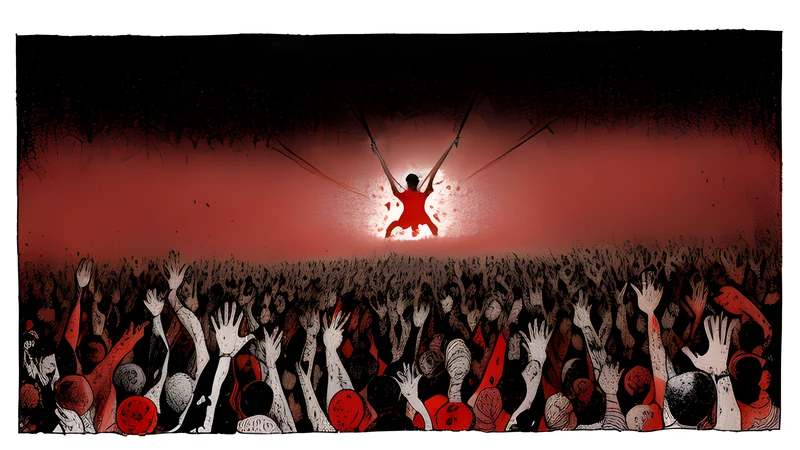
To an outsider it looks like the prelude to a battle. The band stops. The singer waves both arms, parting the crowd like a conductor demanding silence, and the audience obeys, splitting into two dense ranks that back away from each other until a bare corridor of empty floor opens down the middle of the room. There is a pause, a held breath, a single downbeat — and then the two walls charge, sprinting at each other across the gap and colliding in the centre in a roar of bodies. This is the wall of death, the most theatrical and most misunderstood of all the crowd rituals, and the thing nobody outside the room ever believes is that it runs almost entirely on courtesy.
I have been on both sides of that gap more times than I can count, in Danish rooms and at festivals across Europe, and the abiding truth of it is that a wall of death is a piece of collaborative theatre disguised as violence. Everyone in it has agreed to the rules in advance. The charge is real, the collision is real, and yet the whole thing is held together by a web of unwritten etiquette so reliable that serious injury is genuinely rare. Understanding that etiquette is the difference between a joyful ritual and a dangerous mess, so it is worth setting down plainly.
What it actually is
The wall of death is a set-piece, always initiated from the stage. Unlike the spontaneous swirl of a mosh pit, it cannot happen by accident: it requires the band to stop, call it, and hold the crowd in suspense while the two sides form. That top-down choreography is the whole character of the thing. The frontman is a director, milking the pause, stretching the tension, waiting until the room is coiled tight before releasing it on a specific beat — usually the drop back into a heavy riff or a breakdown built precisely for the purpose. The band and the crowd are collaborating on a single dramatic moment, and the timing is everything.
The lineage of the ritual is a story in itself, tangled up with several bands who each claim a share of the credit, and I’ve traced that argument properly in the wall of death, a short history. What matters for the punter on the floor is that the form has settled into a stable global convention: split, back away, wait for the signal, charge, collide, and then — this is the part outsiders miss — dissolve immediately back into a normal crowd or a circling pit. The violence has a hard start and a hard stop, both dictated from the stage.
The physics of the charge
Think about what is actually happening when two halves of a crowd run at each other, because the physics explain the etiquette. Each wall is a mass of people accelerating from a standstill across a gap of perhaps five to ten metres, which is enough distance to build real momentum but short enough that nobody reaches a genuine sprint. At the point of impact the two masses meet and the kinetic energy has to go somewhere: sideways, upward, into the swirl of a pit, or into the bodies at the front. The collision is chaotic by design, and the smaller and lighter you are, the more of that energy you absorb rather than deliver.
This is why the empty corridor matters so much. The gap gives everyone a moment to see the geometry — where the walls are, where the gaps are, who is charging and who is hanging back — before the impact removes all choice. A well-run wall of death has a clean, wide corridor and two evenly matched walls; a badly run one has a lopsided split, a corridor cluttered with people who did not commit to a side, and a collision that lands unevenly. The crowd polices this collectively, shoving stragglers back into the ranks and widening the gap, because everyone understands that a clean geometry is a safe geometry.
The etiquette, stated plainly
Here is the code, learned by every regular through repetition and rarely spoken aloud. You pick people up. The single most important rule of any pit ritual is that a fallen body is an emergency, and the instant someone goes down, the people nearest stop, form a barrier, and haul them upright before the surge can trample them. In a wall of death this is doubled, because the collision puts people on the floor more readily than a normal pit, and the crowd’s reflex to lift is the main reason the ritual is as safe as it is.
You aim your shoulders, and you keep your fists closed at your sides. The wall of death is a collision of bodies, and throwing a punch or an elbow turns a shared ritual into an assault. The regulars know the difference in an instant, and someone swinging deliberately will be ejected by the crowd itself long before security notices. The impact is meant to be absorbed shoulder-to-shoulder and chest-to-chest, distributed across the mass, never delivered as a strike.
You read the room before you commit. A wall of death belongs to certain crowds and certain songs, and starting or joining one at the wrong moment — a mixed-age audience, a band whose fans do not do this, a room too small to open a corridor safely — is a failure of judgement. The best participants are the ones watching the whole floor, holding back near families or smaller punters, and channelling their energy where it belongs. The ritual works because the aggressive people self-select toward the centre and the cautious ones ring the edges, and everyone respects the boundary between the two.
You mind the people who did not sign up. Every crowd contains people who came only to watch, and the etiquette demands you leave them a way out. The walls form in the middle of the floor and leave the back and sides clear, so anyone who wants no part of it can stand and watch in safety. A wall of death that spreads to engulf the whole room, cornering people who never opted in, has broken the contract.
Where it lives, and the Danish version
The wall of death needs space, which makes it fundamentally a festival and big-room phenomenon. You cannot open a ten-metre corridor in a sweatbox like Loppen; the ritual needs the acreage of a proper festival field or a large hall, which is why it belongs to events like Copenhell, where the harbour-side main stage draws crowds large enough to form two convincing walls. It is one of the defining sights of a big metal festival, the moment the aerial photographs are taken, and it has become as much a part of the summer ritual as the queues and the sunburn.
Danish crowds run their walls of death with a distinctly orderly streak, which sounds like a contradiction and is not. The lifting reflex is strong, the aggression is theatrical rather than genuine, and the whole thing tends to break out into laughter as often as into snarls — a very Danish way of doing something that looks, from the outside, deeply unhinged. It sits within the broader ecosystem of crowd rituals I keep coming back to, the family that includes the circle pit and crowd surfing, and which only makes sense once you understand what the mosh pit is actually for in the first place.
The frontman as conductor
The wall of death is the one crowd ritual that lives or dies on the band, and watching a great frontman conduct one is a masterclass in controlling a room. The good ones treat it like a piece of stagecraft: they call it early enough to let the walls form properly, they hold the pause until the tension is almost unbearable, and they drop the signal on a beat the whole crowd can feel coming. The best callers add a layer of showmanship on top — sizing up the room, demanding the corridor be widened, refusing to release the crowd until both walls are worthy of the name. Some singers have become genuinely famous for it, their between-song crowd-conducting as much a part of the show as any song.
There is real responsibility buried in that theatre, and the bands who do this well take it seriously. A frontman calling a wall of death is, for that minute, in charge of the physical safety of several thousand people, and the responsible ones read the crowd before they call — checking there is space, that the audience is the right kind, that nobody is going to get hurt in the name of a photo opportunity. The cynical version, calling a wall of death in a room too small or too mixed for one simply because it looks good, is a genuine breach of the trust between stage and floor. The crowd hands the band that power willingly, and the good bands earn it by using it carefully.
The signal itself is usually musical. A breakdown — the slow, stomping section metal bands build specifically for maximum physical impact — is the natural release point, the riff dropping back in on the exact beat the two walls are meant to collide. When band and crowd hit that moment together, the synchronisation of thousands of people to a single downbeat is genuinely thrilling, a mass of strangers moving as one organism on a cue from the stage. It is the closest a rock show comes to choreography, and it happens spontaneously every summer in fields across the continent.
Why grown adults do this
The obvious question, from anyone who has never done it, is why. Why would a room full of otherwise sensible people agree to sprint at each other for fun. The answer is the same one that explains every physical crowd ritual: it is a controlled release of an enormous shared energy, a way of turning the passive act of watching a band into a participatory one, and a bonding rite that leaves total strangers grinning at each other and dusting each other off. The collision is cathartic precisely because it is consensual and bounded — a burst of manufactured chaos with a hard safety net woven through it.
That safety net is the whole point of writing any of this down. The wall of death survives, decade after decade, because the etiquette holds, and the etiquette holds because each generation of punters teaches the next one the rules through the simple act of picking them up off the floor. Learn the code, watch the geometry, keep your fists closed and your eyes open, and the most alarming-looking thing at any festival becomes one of the most joyful. It looks like a riot. It behaves like a handshake.
Related Content