The Straw Bear Festival, Whittlesea
A man dressed head to foot in straw, banned by the police in 1909 and brought back in 1980
Contents
Every January in the Cambridgeshire fen town of Whittlesey, a man disappears completely inside a costume of woven straw, from a pointed hood down to his boots, and dances through the streets behind a brass band while a crowd of morris sides and mummers follow along. By the evening, that straw costume is set alight and burned to nothing in front of everyone who came to watch. The Straw Bear Festival is one of the odder surviving pieces of English winter custom, and it is odder still for having been formally banned by the police within living memory before the town simply brought it back.
I write this from Copenhagen as a cultural observer — I haven’t stood in that Fenland cold to watch the bear paraded, and Encore doesn’t invent that kind of attendance. What follows comes from the documented history of a genuinely old English custom, one with a specific point at which it died and a specific point, seventy years later, at which a town decided to bring it back from nothing.
What the bear actually did
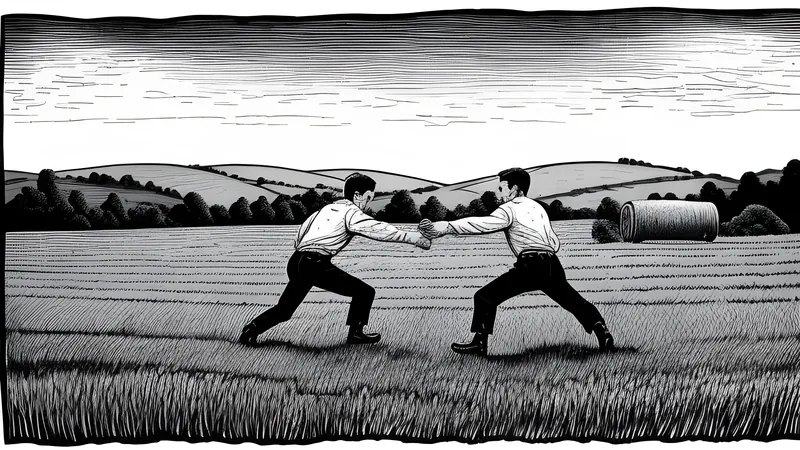
The historical straw bear tradition, as it existed in Whittlesey through the 1800s, was not primarily a spectacle for outsiders. It was a working part of the agricultural calendar. A local labourer would be sewn or wrapped into a costume of plaited straw covering his entire body, led on a chain or rope by a “keeper” through the town’s streets and around outlying farms, and made to dance or perform outside houses and pubs in exchange for money, food, or drink. The custom sat inside the broader tradition of “Plough Monday” customs across eastern England, the first Monday after Twelfth Night, when agricultural labourers with no winter work traditionally went from door to door performing in exchange for charity to see them through the lean months before spring work resumed.
That practical function — costumed begging, essentially, dressed up as folk performance — is important to understand, because it explains exactly why the custom eventually got shut down.
Banned as begging
By the early 1900s, attitudes among local authorities toward this kind of door-to-door solicitation had hardened considerably, and the straw bear tradition fell directly into their crosshairs. A local police inspector formally prohibited the practice, treating the collection of money and gifts by costumed performers as a form of cadging that could no longer be tolerated on the public street. The last recorded appearance of the traditional Whittlesey straw bear, under that older, working, house-to-house form, came in 1909. After that, the custom simply stopped. No community kept a private version alive in back gardens; it went fully dormant for seven decades, the kind of clean break that usually means a tradition is gone for good.
That is the detail I find most striking about this whole story. Most surviving folk customs in Britain can point to some thread of continuity, however thin, connecting the current version back to the original — a single family that kept a mask stored in an attic, a handful of participants who never quite let it lapse. Whittlesey’s straw bear has no such thread. It died, formally and completely, by police order, and stayed dead for most of the twentieth century.
Revived in 1980, on purpose
What brought it back was deliberate historical reconstruction rather than organic continuity. In 1980 the Whittlesey Society, working with local folklore enthusiasts and folk dance revivalists, researched the old custom from historical records and eyewitness accounts and staged a new version of the festival from scratch. Nobody alive in 1980 had performed as the original working straw bear; the revival had to be built from documentation rather than memory, closer to reconstructing a lost recipe from old notes than reviving a living family tradition.
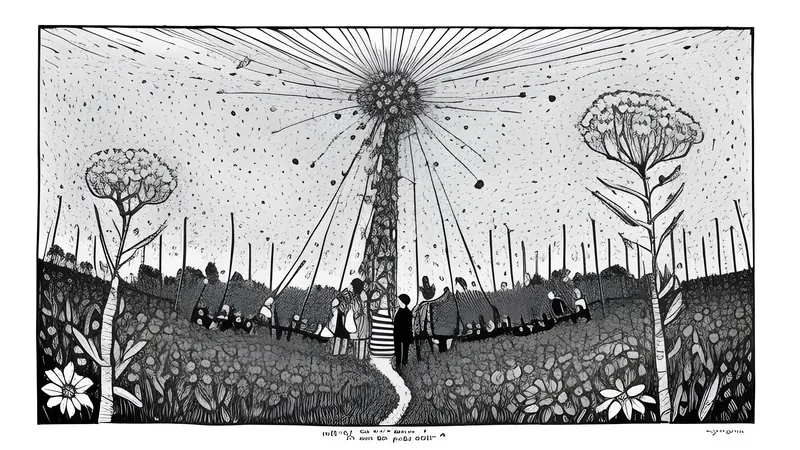
That reconstructive approach explains the shape of the modern festival, which looks quite different from the sparse, working-class door-to-door original. The contemporary Straw Bear Festival is a full weekend, drawing in touring morris sides, mummers, and folk musicians from across the country — recent editions have listed well over 250 invited performing groups taking part in the parade and the associated concerts and ceilidhs held around the town. That scale was never part of the nineteenth-century custom, which was a small, local, transactional performance rather than a folk festival drawing travelling performance troupes. The 1980 revival kept the central image — a man entirely disguised in straw, led through the streets — and built an entire modern folk-festival infrastructure around it.
Burning the winter away
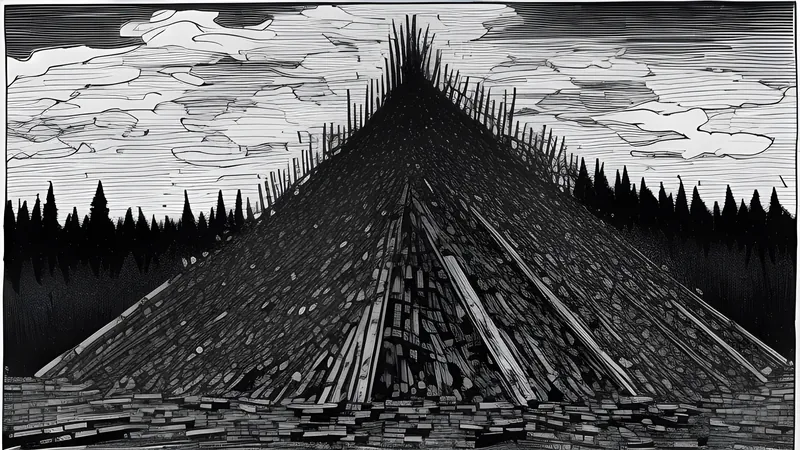
The detail that gives the modern festival its genuine edge is the ending. On the final day, the straw bear costume is ceremonially burned, in a bonfire that draws its own crowd separate from the daytime parade. The stated symbolism, as the festival’s own organisers frame it, is straightforward seasonal magic of the kind found across European winter customs: burning the straw figure represents the death of winter and clears the way for spring, the same basic logic that sits behind a huge family of European fire festivals held in the darkest part of the year.
That puts Whittlesey’s straw bear in genuinely good company. Shetland’s islanders drag a full-size Viking longship through Lerwick every January for Up Helly Aa and set the whole thing alight at the end of the march, a different scale of construction entirely but the identical underlying instinct — build something elaborate specifically so it can be destroyed by fire in front of a crowd. Sweden’s Gävle has spent decades building an enormous straw goat every December, and while the city firmly wants its goat to survive, arsonists have burned it down often enough since 1966 that the annual will-it-survive drama has become almost as much a part of the story as the construction itself. Whittlesey’s version is smaller and more deliberate — nobody is trying to stop the burning, it is simply the planned final act — but it belongs to the same family of custom: build a straw effigy, parade it, then set it on fire to mark the turn of the season.
A costume, a keeper, and a chain
The performance itself keeps a specific structure inherited from the original custom even in its reconstructed form. The bear is accompanied by a keeper who leads it on a chain or rope through the crowd, prompting it to dance, kneel, or lurch towards onlookers in a loose pantomime of a captured animal being put through its paces — a performance tradition with clear echoes in older European customs of costumed “wild man” and captured-beast figures paraded through winter streets across the continent. Children in particular tend to find the bear simultaneously alarming and delightful, which is presumably exactly the reaction the original nineteenth-century performers were going for when charity, rather than spectacle, was the point of the exercise.
Plough Monday’s wider family
Whittlesey’s bear is really one surviving branch of a much larger tree of English Plough Monday customs that mostly did not survive into the twentieth century at all. Villages across the eastern counties once fielded their own versions — plough-dragging processions, “plough jags” performed by disguised farm labourers, molly dancing troupes in blacked-up faces and outsized costumes — nearly all of which had died out completely by the time Whittlesey’s own custom lapsed in 1909. What makes the straw bear worth singling out from that wider, largely vanished family isn’t that it survived better than the rest; it didn’t, it died along with almost everything else. It is that somebody, seventy years later, judged this particular branch worth regrafting rather than leaving as a footnote in a folklore archive.
Other customs that came back from nothing
Whittlesey’s bear has real company in this narrow category of British customs revived by design rather than passed down. The Welsh new year custom of the Mari Lwyd — a horse’s skull mounted on a pole, draped in a sheet, and led from house to house by a party demanding entry through rhyming verse contests — went through its own near-death and comeback: it faded across most of Wales by the early twentieth century, then got rebuilt from documented accounts and re-established as a going concern in villages such as Llangynwyd from the 1960s and 70s onward, on much the same reconstructive logic as Whittlesey’s revivalists used a decade later. Surveys of the English ritual year, such as the folklorist Ronald Hutton’s Stations of the Sun, treat cases like this as evidence of how much of what looks like ancient continuity in British folk custom is really twentieth-century antiquarian reconstruction, built from newspaper notices and folklorists’ notebooks rather than a rich, unbroken oral archive.
That thinness of record matters, because it means the 1980 revivalists in Whittlesey were making real interpretive choices, not simply copying a blueprint. Decisions about how the bear moves, what the keeper does, how long the parade route runs, and how large the accompanying folk-festival programme should grow were choices made by people filling gaps in a sparse historical record — a genuinely creative act, closer to restoring a damaged painting than tracing one.
What a deliberate revival proves
Whittlesey’s straw bear matters beyond its own parish because it is such a clean example of a folk custom being brought back by conscious decision rather than surviving by accident. Most of the enduring British calendar customs I’ve come across carry at least some element of unbroken continuity, however thin. This one has none. It died by police decree in 1909, stayed dead for seventy-one years, and was rebuilt in 1980 by people working entirely from the historical record because they believed the town was worse off without it.
That the reconstruction took, and has now run for more than four decades with hundreds of performers travelling in every January, tells you something about which customs are worth reviving and why. It was never really about the specific choreography of one man in a straw suit dancing outside a pub for tobacco money. It was about a Fenland town wanting its winter marked by something strange, communal, and its own, badly enough that seventy years of silence wasn’t the end of the story. The bear burns every January now simply because a town decided, quite recently and quite deliberately, that it should, tradition or no tradition.
Related Content