The Silent Disco Stage at a Metal Festival
Three thousand people singing along to Abba at full volume, and not one amplifier switched on
Contents
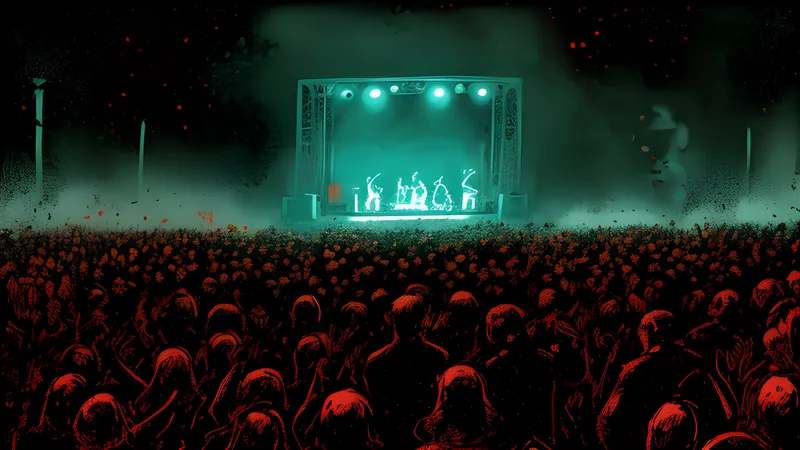
Midnight, a tent behind the main stages, and a few hundred people in battle vests and corpse paint are dancing in total silence. No bassline leaks out, no PA rattles the guy ropes. What you get instead is the sound of several hundred human voices, all a semitone apart, howling along to a chorus only they can hear through a pair of glow-in-the-dark headphones, at a volume that would embarrass a karaoke bar. Someone near me is doing the entire chorus of an Abba song with his eyes shut and both fists in the air, three channels of colour-coded headphones flicking between a Europop set, a nu-metal set, and — I checked twice — a channel of nothing but 1980s power ballads. This is the silent disco tent, and it has become one of the strangest fixtures on the modern European festival circuit, including, improbably, at festivals built entirely around the idea that music should be loud enough to hurt.
The gag writes itself and everyone who books one of these tents knows it. A genre whose whole identity is built on volume as a badge of honour — bigger stacks, more distortion, the front row close enough to feel the kick drum in your ribs — turns out to have a favourite late-night activity that requires nobody to make any noise at all. But the joke is doing more work than it looks like, and the reason silent discos have colonised festival campsites tells you something real about noise, licensing, and what a festival actually is once the headliner walks off.
Where the idea actually came from
Silent disco technology is older than the novelty suggests. Wireless headphone-based listening for group events goes back to experiments in the 1990s, but the format that everyone now recognises — coloured headphones, a DJ or multiple DJs broadcasting on separate channels, a room full of people dancing to music only they can hear — was popularised in the UK festival scene in the 2000s, and Glastonbury is usually credited with turning it from a curiosity into an institution, running a dedicated silent disco in its Green Fields area for years. The reason Glastonbury reached for the format was purely practical: a noise problem. Glastonbury’s entertainment licence, like every UK festival’s, comes with strict conditions attached by the local council, and those conditions include hard curfews on amplified sound aimed at protecting nearby villages from being kept awake by bass frequencies carrying for miles across open Somerset farmland. A silent disco sidesteps the entire problem. The music plays inside several thousand sets of sealed headphones instead of through a rig that can be heard in the next parish, so a promoter can keep a dancefloor running long after the main stages have gone dark and the licence has technically ended.
That’s the mechanism, and it’s spread well beyond Glastonbury because every large European festival runs into the same wall: local noise ordinances, curfews tied to a licence, and neighbours who tolerate a week of chaos precisely because it stays inside agreed hours. A silent disco is a loophole with headphones on, and once festival organisers understood that, it stopped being a Glastonbury quirk and became standard late-night infrastructure at events that have nothing to do with folk or dance music at all.
Why a metal festival wants one
Which brings us to the part that still makes me grin every time I walk past one. Metal festivals run on precisely the same licensing conditions as anything else — a curfew is a curfew whether the headliner is a death metal band from Gothenburg or a folk trio — and once the main stages go dark at their contracted hour, several thousand people who have been awake and adrenalised since noon are still standing in a field with nowhere to put that energy. A silent disco solves the curfew problem and solves a second, more interesting problem: genre fatigue. You can watch eight hours of blast beats and growled vocals and still, at midnight, want to sing along to something that isn’t remotely extreme. The silent disco tent is where the mask comes off. It’s where the person who spent the afternoon in the pit for a death metal set will cheerfully bellow along to Whitney Houston or Meat Loaf with a headphone-muffled voice cracking on the high notes, because nobody around them can hear how bad they sound over their own channel, and everybody’s doing exactly the same thing on theirs.
I’ve stood in the Copenhell version of this tent more than once over the years, wedged behind the main stages on Refshaleøen, and the demographic split is its own small comedy. The corpsepaint contingent tends to cluster on whichever channel is playing the hardest thing on offer, determined to stay in character even at 1am; the couples on a rare night out together gravitate to the slow-dance channel and sway in a corner, oblivious to the death metal happening eight feet away on someone else’s headset. Security tends to relax around a silent disco tent in a way they don’t anywhere else on site, because there’s no barrier to manage, no crowd surge to watch for, no pit to keep an eye on — just a few hundred people moving gently to music nobody else can hear, which is about as low-risk as a festival gets after dark.
There’s also a practical staffing logic underneath the joke. A silent disco needs one DJ booth, a stack of rented headphones, and no PA rig, no stage crew, no noise assessment beyond the headphone transmitters themselves. Compared with running an actual late-night stage — sound engineers, a soundcheck, a support slot’s worth of load-in — it’s a cheap, low-risk way for a festival to keep a corner of the site awake and entertained after curfew, which is exactly why so many of them, metal festivals very much included, have added one to the site map in the years since Glastonbury proved the concept.
The three-channel etiquette
Anyone who’s spent a night in one of these tents knows there’s an unwritten choreography to it. You can tell which channel a person is on by watching them for five seconds — the ones head-banging in place are on the rock channel, the ones doing a slow grinding two-step are on the R&B channel, and the ones doing something that looks suspiciously like the Macarena are, without fail, on whatever channel is playing 2000s pop. Switch channels mid-song and the room reshuffles around you in real time, one glowing headphone colour swapping for another, and for a few seconds you’re dancing to a completely different song than the person you were just dancing next to. It’s an oddly communal kind of solitude — everyone together in the tent, nobody sharing quite the same experience — and it’s the closest thing festival culture has to a genuinely gentle, low-stakes late-night ritual, a long way from the crush and the volume of everything that happened earlier in the day.
I’ve written before about what the mosh pit is actually for and the trust and physics buried in something that looks like a fight from the outside. The silent disco tent is the mosh pit’s opposite number on the same site: no collision, no shared soundtrack even, just a few hundred exhausted people choosing to keep dancing a little longer because the alternative is walking back to a tent and admitting the day is over. It’s also a neat companion to why every festival now feels the same — the silent disco is one of the few late-night additions that genuinely varies from site to site in how it’s used, even as the stages themselves start to blur together from one festival to the next.
The bit that still gets me
What I keep coming back to, walking out of one of these tents at two in the morning with my ears ringing from a full day of actual amplifiers, is how completely the silence fails to register as silence once you’re inside the crowd. You’d think a few hundred people dancing without music would look eerie, and for the first thirty seconds from outside the tent, it does — a wall of shuffling, nodding, mouthing bodies with no soundtrack you can hear. But step inside, put on a headset, and the silence disappears entirely, replaced by the specific and very loud experience of standing in a room where everyone is singing a different song badly and enjoying it enormously. It’s the strangest kind of communion the modern festival has invented: a shared experience built entirely out of a few thousand private ones, running quietly behind the loudest weekend of the year.
Why a metal festival, of all places
The joke writes itself — a field of headbangers thrashing in total silence, headphones glowing red or blue depending on which channel they’ve picked — and that is exactly why it works. A silent stage solves real festival problems at once. It sidesteps the noise curfews that shut outdoor stages down at night, since the sound never leaves the headphones, so the “loudest” thing at the site can run into the small hours without a single environmental-health complaint. It lets two or three DJs run head-to-head on different channels, turning what to listen to into a choice you make with a thumb. And it gives a metal crowd, whose whole culture is built on volume, the strange delight of hearing a field full of people shout a chorus with no music under it at all. The novelty wears thin fast if it is the only stage, but as the after-hours option once the main rigs go dark, it has quietly become a fixture — a place to keep moving when the real amplifiers have been switched off.
Related Content