The Sámi Reindeer Race: Skiing Behind a Bolting Reindeer
A harnessed reindeer, a long rope, a skier hanging on across the ice, and Easter as the great social season of the Arctic
Contents
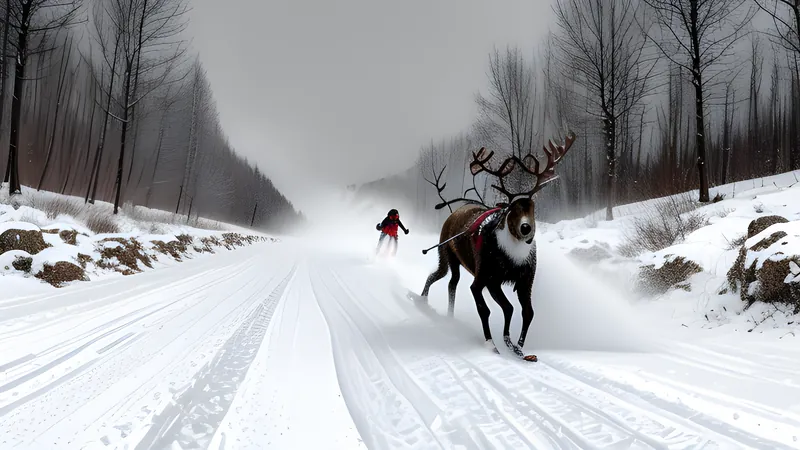
Picture a frozen river up beyond the Arctic Circle, a track marked out on the ice, and a crowd in blue-and-red felt lined along it in a wind that would take the skin off you. At the start line a reindeer stamps and steams, harnessed with a long rope, and at the other end of that rope stands a person on cross-country skis with their whole future in their grip. A signal goes. The reindeer bolts. The skier is yanked off the line at a speed no human generates on their own and hangs on, boots hissing across the ice, for as long as balance and nerve will allow. This is reinkappkjøring — reindeer racing — and it is the loudest, funniest, most heart-in-mouth thing that happens in Sápmi all year.
I write from Copenhagen and I have not stood on that ice; this is a cultural read from a long way south, a lowland Dane’s fascination with a sport built for a landscape I’ve only ever flown over. But I’ve spent years chasing gatherings that a committee would never have invented — the Jokkmokk winter market among them — and reindeer racing sits near the top of the pile. It is a genuine folk sport, still run by the people whose animals and homeland it belongs to, and it rewards a closer look than the “mad Arctic sport” headlines ever give it.
Who the Sámi are, and why the reindeer is at the centre
First, the people, because the sport makes no sense without them. The Sámi are the Indigenous people of the European far north, their homeland Sápmi stretching across the top of Norway, Sweden, Finland and the Kola Peninsula of Russia — a single cultural region drawn straight across four national borders that were laid over it later. They have their own languages (Northern Sámi is the largest of several), their own parliament in each Nordic state, their own flag, and a history with those states that runs from outright assimilation policy to the slow, hard-won recognition of recent decades. They are not a costume; they are a living people, and reindeer are woven through the whole of it.
Most Sámi today are not herders, yet reindeer herding remains the cultural spine, a livelihood and an identity protected in law and practised across the mountains and tundra. The animal gives meat, hide, sinew, antler, and for centuries transport; the herding year runs on the reindeer’s migration between winter and summer pasture. So when a Sámi community turns a reindeer into a racing animal for a weekend, it isn’t a novelty act. It’s the working animal of the culture, briefly and gloriously off the clock — the same beast that pulls a sledge across the winter pasture, now pulling a lunatic on skis down a marked track for the pride of a family and a village.
How the race actually works
The mechanics are simpler and more alarming than you’d guess. The classic form is skijoring behind a single reindeer: the animal is harnessed and controlled by long reins, and a competitor on cross-country skis is towed behind on a rope, down a straight track marked out on a frozen lake, river or flat expanse of snow. There’s no saddle and no sitting; you are standing on skis, being pulled at speed by an animal that can shift into a startling gallop, and the whole event is a negotiation between the reindeer’s willingness to run in a straight line and your ability to stay upright behind it. Reindeer are quick — over a short dash a bolting one moves far faster than most people imagine a stocky Arctic ruminant could — and they are also opinionated, which is where the comedy lives.
Because the animal has a mind of its own, a reindeer race is never quite the clean drag strip the format promises. A reindeer may decide, halfway down the track, that it would rather not; may swerve; may stop dead; may take violent exception to the crowd. The skier’s job is to read the animal and cling on. Runs end with skiers ploughing into snowbanks, reindeer trotting off in the wrong direction entirely, and the crowd roaring — this is a spectator sport with a high and honest rate of glorious failure. There are variants: some events tow the racer on a light sledge (pulk) rather than skis, and there are ridden and driven forms elsewhere. But the skijoring version, human strung out behind a sprinting reindeer on the ice, is the one that stops your breath.
I’ll be straight about the limits of my knowledge, the way the Encore desk insists. I can’t hand you a minute-by-minute account of a single named heat, because I wasn’t there and I won’t invent one. What the record makes plain is the shape of the thing: a real, organised competition, run to rules, with heats and times and a winner, embedded in a much larger gathering. The spills are a documented feature, not a story I’ve dressed up.
Easter is the season, and Kautokeino is the capital
Here’s the part that reorders your whole mental map of the Arctic year. Easter, not midsummer, is the great social season above the Arctic Circle. It makes perfect sense once you think about it: by late March and early April the killing polar night is over, the light has come flooding back, the snow is still firm and fast and reliable, and the herding calendar has a breathing space before the spring migration and calving. So this is when the far north throws its biggest parties — weddings are timed to it, families travel enormous distances, and the scattered communities of the tundra converge.
The beating heart of it is the Kautokeino Easter Festival in the Norwegian interior of Finnmark. Kautokeino (Guovdageaidnu in Northern Sámi) is one of the strongholds of Sámi culture, a town where the Sámi language and reindeer economy are dominant, and every Easter it fills up for days of racing, music, film, theatre, food, market stalls and reunion. The reindeer racing is the outdoor spectacle at the centre — heats out on the frozen ground, the crowd wrapped against the cold, the gákti (the traditional Sámi dress, its colours and ribbon-work coded to region and family) worn because it’s the good clothes you put on for the biggest weekend of the year, never for the tourists.
And Kautokeino is also the home of the Sámi Grand Prix, the flagship competition of joik — the traditional Sámi vocal art, often written yoik in English. A joik isn’t a song about something so much as an attempt to evoke the thing itself — a person, an animal, a place — in sound; the old ones say you don’t sing a joik of your friend, you joik your friend into being present. It was suppressed for generations as heathen, tangled up with the same church and state pressure that tried to stamp out the language, and its survival and revival is one of the quiet triumphs of modern Sámi culture. The Grand Prix runs joik alongside contemporary Sámi song, and it turns the Easter festival into a genuine music event as well as a sporting one. As someone who has argued that the northern dark forges the loudest music in Europe, I find the joik humbling — a vocal tradition that predates the guitar amp by a thousand years and carries the same north-country refusal to be silenced.
The winter markets, and a culture that hosts the world on its own terms
Reindeer racing isn’t confined to Kautokeino. It’s a fixture of the great historic winter markets that stud the Sámi calendar, and the most famous of those is the one I’ve written about before: the Jokkmokk winter market in Swedish Lapland, a market with more than four centuries of history behind it, held every February, where reindeer racing runs alongside the trading, the handicraft (duodji), the food and the cold that has to be experienced to be believed. Between the February markets and the Easter festivals, the deep-winter and late-winter north keeps a whole social calendar that most of southern Europe has no idea exists.
What I keep coming back to, from my warm and frankly soft position down in Copenhagen, is that this is a spectator sport a culture built for itself, out of its own working life, in a place designed to kill the unprepared — and then chose to share. You can go. Outsiders are welcome at Kautokeino and Jokkmokk; you buy your ticket, you wear every layer you own, you stand on the ice and you watch a way of life do the thing it does. But you’re a guest at somebody else’s event, and the reindeer racing is a good reminder of that, because the animal at the centre of it belongs to a family that has herded across those mountains for longer than the borders have existed.
The best folk spectacles all share this quality — they’re inherited, half-mad, run at real risk, and utterly the property of the people whose home they belong to. Reindeer racing has the additional distinction of being staged in the most demanding arena in Europe, under a sun that’s only just returned, by a people who spent centuries being told their culture was something to be ashamed of and who now line a frozen river in their finest to cheer a neighbour hanging off a rope behind a sprinting reindeer. Go and stand in that wind if you ever get the chance. Bring more layers than you think you need. And when the reindeer bolts and the skier is snatched off the line and the crowd erupts, understand that you’re watching one of the oldest working relationships on the continent — human and reindeer — briefly, joyfully, turned into sport.
Related Content