The Roller Derby World Cup: Elbows, Aliases, and DIY Sport
How a punk-rock revival in Austin turned into a self-funded international championship
Contents
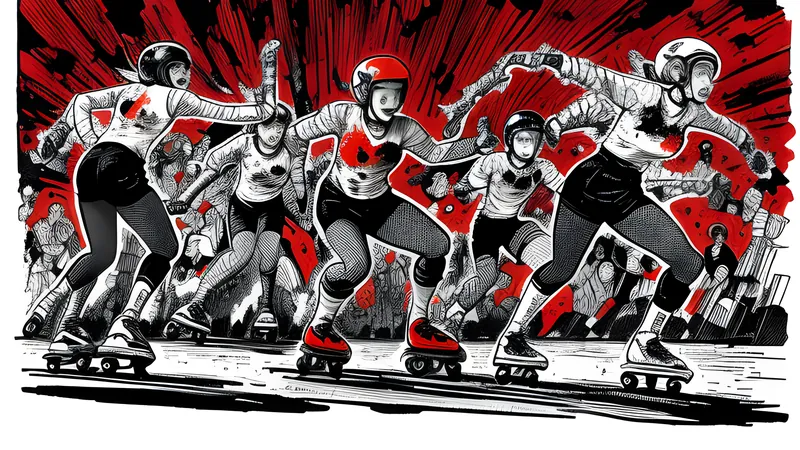
Manchester’s EventCity spent the first weekend of February hosting thirty-eight national teams, hundreds of skaters on quad roller skates, and a scoreline that ran to triple digits before the tournament was even half done. Team USA held off Australia 187–146 in the final to take their third consecutive Roller Derby World Cup, a result that surprised nobody who has followed the sport since its modern revival, but the more interesting story sits underneath the scoreboard: no international sports federation runs this event. The skaters built it themselves.
A sport reborn in a Texas warehouse
Roller derby as most people currently understand it — full-contact, all-skater, played almost entirely by women on quad skates around a flat track — is not a survival of the disco-era banked-track spectacle that briefly filled American arenas decades ago. It is a deliberate revival, invented from scratch starting in 2001 in Austin, Texas, out of the city’s punk rock and DIY counterculture. A handful of skaters put together the first leagues, wrote rules as they went, and built an entire subculture around a sport that had, for practical purposes, not existed in competitive form for a generation.
That Austin origin matters because it set the sport’s whole character before it ever went international. Modern roller derby was never handed down by a governing body. It was assembled by the people who wanted to play it, on their own terms, and that DIY instinct — book your own venue, sell your own tickets, referee your own bouts — has stayed baked into the sport as it spread from a handful of Texas leagues to hundreds of cities worldwide.
From Toronto to Manchester in seven years
The first Roller Derby World Cup ran in December 2011, hosted by Toronto Roller Derby at a converted venue called The Bunker in Downsview Park. Thirteen national teams took part — a genuinely international spread for a first attempt, including Argentina, Australia, Brazil, England, Finland, France, Germany, Ireland, New Zealand, Scotland and Sweden alongside the hosts and the eventual champions. Team USA won that inaugural final in an one-sided 336–33 rout of Canada, a scoreline that told you plenty about how far ahead of the rest of the world the American leagues already were, given the sport’s own American birthplace.
The event has grown fast since. By this year’s Manchester tournament the field had nearly tripled to thirty-eight national teams, and the competitive gap has narrowed considerably — Australia’s 146 points against the USA’s 187 in this year’s final is a different proposition entirely from Canada’s 33 in 2011. England and Canada rounded out this year’s semi-final four, with Canada beating England for third place, and the tournament’s growth from one converted Toronto venue to a multi-day event filling an exhibition centre in Manchester is exactly the trajectory you’d expect from a sport that started as a handful of enthusiasts’ project and kept finding more enthusiasts.
Organised by a magazine, not a federation
Even the founding of the first World Cup underlines how homemade this whole enterprise is: the 2011 tournament was organised by Blood & Thunder, a roller derby magazine, working with the Toronto league to actually stage the thing. A specialist publication convening a genuine world championship is not how any other global sport got started, but it fits roller derby’s pattern perfectly — the infrastructure came from inside the community, built by the people already writing about and playing the sport, because nobody else was going to do it for them.
That first tournament also produced the discipline’s first bona fide superstar. Bonnie Thunders, skating for the Gotham Girls league in New York and voted the sport’s most valuable jammer in both 2010 and 2011, anchored Team USA’s roster in Toronto and helped put together that lopsided 336–33 final. Joy Collision took the tournament’s MVP award. Both are documented, on-the-record figures from a tournament that actually happened, which is worth saying plainly: Encore doesn’t invent skaters or scorelines, and it doesn’t need to here — the real roster is colourful enough on its own.
Borrowed rules, no borrowed authority
The World Cup is not affiliated with the Women’s Flat Track Derby Association, the body that oversees most of the individual leagues that feed the national teams, but it plays under a ruleset developed and standardised by that same organisation — a practical arrangement that lets national federations field teams under a shared rulebook without needing a single global body to police the whole enterprise. That distinction matters more than it sounds: the World Cup exists because the people who play roller derby organised themselves into national teams and agreed on how to play each other, not because a pre-existing international sports authority decided the discipline deserved a championship and built one top-down. It is grassroots organisation working at a genuinely global scale, entirely without the infrastructure most world championships take for granted.
Names as armour
Walk down any roster from any World Cup and you’ll find almost no legal names. Skaters compete under derby names — deliberately theatrical aliases built from puns, alliteration and mock-violent wordplay, a tradition that goes back to the Austin revival itself, where early skaters styled themselves after rock musicians and masked Mexican lucha libre wrestlers in roughly equal measure. The practice caught on hard enough that an entire registry now exists just to stop skaters worldwide from duplicating each other’s names, with tens of thousands of aliases logged and rules governing what does and doesn’t qualify.
The derby name is not incidental decoration. For a sport built by amateurs skating full-contact bouts around a day job, the alias functions the way a stage name or a masked persona functions elsewhere — a deliberate switch flipped between the ordinary self and the competitor who throws hip checks for a living on weekends. It is a different mechanism from the painted, ritualised transformation black metal borrowed for the stage — the kind of thing I’ve written about in corpse paint’s history — but the underlying logic rhymes: put on the name, and a different, more permitted version of yourself gets to come out and hit people.
A championship nobody had to grant
What makes the Roller Derby World Cup worth writing about, from a European desk that mostly covers loud music, is how completely it inverts the usual model of how a sport gets a world championship. Most disciplines wait for validation — an Olympic committee, an international federation, a broadcaster’s interest — before a “world championship” gets to use that name credibly. Roller derby’s community simply decided, seven years into its own modern revival, that it was ready to play itself at a global scale, found a venue in Toronto, and got on with it. The teams paid their own way. The leagues that fed those national rosters were themselves self-funded amateur operations, often running bouts out of borrowed rinks and repurposed halls, not so different in spirit from the DIY hardcore and punk shows that happen in the same kind of rooms on a different night of the week.
I know that particular ecosystem — the borrowed hall, the door money covering the bar bill, the crowd that is also half the volunteer staff — from the loud end of live music, where the mosh pit runs on an identical trust that a room full of people colliding on purpose will look after each other when it counts. Roller derby’s flat track has its own version of that same contract: full-contact hitting, a crowd close enough to the action to feel it, and a shared understanding among skaters that the sport survives on everyone respecting rules nobody outside the community is enforcing.
A men’s game growing in parallel
The women’s tournament remains the sport’s flagship, but it is not the whole story any more. A separate Men’s Roller Derby World Cup has developed alongside it, run to the same borrowed WFTDA-derived ruleset and staged at the same events in recent editions, evidence that the DIY organisational model scales sideways as easily as it scales up. Nobody had to invent new infrastructure to add a second competition; the same self-organised network of leagues and volunteers simply extended itself to cover it, which is precisely the kind of quiet, unglamorous expansion that a sport with no governing body actually has to manage for itself.
The honest version, from a distance
I have not skated a bout, refereed a jam, or stood trackside in Toronto or Manchester, and I won’t invent a scene of a particular hip check to make this livelier than it is — Encore’s honesty line holds here as everywhere else. What the record shows plainly enough is a sport that rebuilt itself from nothing in a Texas warehouse scene, spread by word of mouth and shared rulebooks rather than institutional backing, and arrived, seven years after its first World Cup, at a tournament big enough to fill a Manchester exhibition hall for four days. Team USA’s third straight title is a genuine sporting story. The bigger one is that the whole competition exists at all, built by exactly the people who wanted to play it and nobody else.
Related Content