Illegible on Purpose: The Metal Logo as Gatekeeping
Why death and black metal bands wear names you cannot read — a design history of the spiky thicket
Contents
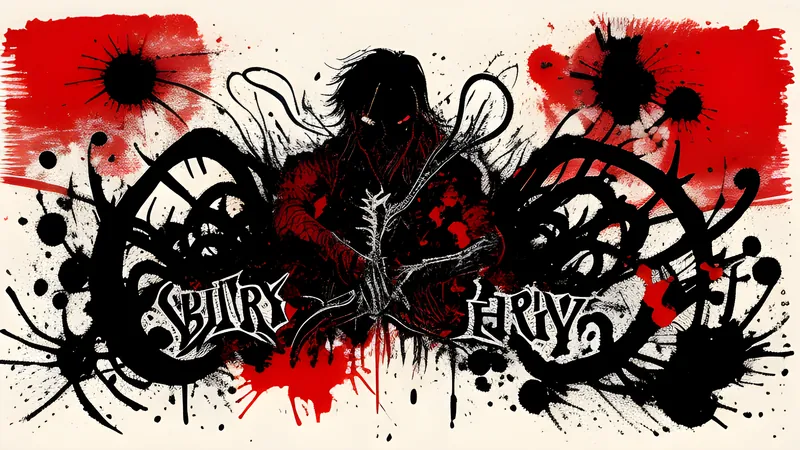
Somewhere in your local record shop there is a black t-shirt with a symbol on the chest that looks like a spider was electrocuted mid-web, or a bramble bush had a stroke. It is a band’s name. You cannot read it. That is the point, and it is not an accident, a failure of design, or a joke. It is one of the most quietly sophisticated pieces of visual gatekeeping any subculture has ever produced: a wordmark engineered to be legible only to people who already know what it says. The illegible metal logo is a password disguised as a graphic, and once you understand what it is doing, the spiky thicket of thorns and inverted crosses stops being noise and starts being one of the sharpest bits of design theory in popular music.
Before the thicket: the logo as brand
Metal did not start out unreadable. The first wave got the point of a logo the way any band or business does — you want your name legible on a poster from across the street. Black Sabbath, the band that arguably invented the whole thing, wore a clean, readable wordmark. The genre’s early giants understood a logo as a brand asset, and most of them are perfectly easy to read at a glance.
The masterpiece of that era, and still the most famous logo in all of heavy music, is Kiss — those two lightning-bolt S’s, designed in 1973 by the band’s own Ace Frehley. It is bold, instantly recognisable, and readable in a fraction of a second, which is exactly why it went on to sell an ocean of merchandise. Iron Maiden’s logo, with its sharp angular serifs, is spikier and more aggressive but still completely legible; you can read MAIDEN across a stadium. Motörhead’s snaggletooth war-pig wordmark, AC/DC’s lightning bolt, Judas Priest’s metallic serifs — this whole first generation treated the logo as a signature, meant to be recognised and read.
The genius move of these early logos was that a single glyph could carry the entire attitude of the music. The Kiss bolts said danger and glam without a word of explanation. Maiden’s spikes said fast and sharp. The logo became a compression of the sound into a shape, and the sharper and more angular the music got, the sharper and more angular the letters became — until the letters started eating themselves.
The turn toward the unreadable
As metal splintered in the 1980s into faster, darker, more extreme forms — thrash, then death metal, then black metal — the logos splintered with it, and legibility began to lose the argument. The trend ran in a clear direction: more spikes, more symmetry, more thorns growing off every letter, until the name became a dense tangle of points and the actual characters dissolved into the ornament.
The undisputed origin point of the illegible death-metal logo is Morbid Angel, whose wordmark — with its thorned, interlocking, near-symmetrical mass of spikes — became the template that thousands of bands copied. Death, Cannibal Corpse, Deicide, Suffocation: the American death-metal wave built a whole visual language of brutal, thorny, hard-to-parse logos where the difficulty of reading the name became a feature of the design. The harder the name was to decode, the more extreme the band was signalling itself to be.
Black metal took the same instinct and pushed it into pure abstraction, and this is where the logo stopped even pretending to be a word. The Norwegian second wave of the early 1990s — the scene I’ve written about with its real, dark, documented history — perfected a style of logo that is essentially a symmetrical inkblot: impossibly thin, spidery lines, radiating spikes, inverted crosses and pentagrams woven into the letterforms, the whole thing mirrored down a central axis so it reads as a sigil before it reads as a name. Bands like Mayhem, Darkthrone and Emperor wore names that a newcomer simply cannot decode. You have to be taught what they say. The logo of the American band Sunn O))) is literally three characters and a set of brackets meant to evoke an amplifier’s sound-wave — a name most people cannot even pronounce, let alone read, on first contact.
The password theory
So why do it? Why would a band deliberately make its own name — the single most important thing to communicate — impossible for an outsider to read? The answer is that illegibility is the entire message.
An unreadable logo is a filter. It sorts the world instantly into two groups: the people who can read it, and the people who cannot. If you can look at that thorned tangle and immediately know it says Incantation or Marduk, you have proven, without a word, that you are inside — that you have done the listening, put in the time, earned the knowledge. The logo functions exactly like a password or a secret handshake: its value comes precisely from the fact that it excludes. A logo everyone can read signals nothing about the reader. A logo only initiates can read turns every t-shirt into a membership card.
This is subcultural capital made visible. Extreme metal has always defined itself partly by its resistance to the mainstream — it is difficult music, harsh and uncommercial by design, and its whole identity is bound up in not being for everyone. An illegible logo is that philosophy compressed into graphic form. It says this is not for you unless you’ve done the work, and it says it before a single note plays. The difficulty is the welcome mat, turned face-down for outsiders and face-up for the initiated. It is the same in-group logic that runs through so much of loud culture — the shared knowledge and earned belonging I keep circling in pieces like what the pit is actually for, where the rules are invisible to newcomers and second nature to regulars. The logo is that dynamic, worn on the chest.
There is a purely aesthetic argument underneath the sociology too, and it matters. These logos are trying to look like the music sounds. Death metal is a dense, brutal wall of overwhelming detail, and a logo that is a dense, brutal wall of overwhelming spikes is an honest visual translation of it. Black metal is cold, abstract, ritualistic and inhuman, and a logo that reads as an occult sigil rather than a legible word captures that atmosphere exactly. Legibility would be a betrayal of the sound. The best of these things are genuinely beautiful pieces of symmetrical draughtsmanship, hand-drawn by specialist artists — Christophe Szpajdel, the Belgian designer known as the “Lord of the Logos,” has drawn thousands of them and turned the illegible metal logo into a recognised art form with gallery shows and a published book.
The joke, the limit and the tribute
The subculture is entirely self-aware about all this, which is part of its charm. There is a long-running strain of parody logos — deliberately absurd thorny wordmarks that spell out mundane words like “brunch” or “corgi” in full black-metal thicket, a joke that only lands because everyone in on it understands the visual language being sent up. You cannot parody a convention that precisely unless the convention is rock solid, and the black-metal-logo generator has been a running internet gag for years for exactly that reason.
There is a real design limit, of course, and the smarter bands know it. A logo you genuinely cannot read is useless for the one thing a logo also has to do: sell records and shirts to people who then have to find you. So most bands run two versions — the full illegible sigil for the album art and the die-hard merch, where obscurity is the flex, and a stripped-back legible version for posters, streaming thumbnails and anywhere a stranger needs to actually find the name. The illegibility is a costume the band puts on for the faithful and takes off at the box office, which is a more commercially clever balance than the corpse-paint aesthetic usually gets credit for.
The streaming era has quietly tested how far the convention can bend. On a phone screen an album cover shrinks to a postage stamp, and a thorned sigil that looked magnificent on a twelve-inch sleeve becomes an indecipherable smudge in a playlist. Some bands have leaned into it anyway, treating the unreadable thumbnail as a badge of refusal to play the algorithm’s game. Others quietly redraw a cleaner mark for the platforms while keeping the full thicket for the vinyl and the shirts, which is the same two-tier trick their forebears ran on gig posters, updated for a scrolling feed. Either way the logic holds: the harder version is a reward reserved for the people who went looking, and the difficulty of finding it is part of what it is worth once you do. A thing anyone can stumble on for free carries less than a thing you had to hunt down, and extreme metal has understood that arithmetic since long before there was an algorithm to defy.
Next time you are in a merch queue at a place like Loppen and you see someone in a shirt covered in what looks like electrified barbed wire, do not read it as bad design. Read it as a message that was working perfectly, delivered and received before either of you said a word. If you could read it, you were meant to. If you couldn’t, that was the message too. The spiky thicket is the most honest logo in music: it tells you exactly where you stand with a subculture that has never once pretended to be for everybody.
Related Content