The Man vs Horse Marathon, Wales
A pub argument settled over 22 miles, and the 25 years it took a runner to win it
Contents
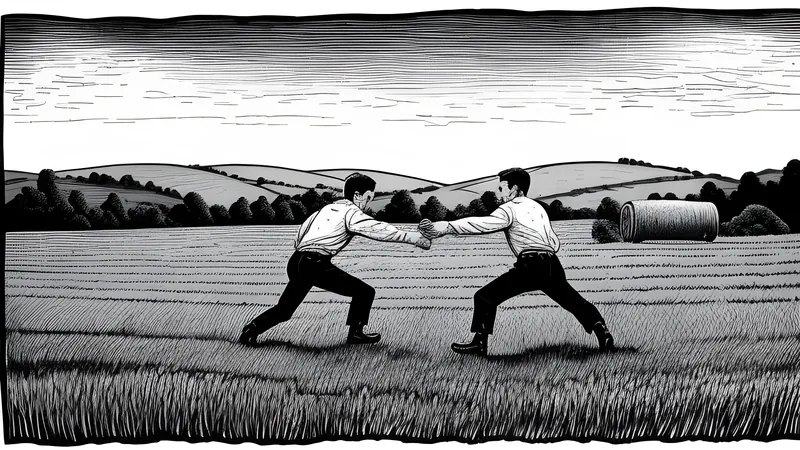
The Man versus Horse Marathon exists because two men in a Welsh pub couldn’t settle an argument any other way. Sometime around 1980, in the Neuadd Arms in Llanwrtyd Wells, a debate broke out over whether a human being, given rough enough terrain and a long enough distance, could out-endure a horse. The landlord, Gordon Green, did what any decent publican with a flair for spectacle would do: rather than let the argument fizzle out over closing time, he organised an actual race to settle it, in public, with proper rules and a proper course. Forty-odd years later, that bar-room dispute is still being run every June, over roughly 22 miles of Welsh road, trail, and mountainside, and the question it set out to answer took a quarter of a century to get a definitive result.
I write about this from Copenhagen as a cultural observer rather than a competitor — I have not lined up at that start line myself, and this piece is built from the public record of one of the odder endurance events in Europe. But an event whose entire premise is a decades-long science experiment about the limits of human endurance against a horse’s is hard to resist writing about.
The terms of the bet
The course threads through the hills around Llanwrtyd Wells, Britain’s smallest town, over a mixture of road, farm track, and open moorland that punishes horse and human in different ways. It is deliberately not flat, and deliberately not a fast, groomed running surface — the whole point of the challenge, as Green originally framed it, was that raw speed favours the horse over any short distance, but a long enough race over sufficiently broken ground erodes a horse’s advantage, because a horse can’t cool itself or recover mid-race the way a human runner can. Runners set off with a head start, staggered ahead of the mounted riders, the exact gap tuned over the years to keep the contest genuinely competitive rather than a foregone conclusion either way.
For the race’s first several years, the horses won comfortably, which is roughly what you’d expect given a horse’s raw pace advantage over any single stretch of ground. The organisers, in a stroke that turned a pub bet into a proper institution, attached a cash prize to the outcome and let it grow: every year no runner beat every horse, the pot increased by another thousand pounds, a rolling jackpot that did two things at once. It kept the story alive in the press year after year, and it raised the stakes on the exact question the race was designed to answer — would a human eventually catch up, and if so, how much would it take?
Bicycles, and the years it took
The race’s rules have flexed over its history in ways that reveal how seriously the organisers took the underlying question. In 1985 cyclists were let into the field alongside runners and riders, adding a third mode of locomotion to the experiment, and for several years the race genuinely ran as a three-way contest between hoof, foot, and pedal. That window closed in 1993, when bicycles were dropped from the main event, returning the race to its original two-way premise of runner against horse. In between, in 1989, a cyclist named Tim Gould beat every horse in the field by three minutes — proof that the terrain could be conquered by something other than a runner’s legs, even if it didn’t yet answer Green’s original bar-room question about human endurance specifically.
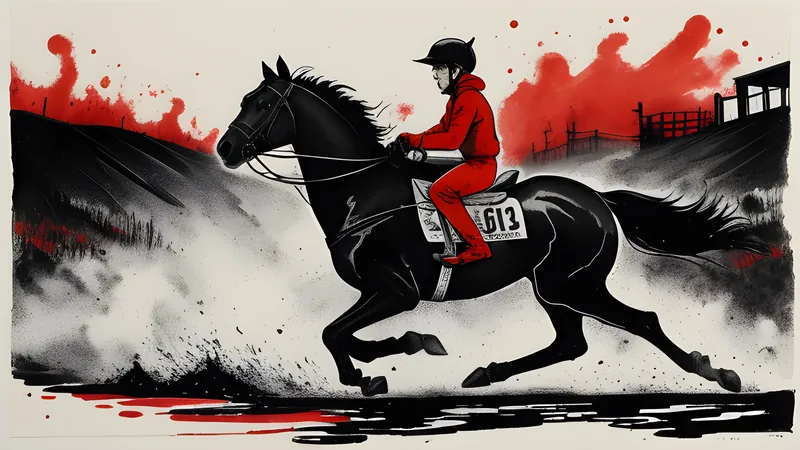
The pure running answer took far longer. For twenty-five years, every single edition of the race, the fastest horse crossed the line before the fastest human runner, and the accumulating prize pot climbed accordingly, year on year, a growing public monument to how difficult the challenge actually was. Then in 2004, at the 25th running, a runner named Huw Lobb crossed the line in two hours, five minutes, and nineteen seconds, roughly two minutes ahead of the leading horse, a mare named Kay Bee Jay ridden by Zoe White. Lobb took home the full accumulated jackpot — reported at £25,000, the sum of two and a half decades of unclaimed thousand-pound increments — and, more importantly to the actual premise of the race, settled the argument that started it. Given the right terrain and the right distance, a human being can out-endure a horse.
Why the terrain does the deciding
The result makes more sense once you understand what the course is actually testing. Horses are extraordinary sprinters and can sustain a strong pace over open, even ground for a long way, but they lose efficiency on technical terrain — steep, broken, twisting ground slows a horse down far more, proportionally, than it slows a fit human runner picking a careful line on foot. Horses also generate and shed heat differently to humans; a horse working hard on a warm day needs to manage its temperature in ways that can cost it time, while a human distance runner’s cooling system, sweating over the whole body surface, is comparatively efficient across a long, hot effort. Neither of those facts alone explains a single result, but stacked together over 22 miles of Welsh hillside, they are exactly the kind of cumulative disadvantage that a short, flat sprint would never expose.
That is what makes Man versus Horse more than a novelty race dressed up for a headline. It is, in effect, a repeatable, annual, public field experiment into a real question in comparative physiology, staged on a hillside in Powys rather than in a laboratory, with proper prize money on the line to keep everyone honest about the result.
Llanwrtyd Wells’s whole strategy
Llanwrtyd Wells did not stumble into this by accident, and Man versus Horse is not an isolated eccentricity — it is one entry in a deliberate, decades-long civic strategy. The town, a former Victorian spa resort that lost its original tourist draw when the taking-the-waters trade faded, turned to invented absurdist competitions as its replacement economy, and it has kept doing it since. The same town hosts the World Bog Snorkelling Championships every August, in which wetsuited competitors thrash face-down through a peat trench on flipper power alone — a different discipline entirely, but the same underlying civic instinct: take the town’s unglamorous natural assets, the bogs and the hills, and turn them into the very reason people travel there.
It’s a strategy I recognise from the festival world too. The best small events I’ve come across, the ones that outlast their novelty phase, tend to be built around something specific to their location rather than something generic and importable — you cannot stage Man versus Horse convincingly anywhere that lacks Llanwrtyd Wells’s particular mixture of rough hill terrain and a community willing to commit fully to the bit, year after year, prize pot and all.
Not the only species racing a human
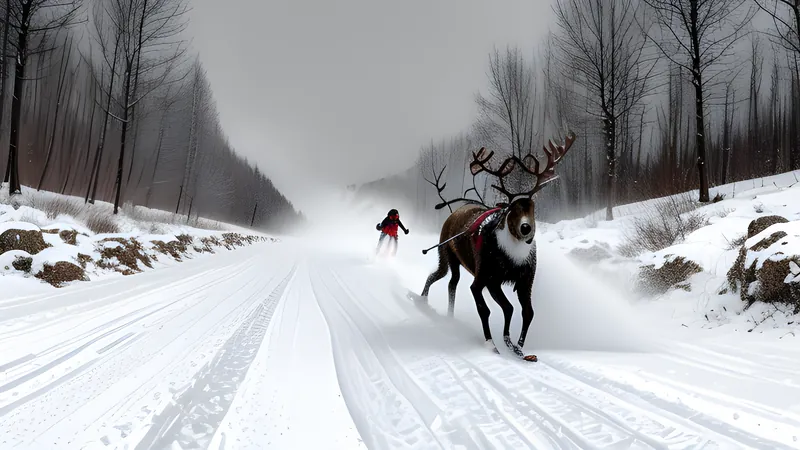
Pitting a person against an animal over distance is rarer as organised sport than you’d think, which is part of why Man versus Horse stands out on the calendar the way it does. Most human-versus-animal contests that do exist lean on the animal’s raw speed over a short, controlled course rather than testing endurance over rough, open country the way Llanwrtyd Wells does. The closer relative, in spirit if not in format, is the kind of animal-and-human endurance event I came across researching the Sámi reindeer races of the far north, where a skier is towed flat-out across snow and ice on a long rope behind a bolting reindeer, human and animal working together rather than against each other — a partnership rather than a duel, but built from the same basic fascination with what a working animal’s body can do against the clock, and what a human’s can do alongside or against it.
That rarity is worth sitting with for a moment. Most of the animal sports Europe still runs — showjumping, racing, sled events — keep the human as the animal’s partner or director rather than its rival. Man versus Horse flips that relationship entirely, and it does so honestly: nobody is disguising the fact that the two competitors are running the identical course under the same rules, which is precisely what makes a result like Lobb’s 2004 win mean something rather than being a gimmick dressed up as a contest.
An argument still worth having
What I like best about this race is that it never fully resolved itself into a foregone conclusion even after Lobb’s 2004 win. A horse has taken the race back most years since, and only a small handful of human runners have repeated the feat since that first breakthrough — which means Green’s original pub argument is still, in effect, being adjudicated every June, one hard, hilly, unglamorous 22-mile stretch at a time. The result isn’t fixed. That is precisely why it is still worth watching, forty-odd years after two men in a Neuadd Arms disagreed loudly enough that somebody decided to find out who was right.
Related Content