The Highland Games: Cabers, Stones, and the Heavy Events
How a set of blacksmith's tools became Scotland's oldest sporting export
Contents
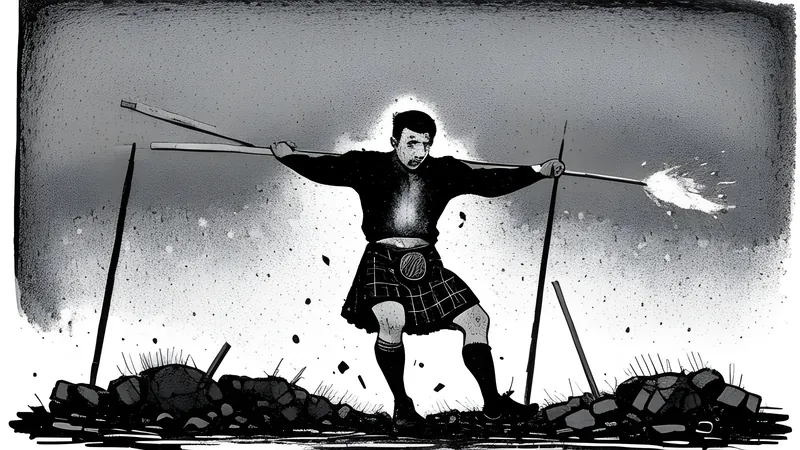
A caber is not thrown for distance. That’s the detail that trips up every first-time spectator, and I got it wrong myself the first time a Scottish friend explained it to me over a beer at a festival bar. You watch a man built like a shipping container heft a twenty-foot pine pole upright, cradle the narrow end in laced hands, sprint three strides, and launch the thing skyward — and your instinct is to look for how far it flew. Distance is not the point. The point is the flip. A perfect toss sees the caber turn end over end in the air and land dead straight ahead of the thrower, the far end striking the ground first and the near end following through to point back at the man who threw it, like a compass needle finding true north. Judges call that the twelve o’clock position. Everything else — nine o’clock, ten-thirty, a caber that simply topples sideways without turning at all — is a lesser toss, however far it travelled. It is a test of technique dressed up as a test of brute force, and that gap between what it looks like and what it actually is has been drawing crowds in Scotland for close to two centuries.
I write this as a Copenhagen-based outsider with a professional habit of following crowds to strange gatherings, and I should say plainly: this is a cultural read from Copenhagen. I have not stood at the rope line at a Highland gathering. But heavy events sit close enough to my usual beat — big bodies, big implements, a crowd that has come specifically to watch strength applied with skill — that I could not resist digging into how the strangest and oldest of Scotland’s sporting traditions actually works.
More than one throwing implement
The caber gets the photographs, but it is only one event in a heavy events programme that usually runs to six or seven disciplines. The stone put is the oldest in spirit if not in paperwork: a stone weighing somewhere in the range of 16 to 26 pounds, thrown either off a run-up to a toeboard or, in the stricter Braemar version, from a dead standing start with no approach allowed at all. The Braemar stone is the purist’s event — no momentum to borrow, just a man, a rock, and shoulder strength, which is precisely why the Braemar Gathering still runs it that way while lighter games have relaxed into the run-up version.
Then there is the hammer throw, which looks like the Olympic event’s country cousin: a round metal ball on the end of a long shaft, swung around the body and released for distance, except the Highland version is thrown with the feet anchored to the ground rather than spun through a full rotation, which changes the physics completely and rewards a different kind of power. There’s the weight throw, where a weight on a chain or handle — 28 or 56 pounds depending on the class — gets slung over one shoulder for distance. And there’s the weight-over-the-bar, in which that same 56-pound weight gets hurled vertically over a raised bar with one hand, judged purely on the height cleared, which is the event most likely to make an untrained spectator wince on the thrower’s behalf.
Every one of these implements has the same origin story: they were not designed as sporting equipment. They were what stood around a working farm or a blacksmith’s yard — a cart axle, a fence post, a loose field stone, a set of scales’ counterweight. Heavy events are, in the most literal sense, farmwork turned into a spectator sport, and that unglamorous ancestry is exactly why the caber toss reads as more honest than most modern strongman competitions built around purpose-forged equipment.
Selecting bodyguards, then keeping score
The folklore around the games’ origins reaches back further than anyone can properly document, and the most persistent version of it has feats of strength and running being used to select the fittest men for a Scottish king’s personal guard and his fastest messengers, with whatever tools were lying around the smithy pressed into service as the test. Whether that specific selection ritual happened exactly as described is the kind of claim that is impossible to pin to a date or a name, and I would not stake much on the details. What is much better documented is the point at which the games stopped being ad hoc contests of local strength and became an organised, ticketed, judged institution: 1832, at Braemar, when the Braemar Highland Society ran the gathering in a recognisably modern form with cash prizes drawn from the society’s own funds.
Braemar’s real claim to fame, though, is what happened sixteen years later. In 1848 Queen Victoria attended the gathering, and the reigning monarch or a senior royal has turned up in the decades since, an unbroken thread of royal patronage that runs through a small Aberdeenshire village every September to this day. It is a genuinely odd juxtaposition when you sit with it: a sport whose implements came from a farmyard, watched from a private enclosure by the head of state. Few sporting traditions anywhere can claim quite that combination of rustic origin and continuous royal endorsement, and it is a large part of why Braemar, rather than any of the dozens of other Scottish gatherings, is the one name that travels internationally.
A circuit spanning the world
Braemar is the famous one, but it is nowhere near the only one, and that scale is the part outsiders tend to underestimate. Scotland runs dozens of Highland games every summer, from the Cowal Gathering’s enormous pipe band competition to small village events that barely make the local paper, each with its own version of the heavy events programme and its own community of athletes who travel the circuit all season. And the games have exported themselves with the Scottish diaspora far beyond Scotland itself — North America alone hosts hundreds of Highland games events a year, and Highland games societies run gatherings from Australia to South Africa, all running broadly the same caber, stone, and hammer disciplines under broadly the same rules.
That global spread tells you something about what actually travels well in a tradition. It is not the tartan or the bagpipes alone — plenty of Scottish heritage events have those and stay strictly local. It is the heavy events specifically, because they need no translation. A crowd anywhere in the world understands, instantly and viscerally, what it is watching when a man flips a twenty-foot log through the air, in a way that requires no knowledge of clan history or Highland dance steps to appreciate. The spectacle does the explaining.
Strength as a craft
What separates the top heavy events athletes from a merely large man with a gym habit is the same thing that separates a good drummer from someone who can hit things hard: technique under load. The caber toss rewards a precise sequence — the balance point found while the pole is still vertical against the chest, the timing of the run, the exact moment of release that lets the far end drop first. Get the technique wrong on a caber that size and it does not gently fail; it can fold back on the thrower, which is why experienced competitors talk about the toss with the same close respect a Highland dancer gives footwork. The Braemar stone, thrown from a standstill with no momentum to borrow, is if anything a purer test of that same principle: raw strength without technique gets you nowhere against a heavier man who has spent years refining exactly how to load his hip before release.
That’s the thread connecting heavy events to the rest of what I usually cover. A great pit at a metal show looks like chaos from outside and is, in fact, governed by an unwritten etiquette that keeps most people upright — you help the person who goes down, you don’t throw punches, you read the room. Heavy events run on the same disguise: brute spectacle on the surface, discipline and craft underneath, and the gap between the two is exactly what keeps a crowd watching a man throw a tree.
Why a farmyard test still draws a crowd
There is a version of this story where heavy events read as pure nostalgia — men in kilts performing agricultural tasks for tourists, a museum piece kept alive by tartan marketing. I don’t think that’s right, and the continuous 1832-to-now run at Braemar argues against it. Scotland is oddly good at this particular trick: keeping an old, faintly mad custom running on genuine community will rather than committee upkeep, the same way Shetland still marches flaming torches through Lerwick every winter for Up Helly Aa, or Edinburgh’s hillside still fills with drummers and fire for Beltane every spring. A tradition kept alive purely for tourists gets thin and self-conscious; you can feel it happening at plenty of heritage events that have long since stopped meaning anything to the people running them. Heavy events have stayed thick, in the sense that the athletes competing on the circuit train year-round, travel gathering to gathering, and take the technical detail of a twelve o’clock toss as seriously as any professional sport takes its own obscure scoring rules.
Two centuries after Braemar first put cash on the table for the best thrower, the games still work on the same basic proposition: give a crowd an implement heavy enough to look dangerous, a rule strict enough to reward skill over size, and a setting old enough to feel inherited rather than invented, and people will keep showing up to watch, royal family included. The caber does not care that it is famous. It just needs to land at twelve o’clock, and the whole small, strange, brilliant tradition survives on whether it does.
Related Content