The Conker World Championship in a Northamptonshire Field
How bad fishing weather in 1965 gave Britain its most deadpan world championship
Contents
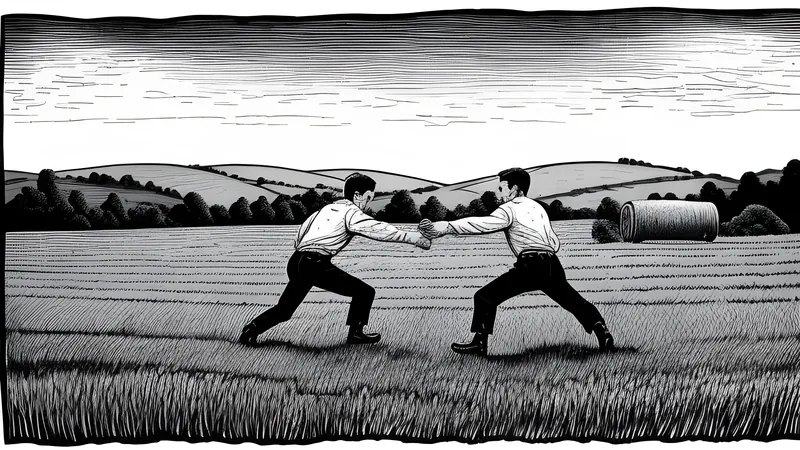
Somewhere between four and five thousand people show up in rural Northamptonshire on the second Sunday of every October to watch roughly four hundred competitors take turns smashing horse chestnuts against each other on a length of string. That sentence should not describe a functioning world championship with decades of continuity, a governing body, and a rulebook precise enough to specify the minimum gap between knuckle and nut in inches. And yet here we are. The World Conker Championships is one of the most purely, unapologetically British sporting events I have ever researched, and its origin story is the most British part of all: it exists because some men couldn’t go fishing.
I’m writing this as a cultural observer rather than an attendee — I have not stood in that Northamptonshire field with a conker of my own on a string, and Encore doesn’t invent that kind of attendance. What follows is built on the public record of a genuinely well-documented, well-organised annual event, because a championship this specific deserves to have its specifics got right.
Rained off, and improvising
The story, as the organisers themselves tell it, starts in 1965 at the Chequered Skipper pub in the village of Ashton, near Oundle. A group of men had a fishing trip planned, the weather turned against them, and rather than simply write the day off they improvised a competition out of the conkers falling from the horse chestnut trees around the village. It is exactly the kind of origin story that sounds too neat to be true and is, as far as anyone can establish, simply true: a rained-off fishing trip is a far more mundane and far more believable genesis than the invented folklore that tends to accumulate around older customs, and the championship has never needed to dress its own history up.
Ashton hosted the event for 45 years, run by and for the village, before outgrowing what a small green could comfortably hold. In 2009 it moved a short distance to the Shuckburgh Arms in Southwick, a nearby village with room for the crowds the event had by then started attracting. That move tells you something the rest of the story confirms: this stopped being a private village amusement decades ago and became a genuine public spectacle, without ever losing the parish-fete texture of its origins.
The rules are stricter than they have any right to be
Conkers, the schoolyard version most people in Britain grew up playing, is a game of vague consensus rules that vary from playground to playground. The World Conker Championships version is not that. It is codified with the seriousness of a sport that has had disputes to settle and decided, once and for all, to close the loopholes.
The organisers themselves prepare the ammunition: upwards of two thousand horse chestnuts are collected, drilled, and threaded onto string ahead of the tournament, each one required to meet a minimum width of 1.25 inches, so no competitor turns up with a suspiciously oversized ringer harvested from a favoured tree. Competitors do not bring their own conkers. This single rule solves the single biggest source of playground cheating — the conker baked in an oven, soaked in vinegar, or varnished to iron hardness — by removing the competitor’s control over the equipment entirely.
The lace itself is regulated too: no less than eight inches, or twenty centimetres, must hang between the competitor’s knuckle and the nut, which stops anyone winding the string dangerously short to gain leverage or protection. Play proceeds in alternating turns, three strikes each, the attacker swinging their conker at the defender’s stationary one, and then the roles reversing. And there is a specific provision for the game that simply refuses to end: if five minutes pass without either conker breaking, a “five-minute rule” kicks in, granting each player up to nine further alternating strikes, with the winner in a still-unbroken deadlock decided by whoever landed the most successful hits on the opponent’s nut across the whole game.
None of that is necessary for a village green amusement between friends. All of it is necessary for a championship that has run long enough, and drawn a large enough field, to have had every possible dispute raised and then legislated against.
The comedy of extreme specificity
What I find genuinely funny about the World Conker Championships, in the same way I find the Wife-Carrying World Championships in Sonkajärvi funny, is the gap between the stakes and the seriousness of the procedure. Nobody’s livelihood depends on whose horse chestnut shatters first. There is no broadcast deal, no sponsor logo the size of a barn door, no athlete whose conker-striking form gets analysed by a sports scientist on a retainer. And yet the rulebook reads like something drafted by people who have genuinely lost sleep over knuckle-to-nut distances.
That specificity is the whole appeal, and it is a very English flavour of comedy — the deadpan insistence on doing an obviously trivial thing with total procedural seriousness, precisely because everybody involved knows it is trivial and refuses to let that stop them. It is the same instinct that gives Britain a cheese rolled down a near-vertical Gloucestershire hillside with an actual injury-prevention protocol standing by at the bottom, a subject I’ve written about before: the daftness and the rigour are not in tension, they are the same joke told from two directions at once.
A costume and a mascot the size of the joke
The championships have, over the decades, accumulated the trappings of a much bigger event without losing their sense of proportion about what they actually are. There is a mascot, “King Conker,” who presides over proceedings in appropriately regal, faintly ridiculous costume. There are novelty categories alongside the serious competitive strikes. Up to four hundred competitors take part across the day, drawn, in a detail that always makes me smile, from a genuinely international field well beyond the immediate area — entrants have travelled in from well outside the UK specifically to swing a conker on a string in a Northamptonshire field, treating the trip the way a metalhead might treat a pilgrimage to a festival on the other side of a continent.
That is not nothing. A niche, self-evidently silly regional pastime does not pull international travellers to a village of a few hundred people without having built, over more than half a century, a genuine reputation as the definitive version of the game. Plenty of countries have some equivalent childhood pastime involving a hard seed on a string. Only Ashton and Southwick built the version everyone now measures themselves against.
The tree the whole sport depends on
There is a real threat sitting underneath all this deadpan Englishness, and it is worth taking seriously precisely because the championship depends on it. The horse chestnut leaf miner moth, first recorded in Britain in 2002, has spread across the country in the years since, its caterpillars tunnelling through the leaves and browning the canopy long before autumn. Layered on top of that is bleeding canker, a bacterial disease identified in the mid-2000s that can thin a tree’s crown and, in the worst cases, kill it outright. Neither problem has wiped out the horse chestnut, and the research on leaf miner specifically suggests the tree itself tends to survive the infestation. But the conkers it produces come out smaller and less viable, and foresters have floated decades-long timeframes for what sustained pressure from both problems could do to the supply of full-sized, competition-grade nuts.
That is why the championship’s own conker-collecting operation matters so much. By gathering and vetting its own stock rather than letting competitors bring their own, Southwick’s organisers are quietly managing the supply chain for a sport that depends entirely on a tree species currently under sustained biological attack, well beyond simply guarding against a doctored ringer smuggled in from a competitor’s back garden. Nobody at the championship talks about it loudly, but it sits there quietly in the background of every drilled and threaded nut: the raw material for Britain’s most deadpan world championship is not guaranteed to renew itself forever.
Fifty years on a length of string
I keep coming back to the fact that this whole tradition exists because a fishing trip got rained out. There was no grand plan behind the World Conker Championships, no marketing consultant deciding that horse chestnuts had untapped spectator potential. A handful of men in a Northamptonshire pub found themselves with an afternoon to fill and a hedgerow full of conkers, and more than fifty years later strangers fly in from other countries to compete in the tournament that grew out of their improvisation.
That is, in miniature, how most of the best strange traditions I’ve come across actually start: an afternoon nobody planned for, filled with whatever was lying around, that somebody then decided was worth doing again next year. The horse chestnuts fall from the same trees every autumn whether anyone competes with them or not. Ashton and Southwick just decided, one rained-off October, that they would keep score.
Related Content