The Circle Pit: Physics and Manners
The spinning vortex at the heart of a metal crowd, and the rules that keep it turning

Contents
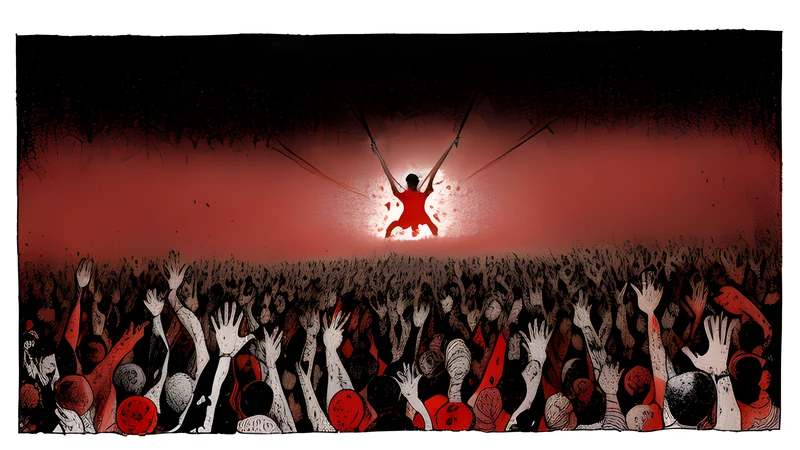
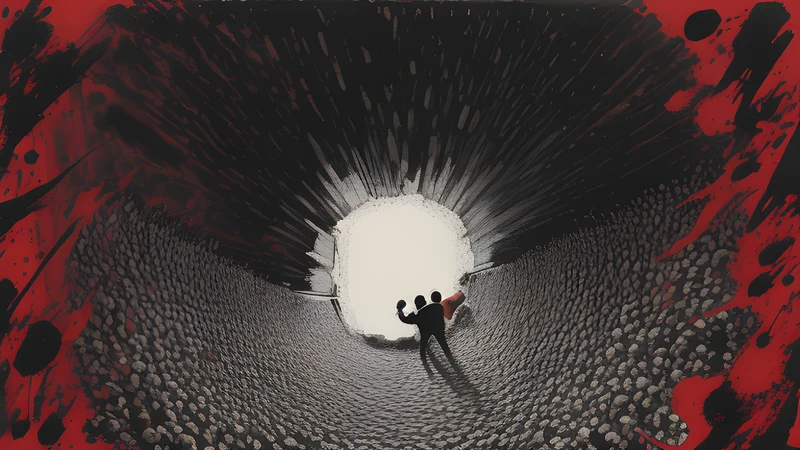
From the balcony it looks like a whirlpool has opened in the middle of the floor. One moment the crowd is a solid mass, and the next a hole appears in it, a ring of open space that begins to rotate as bodies pour around its edge in a single direction, faster and faster, until the whole thing is a spinning human centrifuge with a calm empty eye at its centre. This is the circle pit, the most hypnotic of all the crowd rituals, and like every one of them it looks like chaos and behaves like a system. There is real physics holding it together, and there is a real code of manners keeping it safe, and the two are more closely related than they appear.
I have run in a great many of these, in Copenhagen clubs and at festivals up and down Europe, and the thing that never stops fascinating me is how a circle pit self-organises out of nothing. Nobody draws a line on the floor. Nobody appoints a direction. And yet within seconds of the pit opening, several hundred strangers have agreed on a shared rotation, a shared speed and a shared understanding of where the danger lies, all without a word being spoken. It is one of the purest examples of a crowd behaving as a single intelligent organism, and it repays a closer look than most people give it.
What separates it from the pit
First, a distinction, because the terms get muddled. A mosh pit in the general sense is the churning, shoving, shapeless clearing that opens up at a heavy show — a mass of people barging into each other with no particular pattern. A circle pit is a specific, more organised form: the churn resolves into a rotation, and instead of a formless scrum you get a moving ring. The two flow into each other constantly, a general pit tightening into a circle when the music calls for it and dissolving back into a scrum when it slows, but the circle pit is the disciplined, high-speed version, and it belongs to the faster music.
That is the key to the whole thing: the circle pit is a creature of tempo. It opens up at the fast parts — the thrash gallop, the blastbeat, the d-beat charge — because rotation needs speed to sustain itself, and it collapses the instant the music drops into a slow, stomping breakdown, at which point the crowd switches to the barging, two-step mode that heavy grooves demand. Read the music and you can predict the pit: fast means circle, slow means churn, and the crowd changes gear together on the band’s cue. The best pits are the ones that follow the song’s dynamics exactly, a physical read-out of the music’s own architecture.
The physics of the vortex
Watch a circle pit as a physicist and it makes beautiful sense. Once bodies start moving around a ring in the same direction, momentum takes over: it is far easier to keep running in an established circle than to start a new one or reverse it, so the rotation becomes self-sustaining, each runner both carried by and adding to the collective momentum. The empty centre is the eye of the system, a low-energy calm where the rotational forces cancel out, which is exactly why the middle of a circle pit is one of the safer places to stand and, paradoxically, where a fallen person is most quickly rescued.
The direction is the strange part, and it is worth dwelling on. Circle pits overwhelmingly rotate counter-clockwise, the same way water is popularly imagined to drain, and while there is no law of physics forcing a crowd to pick one way over the other, the convention is remarkably stable across countries and scenes. Some of it is simple imitation — the first few runners set a direction and everyone matches it — and some of it may be a handedness bias in how people instinctively turn. When a band’s frontman occasionally calls for a reverse circle, sending the whole vortex spinning the other way, the crowd’s brief disorientation is proof of how deeply the default is ingrained. The system has a preferred state, and it snaps back to it the moment the novelty passes.
The manners, stated plainly
The etiquette of the circle pit shares its foundation with every crowd ritual, and it starts in the same place. You pick people up. A runner who trips at speed goes down hard and is immediately in the path of everyone behind, so the instant someone falls, the people nearest stop, form a shield, and get them upright before the rotation can run them over. In a fast circle pit this reflex has to be quicker than in any other ritual, because the momentum that makes the pit thrilling is the same momentum that makes a fall dangerous. The crowd’s speed and the crowd’s care are two sides of the same coin.
You run the agreed direction. A single person deciding to sprint against the rotation is a genuine hazard, a head-on collision waiting to happen, and the crowd corrects it fast — either by absorbing the contrarian and turning them around, or by the sheer social pressure of hundreds of people all going the other way. The direction is a consensus, and honouring it is the most basic courtesy of the form.
You keep the aggression theatrical and your fists closed. As with the wall of death, the circle pit is a collision sport played for joy, and there is a bright line between hard, shoulder-led contact and an actual assault. Everyone in the ring understands that line instinctively, and someone crossing it — throwing real punches, targeting individuals — is identified and ejected by the crowd itself with startling speed. The pit polices its own, and it does so more reliably than any security team could.
You mind the edge. The boundary of a circle pit is where the runners meet the stationary crowd, and it is the friction point where trouble starts — people shoved from the ring into bystanders who never opted in. The etiquette asks runners to stay aware of that edge, and it asks the ring of watchers around the pit to act as a soft wall, pushing stray bodies gently back in rather than letting them cannon into the people behind. A well-run pit has a clear, respected membrane between the spinning and the still.
Where it lives, and the Danish read
The circle pit is more democratic in its venue requirements than the wall of death, because a rotation can form in a far smaller footprint than a two-wall charge. You will see one in a mid-sized club as readily as on a festival field — a fast band in a room like Stengade or Pumpehuset can open a circle pit in a space that could never host a wall of death. Scale it up to the harbour fields of Copenhell and the same ritual becomes an enormous slow-turning wheel visible from the back of the crowd, but the mechanics are identical. The pit finds the space it has and fills it.
Danish crowds run their circles with the same good-humoured discipline they bring to every ritual, the lifting reflex strong and the aggression firmly theatrical. It is part of the same family of behaviours that includes crowd surfing and the general churn, and all of it only makes sense once you grasp what the mosh pit is actually for as a social technology. The circle pit is that technology at its most elegant: a self-organising, self-policing, self-sustaining system that appears from nowhere, does its work, and dissolves the moment the music tells it to.
The band’s cue
Circle pits are sometimes spontaneous and sometimes summoned, and the summoning is its own small art. A frontman who wants one will often demand it outright, sweeping an arm in a wide circle over the crowd and roaring at the floor to open up, using the pause between songs to clear a space before the fast riff lands. The best callers time it to the music, holding the crowd on the edge of the tempo and then releasing them into the rotation exactly as the band accelerates, so the pit and the song hit their stride together. Done well, it is a genuine collaboration between stage and floor, the band supplying the fuel and the crowd supplying the machine.
There is a common sequence worth knowing, too, because the rituals interlock. A wall of death that has just collided will frequently resolve straight into a circle pit, the two charging walls dissolving their forward momentum into a rotation the instant they meet — the energy of the collision finding a new shape rather than simply dissipating. Watch enough big-festival crowds and you learn to read the whole grammar: the pause and the split for a wall of death, the collision, the rotation that follows, the switch to the barging churn when the breakdown drops. It is a full vocabulary of collective movement, and a fluent crowd moves through it as naturally as a conversation.
The responsibility on the band is the same as ever. Calling a circle pit in a room too tightly packed to open one safely, or demanding an ever-faster rotation from a crowd already at its limit, is a misuse of the power the audience hands over. The good bands read the floor and pitch their demands to what the room can safely give, which is precisely why the crowds trust them to make the call in the first place.
Why it holds together
The circle pit is, in the end, a small daily miracle of cooperation dressed up as anarchy. Hundreds of strangers, most of them wrung out and half-deaf, coordinate a high-speed collective manoeuvre with no leader, no rules posted anywhere, and no communication beyond the shared understanding that everyone in the ring is looking out for everyone else. The speed is real and the risk is real, and the whole thing works because the etiquette is stronger than the chaos — a safety culture transmitted body to body, generation to generation, taught in the simple act of hauling a stranger back onto their feet.
That is why it is worth understanding rather than fearing. Seen from outside, a circle pit is the most frightening thing in the room, a whirling mass you would be mad to step into. Seen from inside, it is one of the most reliable, most joyful pieces of spontaneous human organisation you will ever be part of. Learn the direction, watch the eye, keep your fists closed and your eyes on the person next to you, and step in. The vortex will hold you up as surely as it spins you round.
Related Content