The Borderland: Denmark's Participatory Burn, Where There Are No Spectators
The Nordic regional burn runs on gifting, consent and a hard rule — everyone works, nobody watches
Contents
Late July, and a certain kind of Copenhagener disappears. You notice it in the bike racks, the quieter co-working spaces, the flatmate who left with a rented van full of scaffolding poles, fairy lights and forty litres of drinking water. Ask where they’ve gone and you get a slightly evasive smile and the word burn. Not a festival, they’ll insist, faintly offended you’d suggest it. There’s no lineup. There’s no bar. There’s no ticket that buys you a good time while someone else provides it. And here’s the part that reliably breaks a newcomer’s brain: at this particular burn, there isn’t even anything to burn. No towering effigy, no fire at the finish. Just a couple of thousand people who built a town in a forest, lived in it for a week, and then took every last cable tie home.
This is The Borderland, the Nordic regional burn, and for the better part of a decade the Danish scene has treated it as the summer’s true north.
A “burn” with no burn
To understand The Borderland you have to understand the word attached to it. “Burn” is the family name for the sprawling network of events descended from Burning Man in Nevada’s Black Rock Desert. There are scores of these regional burns worldwide, each an independent, volunteer-run experiment applying the same cultural DNA to a patch of local ground. The Borderland is the big Scandinavian one.
What every burn inherits is the framework of ten principles that Larry Harvey codified for Burning Man in 2004: radical inclusion, gifting, decommodification, radical self-reliance, radical self-expression, communal effort, civic responsibility, leaving no trace, participation, and immediacy. The Borderland keeps all ten and adds an eleventh of its own — consent — which tells you a great deal about the community’s priorities before you’ve set foot on the land.
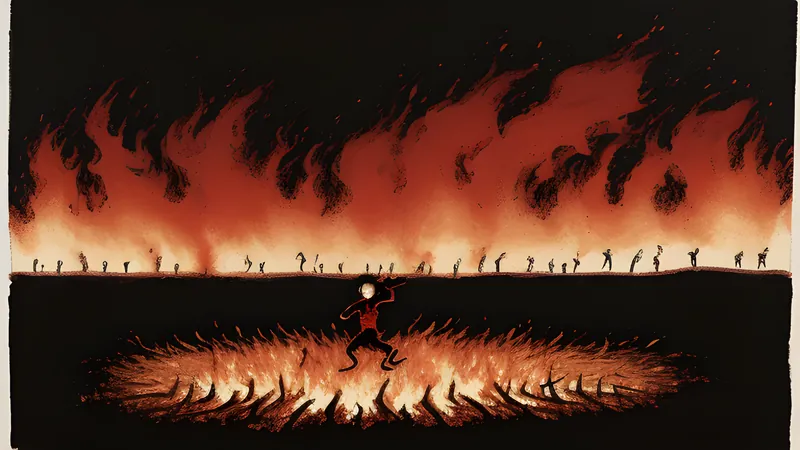
Now, the surprise. Burning Man’s emotional climax is the burn itself: the enormous wooden Man set alight on the Saturday, followed by the quieter, tear-soaked incineration of the Temple. The Borderland has neither. There is no central effigy and no temple, the second absence sitting comfortably with a community that skews firmly atheist and has little appetite for a sacred structure to grieve at. Ask a longtime participant why they still call it a burn when nothing burns and you’ll get a shrug: the fire was always a metaphor for the impermanence, and the impermanence is the point. The town appears, the town vanishes, and the ash is beside the matter.
Its roots help explain the difference. The Borderland grew out of Nordic live-action roleplay — its lineage traces back through FutureDrome, an ambitious Swedish LARP staged in 2001 — and that heritage still shapes the place. Where a classic burn is organised around monumental art in an open desert, The Borderland leans toward participatory theatre in a forest: the theme camps, the characters people build, the temporary societies that spring up around a bar that serves no money’s worth of drinks. Art matters here, but the camps are the main event.
No spectators means no spectators
The line in the title is the one that separates The Borderland from anything you can buy a wristband for. There are no spectators. This is not a marketing slogan softened into a vibe — it is an operational rule with teeth.
At a commercial festival you are, by design, a customer. You pay, you arrive, you are entertained, and the transaction has a producer on one side and an audience on the other. The Borderland deletes that arrangement entirely. To attend you register as a co-creator, which means you sign up to contribute something real: run a camp, build an installation, cook for strangers, haul water, staff a shift on the gate, teach a workshop, hold the sound desk, clean the composting toilets that someone, always, has to clean. If you want to turn up and simply watch, there is nowhere for you to stand, because the place is made entirely of people who came to do a job they invented for themselves.
The machinery underneath is a “do-ocracy” — power belongs to whoever shows up and does the work. There is no central production company pulling strings. The event runs on decentralised working groups, cheerfully named realities for the practical infrastructure and dreams for anything a participant can imagine into being. Nobody is your boss and nobody is your host. That can be exhilarating and it can be exhausting, and veterans will tell you honestly that the first Borderland is often bewildering precisely because no one is coming to fix your problems or programme your evening. You are the programme.
That refusal of the audience role is the whole philosophical engine. It is the mirror image of the modern festival experience I’ve grumbled about in Why Every Festival Now Feels the Same — the polished, sponsored, algorithmically booked machine that sells you a passive good time and harvests your data on the way out. The Borderland’s answer to homogenised, corporatised leisure is to hand you a hammer and get out of your way.
The economy with the money taken out
Decommodification is the principle that does the heaviest lifting, and it is stricter here than most newcomers expect. On the land there are no vendors. None. You cannot buy a beer, a burger, a phone charger or a hug. Money does not change hands, and — importantly — nor does barter, because bartering just reintroduces transaction through the back door. What operates instead is a gifting culture: you bring things to give freely, with no expectation of return, and you receive the same from a hundred strangers over the week. A bar in one camp will pour you a cocktail for nothing; you’ll wander on and hand out the pastries you baked at 4am for nobody in particular.
This sounds like chaos that couldn’t fund itself, so here’s the clever bit. Participants pay a membership fee to cover the land, the sanitation, the safety infrastructure — the unglamorous backbone. Roughly half of that money is then recycled back to the community through participant grants, the Dream funding, so that anyone with an idea for a build or an artwork can apply for the materials to realise it. A slice — the “Fund 33” earmark — is set aside for larger and more permanent art. The organising body is a Swedish non-profit, Gränslandet, and the crucial detail is that the participants are the members. There are no shareholders to satisfy and no profit to extract, which is why nobody is trying to upsell you a VIP tier.
If that model sounds familiar to Danish ears, it should. It rhymes with the ethic behind Roskilde, the vast non-profit festival that funnels its surplus to charity — proof that the Nordic scene has more than one working template for taking the profit motive out of a good weekend. The Borderland simply takes it to the logical extreme: it removes the profit, the price tag, the till and the customer all at once.
The Danish years, and where it lives now
Now for the honest geography, because the story has moved. The Borderland began in Sweden in 2011 — a tiny thing, 46 people in the town of Hjo — then spent a year on Gotland before crossing to Denmark in 2015. For five formative summers it made its home at Hedeland, a reclaimed gravel-pit landscape in the countryside outside Copenhagen, and those were the years it swelled into a proper temporary city and burrowed deep into the Danish cultural bloodstream. A great many of the co-creators, camps and organisers are Danish, and for the Copenhagen scene the late-July pilgrimage became a fixture.
Since 2023 the community has had its own permanent land — Alversjö, a forest of lakes and nature reserve near Eksjö in southern Sweden, bought collectively by the members through a dedicated company set up for the purpose. So calling it “Denmark’s burn” is, strictly, a sentimental claim rather than a cartographic one; the effigy-free town now rises on Swedish soil. But it remains a Nordic project with a Danish heart, an easy hop from Copenhagen, and the crowd that streams out of the city each summer hasn’t changed its habits. The 2024 edition ran across the last full week of July, week 30, as it does every year.
Consent, safety and taking the ash home
The eleventh principle is where the community’s character shows most plainly. Consent is written into the culture as explicitly as gifting is — a burn built on radical inclusion and radical self-expression only works if everyone also has an unambiguous right to say no, and to be heard when they do. The event runs its own safety and welfare teams, staffed by participants, and a strong ethic that looking after each other is part of the work you signed up for rather than a service delivered by security in hi-vis.
Then there’s leave-no-trace, which at The Borderland is closer to an obsession than an aspiration. A gravel pit or a nature reserve is not a festival field engineered to be trashed and cleared by a contractor; it is somewhere the community intends to keep using and, now, actually owns. So the town is dismantled with the same care it was built, the ground combed for micro-litter — every bottle cap, every stray zip-tie, every fleck of glitter that shouldn’t have been there in the first place — until the forest looks as though nobody ever came. That discipline is why there’s no bonfire finale. The most radical thing you can do to a beautiful piece of land is leave it exactly as you found it.
It is easy to be cynical about all this from the outside — the earnestness, the jargon of realities and dreams, the utopian certainty that a week without money proves something about the other fifty-one. And plenty of it is gloriously daft. But I’d caution against the sneer, because the daftness is doing real work. Denmark already has its great communal fire in Sankt Hans, the midsummer bonfire where the whole country gathers to watch the flames together. The Borderland is the stranger, more demanding sibling: a summer ritual that refuses to let you watch at all, hands you the responsibility instead, and asks whether you can build something worth living in for a week and then have the grace to take it down without a trace. Most of us never test that. A couple of thousand people, every July, do — and they come home to Copenhagen tired, filthy, broke in the good way, and quietly convinced the rest of us are missing something.