The Blast Beat: How the Double-Kick Conquered Metal
The rhythm that turned speed into a genre
Contents
There is a sound at the far end of loud music that stops feeling like drumming and starts feeling like weather. Kick, snare and cymbal fire together at a speed the human ear cannot separate into individual hits, and the whole thing becomes a wall of grey static with a pulse buried in it. That is the blast beat, and once you know how it is built you cannot un-hear it — in the pit it is the difference between a fast song and a genuinely overwhelming one.
I have spent a lot of nights standing directly in front of drum risers in the small rooms of Copenhagen, close enough to watch a drummer’s right foot go from a jog to a blur, and the blast beat is the single most physical thing a band can do to a room without moving from their seats. It is worth taking apart, because the mechanics explain the whole history.
What it actually is
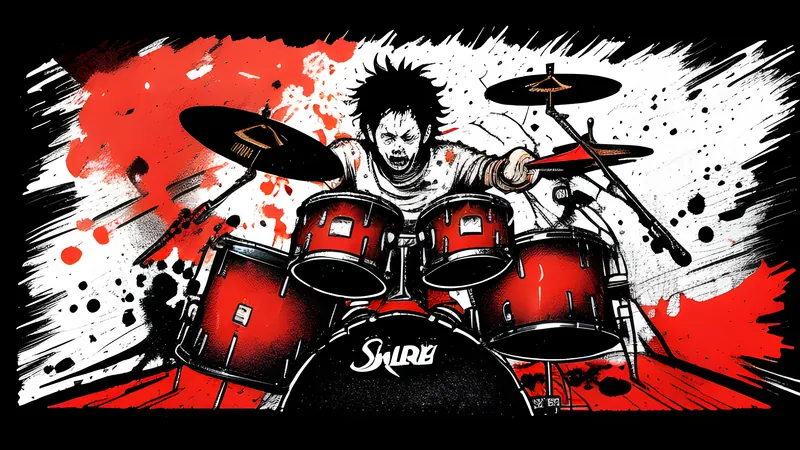
Strip it to the bone and the classic blast beat is a very simple pattern played very fast. The drummer alternates single strokes between the bass drum and the snare, hand and foot trading hits in a rapid left-right-left-right, while the other hand rides a cymbal on every beat. Slow it right down and it is almost a nursery rhythm. Speed it up past roughly ten or twelve hits a second and the individual strokes fuse into that continuous roar, the snare a machine-gun rattle, the kick a felt vibration in your sternum.
The double-kick — two bass drums, or one drum with a twin pedal worked by both feet — is the engine that makes the modern version possible. A single foot can only jog so fast before it seizes; two feet alternating can run indefinitely, and once drummers had that under them the ceiling on metal’s tempo went straight through the roof. The double-kick and the blast beat grew up entangled, and together they gave extreme metal its top gear.
There are variants, and drummers argue about the taxonomy the way birdwatchers argue about gulls. The traditional blast alternates the hands. The “bomb” or “hammer” blast plays kick and snare in unison for a thicker, more brutal thud. The “gravity blast” bounces the stick off the rim to double the snare hits from one arm motion. Each has a different feel in the chest, and a good drummer switches between them inside a single song the way a sprinter changes gait.
The rhythm has a longer history than metal
The double bass drum did not start with anyone heavy. The jazz drummer Louie Bellson designed a double-kick kit as a teenager in the late 1930s and used it to play swinging, showy solos — the fastest, most flamboyant end of big-band drumming. Ginger Baker of Cream and Keith Moon of The Who both hauled second kick drums onto rock stages in the 1960s. So the hardware that metal treats as its own birthright was invented to make jazz and rock more dazzling, decades before anyone thought to make it frightening.
The blast beat as a distinct thing has murkier parentage, and honesty demands admitting the record is incomplete. Fast alternating patterns turn up in early-1980s hardcore punk, where the point was raw velocity and songs that ended before they properly began. The Swedish band Asocial are sometimes credited with an early hardcore blast on a 1982 demo. American bands like D.R.I. and the ferociously fast Repulsion were pushing tempo to the edge of coherence around the same time. No single drummer invented it in a clean, datable moment, and anyone who tells you otherwise is tidying up history to make a better story.
Napalm Death and the name
What is well documented is where the blast beat got its name and its identity as an ideology of speed. The English band Napalm Death, out of Birmingham, made it the load-bearing wall of an entire genre. Their drummer Mick Harris, who joined in the mid-1980s, is generally credited with coining the term blast beat and with turning the technique from an occasional burst into a governing principle. On Napalm Death’s 1987 debut Scum the blast is the default state and everything else is the exception — some songs last a few seconds, and the drumming is the reason grindcore exists as a category at all.
Around the same time in Brazil, as I mentioned in the corpse-paint history, Sarcófago’s drummer was hammering out extremely fast blasts on I.N.R.I. in 1987, so the technique was arriving on multiple continents at once — a good sign that it was an idea whose time had come rather than one person’s invention. Grindcore took the blast as its entire reason for being. Then death metal picked it up and made it precise.
Death metal made it a language
Grindcore’s blast was gloriously sloppy, a controlled avalanche. Death metal drummers took the same technique and turned it into something surgical. Bands out of Florida and Sweden through the late 1980s and early 1990s treated the blast as one colour on a large palette, dropping in and out of it, locking it dead-tight to riffs that changed on a knife-edge. The Swedish scene I wrote about in the Gothenburg sound built melody on top of that machinery, so you would get a soaring twin-guitar harmony riding over a blast beat, beauty and brutality bolted together.
The great early-1990s death-metal drummers turned the blast into an instrument of real expression. Pete Sandoval of Morbid Angel became famous for the sheer relentless machinery of his playing; Gene Hoglan, who drummed with Death and Dark Angel, earned the nickname “the Atomic Clock” for a sense of time so exact it sounded programmed. These players proved the blast could be tight, musical and controlled rather than a mess of noise, and they set a bar the whole genre chased.
That chase produced its own problem: the triggered drum. To make blasts audible on record, engineers began using electronic triggers that swap each kick-drum hit for a uniform sampled click, so every stroke sounds identical no matter how hard or soft it was actually played. It solves the mud problem and it flattens the humanity out at the same time, and the scene has argued about it for thirty years. A perfectly triggered blast is clean, legible, and slightly dead; a raw, un-triggered one is messier and more alive. Where you stand on that says a lot about what you want from the drums.
By the 2000s the technical arms race had produced drummers who could hold blasts at genuinely inhuman tempos for whole songs, cleanly, with a metronome’s consistency. Some of this is thrilling. Some of it is athletics for its own sake, a drum-off with no music attached, and there is a real argument in the scene about whether the pursuit of ever-faster blasting has cost more feel than it has bought excitement. My own view, earned from a lot of gigs, is that the blast beat is a spice and not a meal. A band that blasts constantly numbs you within two songs; the drummer who knows exactly when to drop into it, and — more importantly — when to drop out, is the one who takes the top of your head off.
Why it destroys a room live
On record a blast beat can turn to mud, a smear of compressed grey noise where you lose the individual instruments entirely. This is one of the recording problems that feeds straight into the loudness war, because bands squash the life out of already-dense music trying to make it hit hard, and the blast is the first thing to disappear into the sludge.
Live is where it comes alive, literally. Standing in front of a real kit driven by a real double-kick pedal, you do not so much hear the blast as get hit by it. The kick drum moves air; you feel each impact in your chest cavity before your ears have resolved it into a rhythm, and the sheer relentlessness of it does something to a crowd that slower music cannot. It is why a good grind or death-metal set turns the floor into the churning chaos I described in what the mosh pit is actually for. The body responds to the tempo before the brain catches up. Your heart rate is being out-run by a bass drum, and some animal part of you decides the only sane response is to start moving.
There is a reason the technique refuses to date, too. Trends in loud music come and go — the breakdown, the drop, the djent chug all had their moment and cooled — yet the blast beat has stayed a permanent fixture for nearly forty years, because it is doing something structural rather than stylistic. It is the fastest a drummer can go, and there will always be bands who want the fastest, loudest, most extreme thing available. Speed is a frontier, and the blast is the flag planted at the far edge of it.
That is the whole trick, really. The blast beat is a machine for exceeding the human pulse. It takes a rhythm your body understands — the heartbeat, the run, the panic — and pushes it past the point where you can follow it, and in that gap between what you feel and what you can count, an entire genre of loud music found its home.
Related Content