The Barrier Crew: The Hardest Job in the Room
The people who work the crash barrier, facing the wrong way all night
Contents
There is a line of people at every big show who spend the whole night with their backs to the band. You paid to watch the stage. They get paid to watch you. That gap in the floor between the front row and the monitor wedges — the pit in the technical sense, the photo pit, the strip of gravel or plywood a metre and a bit wide — belongs to them. The barrier crew. The people on the barricade. The hardest job in the room, and the one almost nobody in the crowd ever properly looks at.
I’ve stood in that front row more times than I can count, at VEGA and Amager Bio and Den Grå Hal and out on the harbour concrete at Copenhell, close enough to watch the crew work all night. And once you start watching them instead of the guitarist, you can’t stop. Because the show you paid for is the loud one on stage. The other show — the quiet, brutal, athletic one — is happening in that metre-wide trench, facing the wrong way.
What the job actually is
Start with the physical facts, because they get lost under the romance. A crowd crush pushes forward with a force that builds and releases in waves. At the front of a packed hall of a couple of thousand people, the barrier takes the load of everyone behind the first three or four rows leaning, surging, being pushed. The steel is bolted and weighted and angled back towards the stage for exactly this reason. The people working it stand in the gap behind it and take what comes over the top.
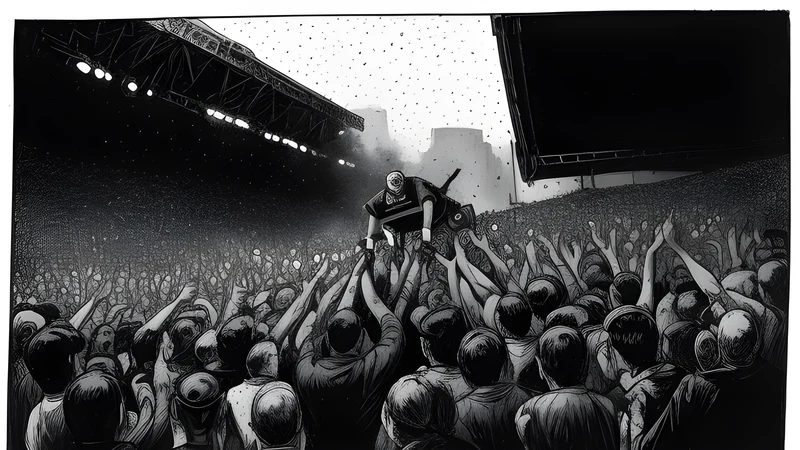
What comes over the top is human beings. Crowd-surfers arrive head-first, feet-first, sideways, sometimes all three inside one song. Each one has to be received, turned the right way up, lowered onto their feet in the trench, and pointed at the exit gap that funnels them back down the side. A busy hardcore or metal show can deliver a body over the rail every ten or fifteen seconds for the length of a set. The crew catches every single one. They do it for ninety minutes. They do it while the low end from the PA is physically vibrating their sternums and they can’t hear a word anyone says.
Then there’s the water. On a hot night in a sold-out room the temperature at the front climbs fast, and the crew works a steady bucket-line of paper cups over the barrier to the people pinned against it who can’t move to get their own. Watch a good crew and you’ll see them clock the specific faces going grey, the ones who’ve stopped singing, the kid who was buzzing an hour ago and is now glassy and swaying. They pull those people out over the rail before anyone faints. That is the actual job. The catching is the visible part. The reading is the skill.
Reading the room
Here’s the thing that took me years of front-row nights to understand. A great barrier worker is watching the crowd the way a lifeguard watches the sea. They aren’t reacting to the surfer already in the air — that one’s just physics now, catch it and move on. They’re watching the swell two rows back that’s about to launch the next three. They’re watching the pit open up stage-left and doing the arithmetic on where its edge will collapse. They’re watching one specific person who’s had a hard time of it and deciding, calmly, that the next surge is the one where that person comes out.
The band feeds this. A singer who knows what they’re doing runs the crowd like a conductor, and the barrier crew is reading the same score from the other side. When the frontman winds the room up for a big breakdown, the crew braces, because they know exactly what the floor is about to do. The good ones have heard the record. They know which song is the wall-of-death song and they’re set for it before the riff lands. There’s a whole silent conversation happening between the stage, the crowd and the trench, and the crew is fluent in all three languages at once while being able to hear none of them.
This is why the barricade and the photo pit are an uneasy marriage for the first three songs of a big show. The photographers are down there doing their own job, crouched and shooting, backs also to the crowd, right in the drop zone where the surfers land. A good crew shepherds the shooters, warns them when a wave’s coming, and clears them out before it gets truly heavy. The photographers know it too — the smart ones treat the barrier crew as the people keeping them alive down there, and get out of the way the second they’re told.
Why they face the wrong way
I keep coming back to that image because it’s the whole thing in one picture. Everyone in the building is facing one direction. This one line of people faces the other. They will not see the show. They took a job that guarantees they miss the thing everybody else is here for, and they took it on purpose, and the best of them are proud of it.
Ask around and you find that a lot of long-serving barrier crew are music people themselves — punks and metalheads who worked out that the barricade is the best seat in the house for a completely different event. They get the front-row physicality without the tunnel vision. They know every band on the circuit because they’ve worked every band on the circuit. And they carry a duty of care that most punters never think about: the unspoken deal is that you can throw yourself bodily over a steel rail into a stranger’s arms in a dark room full of two thousand people, and that stranger will catch you, and it will be fine. That deal only holds because the crew holds it up, night after night, show after show.
It doesn’t always hold, and the history of live music is scarred where it hasn’t. The disasters everyone in the industry learns from — Roskilde in 2000, the crushes at festivals across the decades — are the reason the modern barrier system exists at all: the finger-shaped barricades that break a crowd’s mass into columns, the pulsed front-of-stage gates, the “circle” barriers that give the crush somewhere to bleed off. All of it is engineering built around one grim lesson, that a forward-moving crowd doesn’t feel dangerous to the people inside it right up until it is. The crew is the last human layer on top of that engineering.
The shift
The other thing the crowd never clocks is the arithmetic of the shift. A barrier worker doesn’t do one band and go home. At a club show they’re rotated on and off the front through the whole bill, the openers included, and at a festival they’re on rolling shifts across a twelve-hour day in whatever the weather is doing. Rain turns the trench into a mudbath and the surfers into wet sandbags. Sun cooks the crew in black security polos while they run the water line for everyone else. There is no version of the day where they get to sit down.
The good crews rotate positions deliberately, because the corner of the barrier where the pit meets the rail is the meat grinder and nobody should work it for a whole set. You’ll see them swap along the line between songs, the fresh pair of arms sliding into the hot spot while the tired one drops back towards the calmer middle. It’s choreographed, quiet, and invisible from where you’re standing. The gear is minimal and unglamorous: gloves, ear protection they mostly can’t afford to fully use because they need to hear the stage cues, boots that can take a dropped body landing on them, and a radio to the pit boss and the medics behind the stage. When something goes properly wrong — a real crush, a seizure, a fight breaking out three rows back — that radio is the whole safety net, and the person holding it has about four seconds to make the call to stop the show.
Stopping the show is the nuclear option, and a senior barrier boss will do it without hesitating when the floor turns dangerous. Bands hate it and good bands understand it. I’ve seen a frontman kill a song mid-riff because the crew signalled a down body in the crush, hold the room quiet while the medics got in, and only restart when the trench gave the thumbs-up. That partnership — stage and barrier reading the same danger and both willing to pull the plug — is the difference between a heavy show and a horror story.
The etiquette from your side
If you go down the front — and you should, at least once, because the front row of a loud show is one of the great physical experiences going — there’s a courtesy owed to these people, and most of it is obvious once you’ve watched them work.
When they reach for you, go limp and go with it; a stiff, panicking surfer is twice as hard to land safely. If they tell you to get out, get out — they’ve seen something you haven’t. Take the water when it comes and pass it back to whoever behind you looks worse than you. If someone goes down in front of you, make space and shout, don’t step over. And when you come over the rail at the end of your surf, don’t linger in the trench gawping at the stage from the forbidden side; move, clear the gap, let them reset for the next one. This is the same basic contract that governs crowd-surfing itself — the crowd holds you up, the crew lands you, and the whole thing works because everyone quietly does their bit.
I’ve watched a barrier worker at Copenhell catch a surfer, lower a fainting teenager over the rail with the other arm, and point a lost photographer towards the exit gap, all inside about eight seconds, and then set her feet and look back up at the swell for the next one. No fuss. No acknowledgement from the crowd, who never saw any of it because they were watching the band. That’s the job. The stage gets the lights and the noise and the encore. The trench gets the bodies and the water and the long look into the swell, and asks for nothing back.
So next time you’re down the front and the set ends and the house lights come up, do one small thing. Find the person on the barricade who spent your whole favourite show facing you instead of the band, and say thanks. They caught a couple of hundred people tonight. One of them was probably you.
Related Content