Swedish Midsummer: Raising the Maypole in the Endless Light
A leaf-wrapped pole, a ring of dancers pretending to be frogs, and a whole country that empties into the countryside
Contents
There is a Friday every June when Sweden simply stops. Not slows — stops. Stockholm hollows out, the corner shop shuts, the office empties by lunch on the Thursday, and eleven million people migrate toward a lake, a red cottage, a field, or a summer house belonging to somebody’s aunt. Somewhere in that field a pole wrapped in birch leaves and wildflowers is hauled upright, and a ring of adults in flower crowns hop around it pretending to be small frogs. This is Midsommar, and it is the truest thing the Swedes do all year.
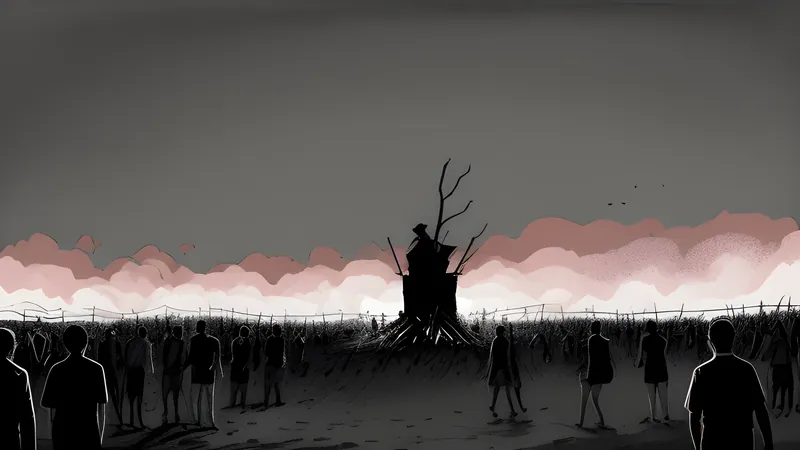
I write this from Copenhagen, which sits close enough to Sweden that I can see it from a decent rooftop and far enough that Midsommar is somebody else’s holiday. The Sound between us is a twenty-minute ride, and yet the two countries mark the solstice with completely different tempers. We Danes light a bonfire, burn a symbolic witch on top of it, sing a song about loving our country, and go home. The Swedes raise a green phallus in a meadow and dance around it until the light gives out, except the light doesn’t really give out, and that is the whole point. Having watched both up close, I’ve come round to thinking the Swedes have the better idea.
When it happens, and why it moves
Midsommar is pinned to the Friday that falls between the 19th and 25th of June, with the main event — Midsommarafton, Midsummer’s Eve — on that Friday and a lie-in on the Saturday. It used to sit on fixed calendar dates, the 23rd and 24th, tied to the old feast of St John the Baptist, the same John who gives my own country’s Sankt Hans Aften its name. In 1953 the Swedes did something very Swedish and rationalised it: they moved the holiday to a floating Friday so it would always land on a long weekend. Practical, bloodless, and it worked. Midsommar is now effectively a national instruction to leave the city.
The astronomy underneath it is the real engine. This far north the solstice sun barely bothers to set. In Stockholm the June night never gets properly dark — a long violet dusk slides straight into dawn. Push up into Lapland and the sun does not set at all; it grazes the horizon and climbs again. A Swede spends most of the year in a deficit of light, hunched under a low grey lid from November onward, and Midsommar is the moment the account swings hugely, absurdly into credit. You cannot understand the intensity of the celebration without understanding the darkness it answers. I’ve made this argument before about why Scandinavian winters bred the loudest music on the continent — the same swing between deprivation and excess drives both the noise and the flower crowns.
The pole, and what to call it
The centrepiece is the pole, and the pole has a naming problem that tells you something. In Swedish it is the midsommarstång — the midsummer pole — but plenty of people call it the majstång, the maypole, which is confusing because Sweden raises it in June, not May. The best explanation is that maja is an old verb meaning to dress or deck with green leaves, so a majstång is a “leaf-dressed pole” rather than a “May pole.” The custom itself almost certainly wandered north from Germany in the late medieval period and got welded onto the solstice once it arrived. Sweden borrowed the object and moved it to the brightest week of its own year.
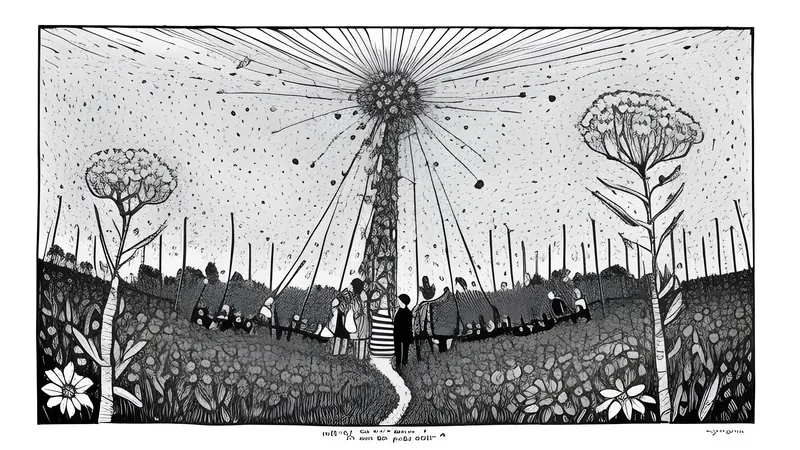
The standard Swedish pole is a specific and slightly ridiculous shape: a tall central mast with a horizontal crossbar near the top, and from each end of that crossbar hangs a large ring, so the whole thing reads as a cross wearing two green wreaths, or — there is no polite way around this — a giant leafy figure with two hoops. Everyone notices. Nobody official will confirm the obvious fertility reading, and everyone under the age of ninety knows exactly what it looks like. It is wrapped tightly in birch branches and threaded with whatever the meadow is offering that week — lupins, ox-eye daisies, buttercups, cornflowers.
Raising it is a communal job and genuinely good theatre. The pole is assembled flat on the grass, dressed by a committee of grandmothers and restless children, and then a scrum of the strongest people present walks it up hand over hand with long forked poles, easing it vertical while everyone else shouts encouragement. It is the one moment of real physical drama in an otherwise gentle day, and when the thing finally stands the crowd always cheers as if a barn had just been raised, which in effect it has.
The frog dance, sung by grown adults
Then comes the part that undoes every stereotype about Swedish reserve. Around the raised pole, the ring dances begin, and the most famous of them is Små grodorna — “The Little Frogs.” The tune is borrowed, cheerfully, from a French military march (the melody that English speakers know as the marching song about a war leader “and his men”); the Swedes stripped out the martial words and replaced them with a description of frogs, noting with mock solemnity that frogs have no ears and no tails. On the relevant lines everyone crouches, sticks their hands out at their hips to make no ears, waggles behind to signify no tail, and hops around the flower-decked pole going kva-kva-kva.
I want to be clear about who is doing this. Not children — or not only children. Bank managers. Surgeons. Serious, tall, dignified Nordic adults in linen and flower crowns, hopping like amphibians in front of their in-laws, entirely sober enough to know precisely how they look and doing it anyway. It is one of the most quietly radical things I’ve seen a nation agree to. The Swedes I know describe the frog dance with a specific wince-and-grin, the face of someone who both dreads it and would be devastated if it were cancelled. That contradiction is the holiday in miniature.
The flower crown belongs to the same logic. On Midsommar morning people go out and pick wildflowers and weave them into circlets for their hair, and there’s a piece of folklore that earns its keep here: a young person who gathers seven different kinds of flower and sleeps with them under the pillow will supposedly dream of the one they’ll marry. It’s a solstice divination custom of a kind you find all across old Europe, and in Sweden it survives as a charming party-piece that nobody quite believes and everybody still repeats. The crowns are worn by everybody regardless — men, women, dogs on occasion — and by the end of the long evening they are wilted and lopsided and somehow better for it.
Herring, potatoes, and the discipline of the schnapps song
The food is fixed and non-negotiable, which I admire. The table centres on sill — pickled herring, served in several marinades, mustard and onion and dill and a sweeter one — eaten with boiled new potatoes, the first small waxy potatoes of the season, dressed with butter and dill and a scatter of chopped chives. There’s usually gravlax, cured salmon; often a västerbottensost quiche; sour cream; crispbread; and for pudding the first Swedish strawberries of summer, eaten plain because they don’t need anything. It is a menu built entirely around what the Swedish year can actually provide in the third week of June, which is why it feels less like a meal and more like a report on the state of the country.
And with the herring comes the schnapps, and with the schnapps come the snapsvisor — the drinking songs. This is the detail outsiders miss. You do not simply drink the ice-cold aquavit; you earn each measure with a song. Someone at the table starts a snaps song — short, rhyming, frequently filthy, sung standing — and only at the end of the verse does the table lift the little glass and knock it back. The most famous, Helan går, is essentially a rousing communal instruction to drink the whole thing, with a gently mocking coda for anyone who couldn’t manage the first glass. The songs pace the drinking and turn it into a group ritual with rules, which is a very Swedish way to have a wild time: even the abandon is organised. A long Midsommar lunch runs on this rhythm — herring, song, glass, talk, repeat — for hours, out of doors, in light that refuses to fade.
Why the Danes do it differently, and what the Swedes have got right
Across the Sound, my own Midsummer is a darker, more Romantic affair. Sankt Hans Aften on the 23rd of June is about the bonfire on the beach, an effigy of a witch on top, and a nineteenth-century song wishing the witch a fast broom-ride to a mountain in Germany — a folklore hangover from the witch-hunt centuries, wrapped up now as a sentimental national singalong at the water’s edge. It’s beautiful and a little melancholy, and it’s over by eleven. The Finns lean the same direction as us, toward fire and lakeside stillness; their Juhannus bonfires and the solstice-week festivals like Nummirock, Finland’s Midsummer metal gathering, keep the flame at the centre. Fire is the northern default. You answer the returning light by making more of it.
Sweden went another way and I think it’s the shrewder one. Where the Danes burn something and the Finns light a lake on fire, the Swedes raise a green growing thing and dance around it — an unmistakably vegetal, fertile, forward-looking gesture rather than a purifying blaze. It’s a solstice about abundance rather than about warding off the dark. That’s the difference between a bonfire and a maypole, and once you notice it you can’t stop seeing it. My country stares at the flame; theirs stares at the flowers.
What both nations understand, and what every good solstice custom in Europe understands, is that the longest day has to be marked physically or it slips by unfelt. You have to put your hands on a pole, or a torch, or a bag of new potatoes, and do the thing your grandparents did in the same meadow. Midsommar has the additional genius of being genuinely daft — the frogs, the wobbling crown, the songs that make you sing before you’re allowed to drink — and daftness, as I keep learning at the strange gatherings of this continent, is how a serious people gives itself permission to be happy in public.
So on that Friday, when Sweden empties and the trains north run full of people in white with flowers in their hair, I raise a glass from the Copenhagen side of the water. They’ve got the light, they’ve got the herring, and they’ve got the good sense to spend the brightest day of the year hopping around a meadow like a nation of frogs. Skål to that. The pole goes up, the light stays on, and for once nobody is in a hurry to go home — because home, that weekend, is the field itself.
Related Content