Sweden Rock 2018: My One Year in the Sölvesborg Forest
Iron Maiden, Ozzy, Judas Priest and a Helloween reunion in a Blekinge pine forest — the heritage-metal pilgrimage across the bridge
Contents
Sweden Rock is the closest big foreign festival to Copenhagen, and in 2018 I finally spent my one summer trip finding out why the old guard treat it as holy ground. Over the Øresund Bridge, down through Skåne, into the pine forest of Blekinge, and out at Sölvesborg — a small town on Sweden’s south coast that swells past its own population every June when 30-odd thousand people in denim and battle vests arrive to worship at the church of classic metal. The festival ran 6 to 9 June. The bill up top read like a heritage-metal wishlist: Iron Maiden, Ozzy Osbourne, Judas Priest, and a Helloween reunion that had no business being as good as it was. I came home a convert to a festival I had spent years being slightly snobbish about, and this is the record of why.
The festival that time forgot on purpose
Sweden Rock has run near Sölvesborg since 1992, and its whole identity is a refusal to modernise its taste. Where Copenhell chases the current heavy canon and Roskilde chases the culture at large, Sweden Rock plants its flag in the classic and heritage end — traditional heavy metal, hard rock, the NWOBHM survivors, the hair-metal veterans, the prog and the doom and the blues-rock granddads — and books it with a completeness that no other European festival bothers with. It is a museum that is also a mosh pit, and I mean that as the compliment it is.
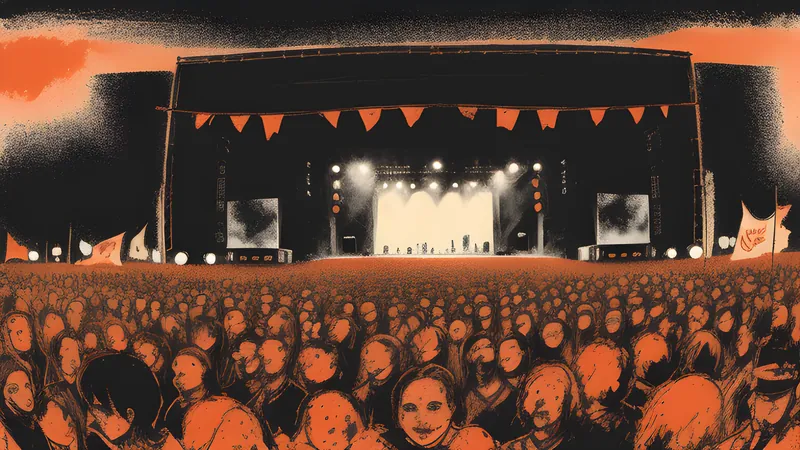
The site is a forest. That is the first thing that reorganises how you think about the place. Copenhell is an industrial harbour, all rust and concrete; Roskilde is an open field; Sweden Rock is set among actual pine trees in Norje, just outside Sölvesborg, and the shade and the soft forest floor change the entire physics of a festival day. You can duck out of the sun between bands. The paths wind through woodland. There is a strange, becalmed, almost pastoral quality to a heavy festival held under a canopy of Nordic pine, and by the second day I understood why the regulars — many of them older than the bands they came to see — keep coming back to this specific patch of Blekinge rather than any of the bigger, flashier events.
The crowd is the other revelation. This is the oldest-skewing big metal crowd I have stood in. Denmark’s festivals run young; Sweden Rock runs grey, in the best way — lifers in their fifties and sixties who saw these bands the first time round, who know every word, who have been making this pilgrimage for a quarter of a century and who treat the whole thing with a settled, unhurried devotion. It is a gentler, more patient audience than a Copenhell pit, and it is one of the most knowledgeable crowds you will ever share a field with. These people did not come to discover anything. They came to pay respects.
Iron Maiden, and the launch of the Beast
Iron Maiden headlined on the Legacy of the Beast tour, which had only just begun that summer, and Sweden Rock was one of the early European stops. The Legacy production was Maiden operating at full theatrical throttle — the stage dressed like a run through the band’s own mythology, Bruce Dickinson tearing around a set that had been built for arenas and squeezed onto a festival stage. Maiden are the correct headliner for a place like this precisely because they have never condescended to a festival crowd in their lives; they play the forest the way they play Wembley, and a Sölvesborg audience that has followed them since The Number of the Beast gives it all back with interest.
Watching Maiden in that forest, surrounded by people twice my age who had clearly done this dance a hundred times, was the moment I stopped being a tourist at Sweden Rock and started to get it. There is a particular pleasure in seeing a canonical band in front of the crowd that canonised them. The energy is not the young, chaotic surge of a modern-metal pit. It is something closer to communion.
Ozzy, Priest, and the heritage tier
Ozzy Osbourne played what was billed as part of his long farewell run, and there is no honest way to watch a set like that without a complicated feeling in your chest. Here was the man who effectively invented this entire genre, decades past his prime, doing the songs — the Sabbath monuments and the solo staples — for a forest full of people who owe their entire record collection to him. I will not pretend it was a vocal masterclass, because it was not, and fair comment on a performance is the whole job of writing this desk. But the fact of Ozzy on that stage, the living root of everything around him, was its own kind of overwhelming, and the crowd carried the parts he could no longer reach. Some shows you go to for the performance. Some you go to for the witness.
Judas Priest were, honestly, the tightest of the three big headliners. They were touring Firepower, a late-career record far better than a band forty-plus years deep has any right to make, and Rob Halford — motorcycle, leather, that voice still finding the high notes — led a set that reminded everyone why Priest are the platonic ideal of heavy metal as a genre. If Maiden were the theatre and Ozzy was the relic, Priest were the machine, running clean and hot. In a festival built entirely around heritage, they were the act that made “heritage” sound like a live threat rather than a nostalgia exercise.
The Helloween reunion that stole it
The set I did not expect to love was Helloween. They came through on the Pumpkins United reunion — the configuration that brought back Michael Kiske and Kai Hansen alongside the Andi Deris-era band, three eras of the group’s vocalists and founders sharing a stage for the first time in decades. On paper it is exactly the kind of thing I am usually sniffy about. I have written at length about the séance economics of the reunion tour, the way a legacy act’s catalogue keeps touring after the thing that made it has moved on, and how often it curdles into a cash grab.
Pumpkins United was the version that earns its existence. Getting Kiske and Deris trading verses, Hansen back in the fold, the whole power-metal circus firing on its full historical roster — it was joyful in a way reunions rarely are, because the reconciliation was clearly real and the players were audibly delighted to be doing it. A forest full of German and Scandinavian power-metal lifers lost their minds, and I lost mine a bit with them. It was the set that converted my snobbery about Sweden Rock into genuine affection. Some reunions are a wake. This one was a wedding.
The rest of the forest
The depth of a Sweden Rock bill is the part the headlines never capture. Below the giants, 2018 ran deep into the genre’s whole family tree: Meshuggah bringing the modern Swedish extreme end, Kreator flying the thrash flag, Stone Sour, Tarja Turunen doing the symphonic thing, Nazareth and Slade and Rose Tattoo representing the actual grandfathers of hard rock, Dark Tranquillity and the melodic-death contingent, Body Count, Baroness, Backyard Babies, Pretty Maids from just across the water in Denmark. You could spend a whole day at Sweden Rock without going near a headliner and still see more canonical heavy music than most festivals put on their entire poster.
That completeness is the festival’s real argument. It is not chasing the biggest current ticket-movers. It is trying to represent the entire history of a genre in one forest over four days, and it does it with a curatorial seriousness that borders on scholarship. The smaller stages ran the obscure and the reunited and the never-quite-famous with the same care as the main stage ran Maiden. For a certain kind of metal obsessive this is the most complete festival in Europe, and after 2018 I understood the pilgrimage.
The verdict, and the counterweights
Sweden Rock 2018 was the year I learned that the festival I had quietly written off as an old-timers’ nostalgia camp was one of the most seriously curated heavy-music events on the continent. The forest setting, the greying and gloriously knowledgeable crowd, the sheer completeness of the booking — it added up to something no Danish festival offers, and the two-hour drive across the bridge is nothing for what is on the other end.
If you want to understand where Sweden Rock sits in the ecosystem, put it next to its neighbours. Copenhell in the Copenhagen harbour is the modern, industrial, corporate-owned counterweight — younger, louder, chasing the current canon rather than curating the old one. And Wacken in Germany is the enormous village-hosted version of the same heritage impulse, five times the size and a good deal more chaotic. Sweden Rock is the forest one: smaller than Wacken, older than Copenhell, and more devoted to the deep history of the genre than either. It was my one foreign trip of 2018, and it was worth every kilometre. If you love the classic end of this music, put Sölvesborg on the list. The old gods live in that forest, and the people who worship them are the best-informed congregation you will ever stand among.
Related Content