Swamp Football World Championships
Ninety minutes of football, knee-deep in a Finnish peat bog
Contents
Take a game of football, remove the pitch, and replace it with a peat bog that swallows your leg to the knee on every stride. That is swamp football — suopotkupallo — and every summer a few hundred teams travel to a remote corner of northern Finland to play it on purpose, at speed, until they can barely stand. It is exhausting to watch. It looks like the most fun you can have with your boots full of mud.
This is my kind of spectacle, which is to say it is loud, physical, faintly ridiculous and completely sincere, and it sits right alongside the other great Finnish contributions to the world of magnificently pointless competition. I have never laced up for the bog myself — I write about crowds, I do not throw myself into them at knee height in Kainuu — but the Swamp Football World Championships is one of the events I would clear a weekend for, and the story of how a training drill for skiers became a world championship is worth telling straight.
Born in a bog, on purpose
The birthplace is Hyrynsalmi, a small municipality in the Kainuu region of northern Finland, and the origin is genuinely practical. The commonly told father of the sport is Esa Romppainen, a cross-country skier connected to the Vuokatti training scene, who used the resistance of a swamp as a brutal summer strength workout. Running through a bog is punishing in a way ordinary training rarely is — every step is a fight against suction, the ground gives and grabs, and your legs are burning within minutes.
Someone had the good sense to turn the torture into a game. The first tournament was pulled together by volunteers in the summer of 1998, with 13 teams in that inaugural Finnish competition. The appeal spread fast. The following year the field had roughly quadrupled, and by the last event of the millennium the thing had ballooned into a European-scale gathering with dozens of teams. Guinness recognises it as the longest-running annual swamp soccer tournament, held at Hyrynsalmi since 2000. It has since grown to draw around 200 teams and thousands of spectators, and the sport has crossed borders into places like the United Kingdom, Iceland and Turkey.
The rules, and why the bog changes everything
Swamp football keeps the skeleton of the real game and then lets the terrain wreck it. Teams are small — typically six a side, including a keeper — the pitch is short, matches are brief, and there are no throw-ins, because trying to run and throw in a bog is a fantasy. The clock is mercifully quick, because nobody could last a full ninety minutes in that ground.
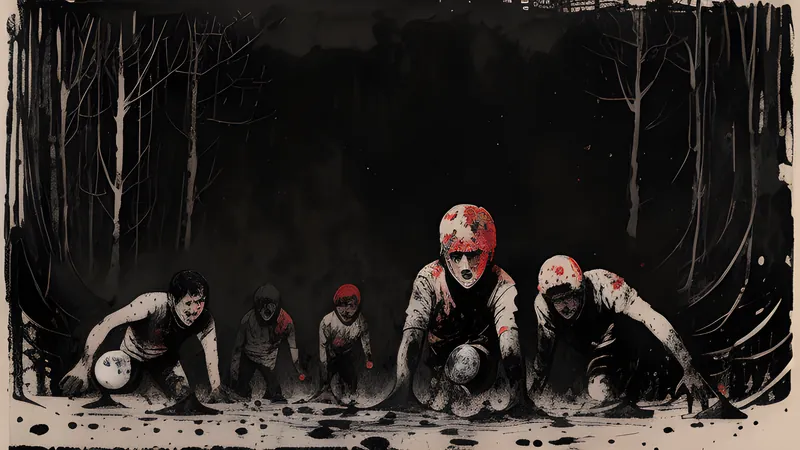
Everything you know about football breaks down in the mud. The ball does not roll; it stops dead where it lands, half-buried, so there is no passing game to speak of and no elegant build-up. Sprinting is impossible. Changing direction is a negotiation with the swamp. Players lose boots in the muck constantly — the peat clamps down and pulls them clean off — and much of the comedy is watching a striker hop one-legged toward goal while the bog keeps his other boot as a trophy. Falling over is not a risk in swamp football; it is the baseline condition. Everyone is filthy within seconds, and staying upright is its own small victory.
What emerges is a game of raw effort and slapstick, where fitness matters far more than skill, where a moment of composure in front of goal counts for everything because there will not be another one, and where the final whistle comes as pure relief. It is football stripped back to running, kicking and refusing to drown, and it is riotous to watch precisely because the environment humbles everyone equally.
The physical toll is real, and part of the spectacle is watching fit, competitive players discover just how quickly the bog empties the tank. A few minutes of hauling your legs out of clinging peat leaves even trained athletes gasping, which is exactly why short match times and small squads are baked into the rules. Rolling substitutions keep fresh legs coming, because no set of legs stays fresh for long down there. Cross-country skiers, footballers and rugby players have all turned up over the years assuming their fitness would carry them, and the swamp has taught every one of them the same humbling lesson: the ground you are standing in is the strongest opponent on the pitch.
There is a whole festival wrapped around the football, too. Hyrynsalmi in swamp-cup weekend is closer to a music festival than a sporting fixture — camping, food stalls, live acts, costumed teams, and a crowd that comes as much for the atmosphere as the scores. The competitive divisions run alongside pure novelty teams there for the laugh, and the mix of the two is exactly the tone the event thrives on. Nobody is pretending this is elite sport, and that honesty is what makes it charming.
Finland’s genius for the glorious dead end
Swamp football belongs to a very specific and very Finnish tradition, and once you have spent time with these events you stop being surprised and start being impressed. This is the nation that gave the world the Wife Carrying World Championships in Sonkajärvi, the Air Guitar World Championships in Oulu, and the Mobile Phone Throwing World Championships. There is a national instinct for finding an absurd premise, treating it with total sporting seriousness, and building a genuine world championship around it — trophies, records, international entrants and all.
I have a working theory about why the north produces so many of these. The Finnish summer is short and intense, the winters are long and dark, and when the warm months finally arrive there is a released, gleeful energy that has to go somewhere. Combine that with a dry, deadpan sense of humour and a landscape absolutely full of bogs, and swamp football starts to look almost inevitable. You have the raw material — thousands of hectares of peat — and you have a culture perfectly happy to look ridiculous in the service of a good time. The rest writes itself.
There is a kinship here with the wet, muddy oddities of the wider spectacle world, too. The Bog Snorkelling World Championships in Wales runs on the same fuel: take a hostile, sodden, faintly disgusting patch of ground and turn it into an arena, then invite the world to flounder through it for glory. The bog is the co-star. The comedy comes free with the terrain.
The spectacle, filth and all
What makes swamp football genuinely worth watching — and it does pull big, cheerful crowds to a remote resort like Ukkohalla every summer — is the same thing that makes any great physical spectacle work: total commitment against impossible conditions. There is real athletic effort in there, players genuinely trying to win, and the bog reduces everyone to the same mud-caked, staggering, laughing state regardless of how good they are on a dry pitch. Watching a serious team discover that their passing game means nothing in a swamp is one of the great levelling comedies in sport.
It is also, by design, impeccably good-natured. The teams turn up in costume as often as in kit, the atmosphere runs closer to a festival than a cup final, and the whole affair is soaked in the cheerful self-awareness of people who have travelled a long way to a Finnish bog to fall over repeatedly in front of strangers. The mud is the great equaliser and the great joke, and everyone is in on it, players and spectators alike, from the first churned-up kick-off to the last exhausted, mud-soaked whistle of the weekend.
Would I make the trip? Gladly
Hyrynsalmi is a long way from a Copenhagen sofa, and I have never stood at the edge of that particular bog watching two hundred teams churn a field into brown soup. I would go, though, without much persuasion, because swamp football is exactly the kind of event I find myself drawn to between the loud rooms — a spectacle with no pretension, no gloss, and nothing on offer but effort, mud and delight.
If you want the essence of the Finnish summer spectacle in one image, it is this: a bog somewhere north of nowhere, a few hundred teams in ruined boots, a ball sitting stubbornly half-sunk in the peat, and everybody in the field laughing too hard to run. It should not be a world championship. It has been one for a quarter of a century, drawing teams from across Europe to a Finnish resort every summer. And that gap — between how silly it looks and how seriously it is taken — is the whole reason it is one of the best things Finland does, and the reason I keep a soft spot for these events between the loud rooms I actually cover.
Related Content