Stonehaven Fireballs: Scotland Swings Fire on Hogmanay
Every 31 December, a harbour town in the Scottish north-east walks its High Street trailing balls of flame
Contents
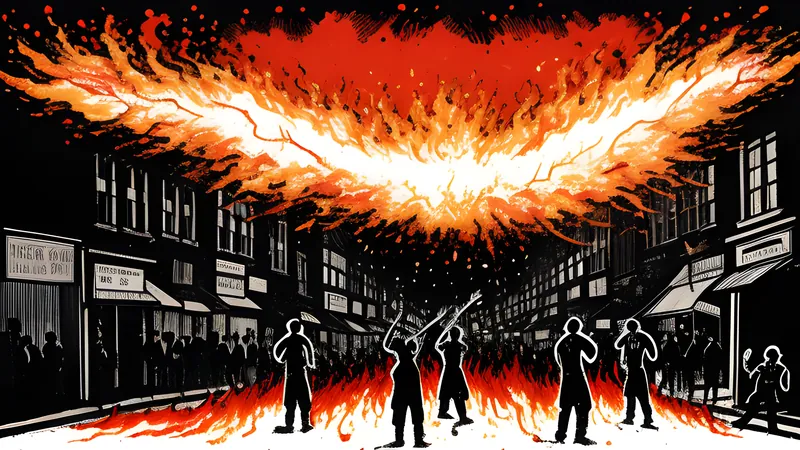
At the last stroke of midnight on Hogmanay, roughly forty people walk up the High Street of Stonehaven with balls of fire spinning at the end of five feet of chain, and the whole town comes out to watch them do it. This is Aberdeenshire, the harbour town about fifteen miles south of Aberdeen, and this is how the north-east of Scotland decides to greet a new year — by carrying open flame through a crowd of thousands, in the dark, in the cold, with the North Sea slapping the harbour wall a hundred yards away.
I have not stood in that crowd. Stonehaven is a long way from my usual patch, and I would rather tell you what the record actually holds than pretend I was leaning on a bollard on the High Street with a cup of something warm. What the record holds is strange and specific and worth the telling.
Wire, wick and a very long swing
The object itself is homemade and personal. A fireball is a cage of chicken wire, roughly the size of a football, stuffed with whatever the swinger has decided burns well and burns long — old rags, paper, pine cones, twigs, bits of coal, chunks of firelighter, cloth soaked in paraffin. It hangs from a length of wire or chain about a metre and a half long, with a handle at the top so the swinger can whirl it in a vertical circle at arm’s length. Each swinger builds their own in the weeks before, and the recipes are guarded the way a baker guards a starter. Too light and it burns out before the walk ends. Too heavy and your shoulder gives out halfway up the street.
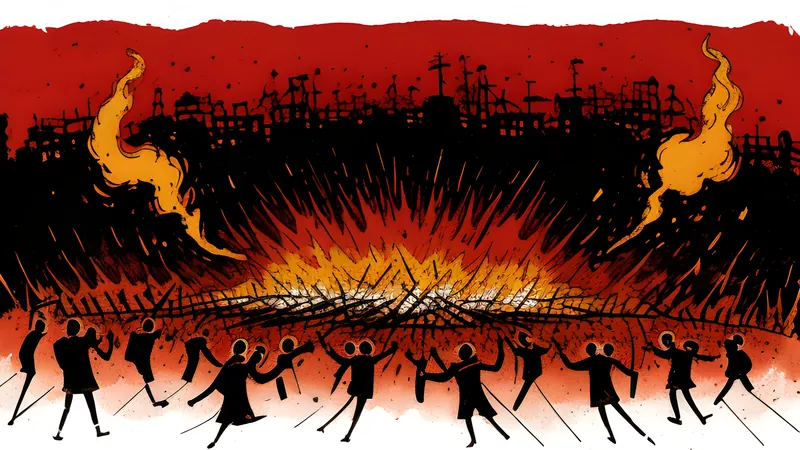
The choreography is simple and terrifying to a first-time watcher. On the midnight bells, the swingers gather at the top of the old town near the Mercat Cross, light their cages, and process down the High Street to the harbour and back, swinging the whole way. A pipe band leads. Stewards in fire-retardant gear walk alongside. When a fireball finally burns through its wire or a swinger reaches the end of their strength, the cage gets flung into the harbour, where the sea puts it out with a hiss you can hear over the crowd. That final arc of fire into black water is the image everyone takes home.
On record since 1908, older in the bones
Here is where I have to be careful, because the tidy origin story is usually wrong. You will read that the fireballs are Iron Age, that they descend from pagan sun-worship, that the fire purifies the air and drives out the evil spirits of the old year before the new one can start. That is the folklore, and it is a lovely idea. The documented history is shorter and more honest: the first clear press mention of the Stonehaven fireballs is from 1908, and the report treats the event as already familiar, printed as though the reader knew exactly what was meant. That tells you the tradition was established well before the newspaper bothered to explain it, though nobody can give you a firm founding year with a straight face.
The ceremony has run every Hogmanay it possibly could since then, pausing only for the two world wars — the record gives gaps around 1917–18 and 1940–45, when blackout and rationing made a street full of open flame impossible. The rest of the twentieth century it simply happened, year after year, a local thing that locals did because their parents did it. In the modern era it has become a properly organised charity event, run by a committee, insured, stewarded, with the swingers vetted and the route managed. The romance survives the paperwork, which is the trick every good folk ritual has to pull off eventually.
Whether the fire ever meant to purify anything is unknowable now. What is true is that fire at midwinter, at the turn of the year, in the dark bottom of a northern December, answers something old in people. You do not need to believe in spirits to feel it. You just need to stand in a freezing harbour town at midnight and watch forty people carry light up a street, and the reason writes itself.
The swingers themselves are the tradition’s real archive. Membership passes down families and along friendships; a swinger who has done thirty years hands the knowledge to a nephew or a neighbour’s kid, and with it the craft of packing a cage so it burns bright but does not shed sparks, of pacing the walk so your arm lasts the full length of the High Street, of the exact wrist action that keeps the ball in a clean vertical circle. There is a waiting list to swing, and a genuine honour in being asked. The committee keeps the numbers to roughly forty, because more than that and the street cannot hold both the fire and the crowd. That deliberate smallness is why it still feels like a town doing something for itself, rather than a show staged for tourists who happen to be watching.
Fire festivals are Scotland’s real national sport
Stonehaven is the loudest of a family. Scotland does fire in winter the way other places do fireworks, and the fireballs sit alongside a whole calendar of flame. Up in the Northern Isles, Shetland burns a full-scale Viking galley in the biggest fire festival in the country — I have written about Up Helly Aa at length, and the two events rhyme even though one is a subtle midnight procession and the other is a thousand guizers torching a longship. Both are communities using fire to mark the dead middle of the year, and both are fiercely, almost defensively local: run by the town, for the town, with outsiders welcome to watch but never quite to belong.
Down in the capital, the modern reinvention of the same instinct is the Beltane Fire Festival on Edinburgh’s Calton Hill, a revived May-Day rite of drummers, body paint and torch-lit processions that borrows the aesthetics of the old fire calendar and stages them for a paying crowd. Put the three together and you can see a spectrum. Beltane is theatre with pagan set-dressing. Up Helly Aa is a town’s private mythology performed at scale. Stonehaven sits in between: a genuine unbroken local custom, small and homemade, that happens to look spectacular enough to pull the cameras.
The Scottish weather is the co-star nobody credits. These festivals live in a climate of early dark, hard cold and wind coming off the water, and that is exactly what makes a moving flame so powerful. A fireball swung in July daylight would be a curiosity. Swung at midnight in a Stonehaven December, with the swinger’s breath fogging and the crowd stamping to keep warm, it is elemental.
What the crowd is actually there for
The thing about Hogmanay in Scotland — properly the whole New Year period, taken more seriously here than Christmas ever was — is that it is a communal event before it is a personal one. The English tend to see in the new year in a pub or a living room. The Scots have historically taken to the street: first-footing from house to house, the bells rung in the town centre, strangers shaking hands. Stonehaven’s fireballs are that instinct concentrated into fifteen minutes of moving fire. Everyone in town is out. The pubs empty onto the High Street. Kids sit on shoulders. The swingers are people you know — the joiner, the fisherman’s daughter, the retired teacher who has done it for thirty years and is not about to stop.
There is real risk in it, handled with real care. Open flame at head height in a packed street is not something you improvise, and the modern committee is meticulous: the route is barriered, the swingers rehearse, the stewards carry extinguishers, and the crowd is kept back far enough that a stray spark lands on tarmac rather than a coat. Accidents are rare and minor by design. The point is never danger for its own sake; the point is a town holding its nerve together while the fire goes past, then cheering when the last cage sails into the harbour.
If you ever find yourself in the Scottish north-east at the tail of December, go. Book early, because the town’s beds fill and the trains from Aberdeen run packed. Stand somewhere along the High Street by half eleven. Wear more than you think you need. And when the bells go and the first cage catches and the pipe band strikes up, you will understand why a small harbour town has refused, for well over a century, to let the year turn quietly.
For more of the same northern instinct — communities using firelight to mark the calendar — the Shetland galley-burning of Up Helly Aa is the natural next stop, and Edinburgh’s Beltane revival shows how the old fire rites get rebuilt for a new audience.
Related Content