Stage Diving and Who Actually Catches You
The leap, the barrier crew, and fifty years of an audience agreeing to hold each other up
Contents
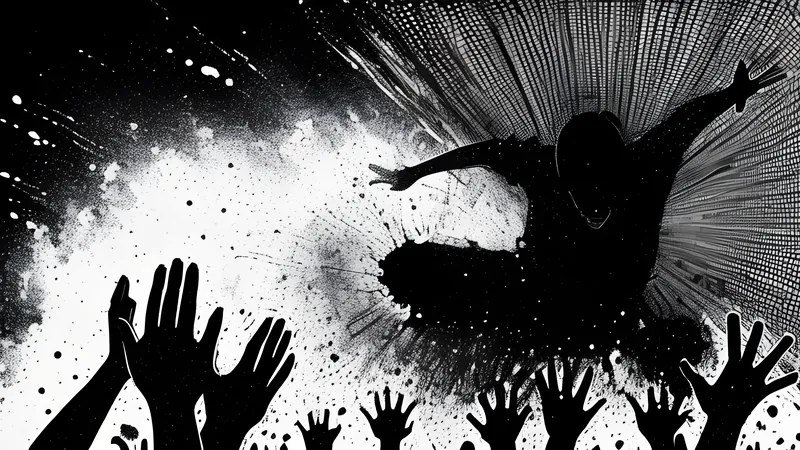
A stage dive lasts about a second and a half from launch to landing, and in that second and a half, an enormous amount of trust changes hands between total strangers. Someone climbs onto a monitor wedge, hesitates for exactly as long as the song lets them, and throws themselves backwards into a crowd that has maybe two seconds’ warning. What happens next is either a smooth, almost tender catch-and-pass over a forest of raised arms, or a bad landing that ends the night for everyone nearby. The difference between those two outcomes is never luck. It’s a chain of specific, learnable decisions made by specific people, most of whom the diver will never thank and never meet.
I’ve watched this exact drama play out at barriers from Copenhagen to Nuremberg, and the thing that never stops fascinating me is how invisible the machinery is until you go looking for it. From the crowd it looks like chaos with good intentions. From the barrier, it’s closer to a small, well-drilled emergency service that resets itself every few minutes all night.
Iggy started it, on camera, in 1970
Stage diving has an origin story that’s genuinely documented rather than folklore, which is unusual for a practice this old. Iggy Pop, fronting the Stooges, is widely credited with the first filmed stage dive, walking out over the raised hands of the crowd at the Cincinnati Pop Festival in June 1970 — footage that still circulates as the founding document of the whole practice. The context matters: this was a man already famous for smearing peanut butter on his bare chest and rolling in broken glass, an artist actively trying to dissolve the distance between the stage and the crowd rather than perform above it. Stage diving, in its original form, wasn’t a stunt for the diver’s own thrill so much as a physical argument that the barrier between performer and audience was artificial and should be crossed.
Punk picked the practice up through the 1970s as a natural extension of its whole ethos — no separation, no hierarchy, the singer as just another body in the room — and hardcore in the 1980s turned it into something closer to a house style, with singers routinely finishing a verse from inside the crowd rather than on stage at all. By the time metal and hardcore festivals were running their own dedicated barriers decades later, stage diving had gone from a radical gesture to an expected feature of the show, which is exactly the moment it stopped being something bands did occasionally and became something festivals had to plan around. Crowd-surfing, the diver’s quieter cousin, has its own separate lineage running through Californian punk clubs of the same era, where fans would pass a friend hand over hand across the room for the length of a song simply because the floor was too packed to walk. The two practices merged in the public imagination decades ago, but they solve slightly different problems: one launches a body from the stage, the other lifts one up from inside the crowd, and a well-run barrier crew has to watch for both at once.
The barrier is a piece of equipment built for this
Here’s the part almost nobody in the crowd ever thinks about: the metal barrier at the front of a big stage is a purpose-built catching platform as much as it is crowd control. Modern touring barriers — the kind supplied by companies like Mojo Barriers, the industry standard at major festivals across Europe — are designed with a stepped structure specifically so security staff can stand on a raised platform behind the front rail, at a height where they can see over the crowd and reach a diver as they come over the top. That platform exists because promoters learned, the hard way, over decades, that an unmanned barrier at a heavy show is where injuries happen. The people standing on it aren’t generic bouncers pulled off a nightclub roster. At festivals with a serious stage-diving culture, barrier crews are specifically trained for it — spotting a diver climbing the stage-side ladder before they jump, tracking their trajectory, catching the fall, and getting them over the rail and off toward a first-aid point within seconds, all while the show carries on a few feet away.
The crowd does its own half of the job, and this is the half that still gets me every time. Long before a diver actually leaves the stage, a patch of the crowd nearest the barrier has usually already clocked them climbing up, and hands go up on instinct — not because anyone shouted an instruction, but because everyone in that patch of floor has done this dance often enough to know the shape of what’s coming. The diver lands across a dozen forearms rather than one, gets passed forward hand over hand toward the barrier, and the whole thing runs on a kind of distributed, unspoken agreement that nobody in that crowd would consciously articulate but everybody obeys.
Why it still goes wrong
None of that means it’s safe, and it would be dishonest to write about stage diving without saying so plainly. The physics work against the diver in ways that are easy to underestimate: a body coming down from head height lands with real force, the crowd underneath isn’t always paying attention or positioned correctly, and a diver who mistimes the jump can come down on the barrier itself rather than into hands, which is where the serious injuries happen. Bigger festivals have, over the years, responded with genuinely engineered solutions rather than just hoping for the best — some venues run a secondary, lower barrier a few metres back from the main one specifically to create a managed pit for crowd-surfers and divers, keeping that activity away from the crush at the very front where people are packed tightest and have the least room to brace.
The other honest part of the story is generational and cultural. A stage-diving crowd needs to be primed for it — an audience that came expecting it, standing in a configuration that allows for it, at a show where the promoter and the band have implicitly signed off on the practice. Drop the same stunt into a seated arena show or a crowd that isn’t expecting it and you get a very different, much worse outcome, which is exactly why bands who built their whole reputation on this kind of audience participation will sometimes explicitly ask fans to hold off at a venue where the barrier or the crowd configuration doesn’t support it.
Insurance sits underneath all of this in a way that rarely gets talked about outside a promoter’s office. Public liability cover for a touring show or festival is priced partly on the promoter’s own risk assessment, and a barrier with a dedicated stage-diving lane, trained catchers and a visible medical point nearby is a materially different risk profile from a flat rail with two disinterested bouncers leaning on it. That’s a large part of why the bigger, better-run festivals invest in barrier design and staff training that looks, from the crowd, like an unremarkable metal fence: the fence is doing quiet, expensive, carefully considered work every single time somebody climbs up and jumps.
What the leap actually says
What I keep landing on, watching this from the barrier rather than the stage, is that a stage dive is really a test the crowd sets for itself and mostly passes. It’s the loudest possible statement of trust a room full of strangers can make to each other, repeated dozens of times a night at the right kind of show, and it works often enough that everyone forgets how strange the arrangement actually is: throw your whole weight backwards into a crowd of people you’ve never met, on the assumption that enough of them care enough about the unwritten rules of the room to catch you. Most nights, they do. That’s not really a fact about stage diving. It’s a fact about what a crowd is willing to become, for the length of one song, when everybody in it has agreed to the same unspoken deal.
I’ve written before about the mechanics of what the mosh pit is actually for, which runs on a related but distinct kind of collective trust — controlled collision rather than controlled falling. And the barrier crews who catch divers are the same people who spend the rest of the set pulling exhausted fans out over the rail during three songs, no flash, in the photo pit below them — one barrier, doing two very different jobs, all night.
The unwritten contract
What holds the whole thing together is an unwritten contract that nobody signs and everybody in a functioning crowd honours. The diver’s side of it is simple: go up where people can see you coming, keep your elbows and boots to yourself, and do not aim for the one gap in the floor. The crowd’s side is that a raised body gets caught and moved, not dropped and stepped over. When both halves hold, a stage dive is one of the safest-looking dangerous things you will ever watch. When one half fails — a diver who leaps blind onto a thin crowd, or a front row that parts instead of lifting — it stops being a trust exercise and becomes an A&E visit. Venues and bands police the edges of this: some rooms ban it outright, some singers wave divers on, and the security in the pit are mostly there to pull people over the barrier and set them down, not to stop the ritual. The etiquette is learned by watching, passed along without a word, and it is the reason a room full of strangers can throw each other around all night and everyone walks out intact.
Related Content