Slinningsbålet: Norway's Record-Breaking Bonfire Tower
In Ålesund, teenagers spend a whole summer stacking pallets by hand into a tower taller than a fifteen-storey building, then burn it for midsummer
Contents
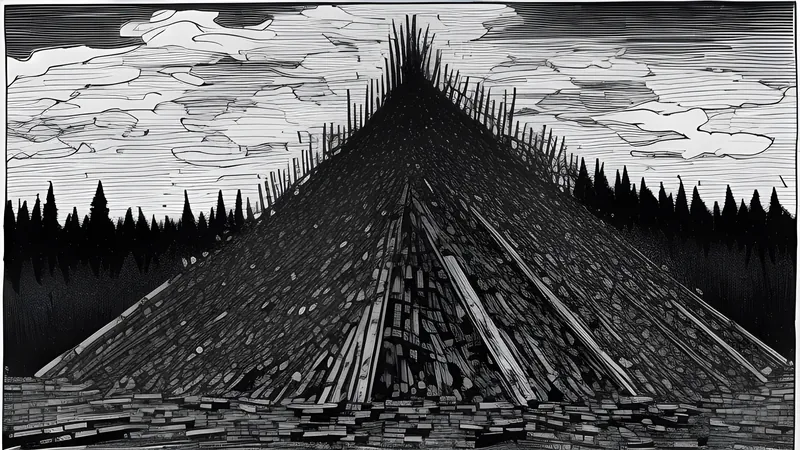
Every summer in the coastal town of Ålesund, on the west coast of Norway, a group of local teenagers spends about seven weeks hand-stacking wooden pallets into a tower dozens of metres tall, without cranes or machines, and then, on the Saturday nearest midsummer, they set it on fire and burn the whole thing down in front of the town. In 2016 the tower reached 47.4 metres — roughly a fifteen-storey building — and took the Guinness World Record for the world’s tallest bonfire. This is Slinningsbålet, and it is one of the most astonishing feats of pure communal stubbornness in the Nordic calendar.
I am Danish, so midsummer fire is in my bones, but even to a Scandinavian this one is jaw-dropping. Most of us grow up with a friendly bonfire on the beach for Sankt Hans, the Nordic midsummer festival on 23 June. Ålesund grows a skyscraper of fire. The scale of it changes the whole meaning of the tradition, and the way it gets built is the best part of the story.
Seven weeks, by hand, by teenagers
The build starts on 1 May every year. A group of young people, roughly aged thirteen to twenty-two, from the Hessa peninsula and the Slinningen area of Ålesund, begin gathering single-use wooden pallets — the disposable kind that local companies would otherwise scrap, donated instead for the tower. Then, every evening after school, in whatever the west-Norwegian coast throws at them, which is usually rain and wind, they stack. No cranes. No lifting machinery. The entire structure goes up by hand and by nerve, the builders climbing the growing tower and hauling pallets ever higher, tier upon tier, tightening and squaring it as it rises so the thing does not lean or fall.
That constraint — hand-built, by kids, without machines — is the soul of it. Anyone can pay a contractor with a crane to stack pallets into the sky. What makes Slinningsbålet extraordinary is that a rotating cohort of teenagers does it themselves, every year, as an inherited responsibility passed down the peninsula from older kids to younger ones. They learn the engineering by doing it: how to build a base wide enough to carry the load, how to keep the centre of gravity honest, how high they dare go before the summer runs out and midsummer arrives. The tower is finished on the Saturday closest to 23 June, lit, and reduced to embers over a few roaring hours while thousands watch from boats in the fjord and from every vantage on shore.
The record, and the sense to walk back from it
The 2016 record was the peak of an arms race the town had been running with itself for years, each summer’s crew trying to out-build the last. Reaching 47.4 metres was a genuine engineering achievement and a genuinely dangerous one — a tower that tall, built by hand out of stacked pallets, is a structure at the edge of what is safe to climb and safe to stand near when it burns.
The mature thing Ålesund did afterward was to ease off the height record and keep the tradition. Chasing an ever-taller tower every single year is a recipe for a collapse or a burn injury, and the community understood that the ritual matters more than the number. Modern Slinningsbålet towers are still enormous, still hand-built, still spectacular — they simply no longer treat the world record as an annual target to beat. That is a wiser town than the one that built the 2016 monster, and the tradition is healthier for it. Impeccably safe stewardship is the whole reason a fire festival gets to have a fiftieth birthday.
The record itself had a rival, which is part of what drove the height up. The village of Alkmaar in the Netherlands and other pallet-stacking towns have chased tall bonfires too, and for a while there was a genuine cross-border contest for the crown. Ålesund’s 47.4 metres in 2016 settled the argument emphatically. Stepping back from the race afterwards was Ålesund’s own decision rather than anyone else’s, and it says something good about the place: a town that had just proved it could out-build the world chose, deliberately, to stop measuring the tradition by a tape.
Why teenagers keep signing up
The question that hangs over Slinningsbålet is the obvious one: why would successive cohorts of teenagers give up a Norwegian spring and early summer — their evenings, their weekends, their dry clothes — to a job whose only reward is watching the result go up in smoke? The answer is the answer to every great communal build. The tower is a machine for making a group of young people into a team with a deadline, a skill and a story. The kids who build it inherit the role from the ones just ahead of them and hand it to the ones just behind, and in the doing they learn practical engineering, physical courage, patience and the specific pride of having made something enormous with their own hands. The burn is not a waste of the work; the burn is the ceremony that makes the work mean something. You labour all summer precisely so the town can gather and watch it end in fire, and then you start planning next year’s.
There is a safety culture wrapped tightly around all of it now, and it deserves credit. The build is supervised, the structure is engineered rather than merely piled, the exclusion zone at the burn is large and enforced, and the whole event runs with the blessing and oversight of the local authorities. A fire this big does not survive decade after decade on luck. It survives because Ålesund treats it as a serious undertaking that happens to look like joy — which, when the column finally catches and the heat rolls across the water and the whole fjord turns orange, it absolutely is.
What midsummer fire is actually for
Strip away the record and Slinningsbålet is the biggest, boldest version of something the whole Nordic world does on the same night. Sankt Hans — Saint John’s Eve, tied to the birth of John the Baptist and grafted onto a much older midsummer fire custom — is celebrated across Denmark and Norway on 23 June with bonfires on beaches and hilltops, songs, and in Denmark the slightly grim spectacle of a straw witch burned on top of the fire to send her packing to the Harz mountains. It is the light half of the year answering the dark: where the far north gathers around fire in the black of midwinter, Sankt Hans is the fire of the endless summer evening, lit when the sky barely darkens at all.
I have written about the Danish version of this night — the beach fires and the community singing of Sankt Hans Aften — and Ålesund is recognisably the same festival turned up to a scale nobody else attempts. Same date, same John-the-Baptist frame, same impulse to burn something big while the light lasts. The difference is ambition: Denmark lights a bonfire; Hessa builds a tower you can see from the next fjord.
The other cousin is the spring bookend of the fire calendar, Walpurgis Night — Valborg — lit across Sweden on 30 April to burn away the last of winter and welcome the growing season. Line the two up and you get the Nordic year in fire: Valborg opens the warm half at the end of April, Sankt Hans crowns it at midsummer, and Slinningsbålet is the loudest note either tradition has ever hit. The through-line is constant — a northern people using an enormous fire to mark the turning of the light and, just as importantly, to give a community a reason to build something together.
Going to see it
If you want to witness it, aim for Ålesund in the days around 23 June. The town itself is worth the trip regardless — a small city rebuilt almost entirely in Art Nouveau style after a fire levelled it in 1904, sitting among some of the most dramatic fjord scenery in Norway, which gives the burning tower an absurdly beautiful backdrop. Watch from a boat if you can arrange it, because the sight of the whole column catching from the fjord, reflected in the water under a sky that never fully goes dark, is the picture people carry away.
Respect the barriers and the stewards; a tower of burning pallets throws serious heat and the exclusion zone exists for a reason. And spare a thought, when it goes up in flame in a couple of roaring hours, for the teenagers who spent seven wet weeks after school building it by hand, knowing all along that the entire point was to watch it burn. That is the tradition in one image: a summer’s patient, unpaid, hand-hauled labour, given to the fire for the sake of a single midsummer night. For the gentler seaside version of the same evening, the Danish Sankt Hans bonfires are where most of us actually grew up; for the spring fire that opens the season, there is Valborg.
Related Content