Sleep Token and the Rise of the Faceless Band
How four masked Londoners turned anonymity into metal's biggest new story
Contents
Yesterday a London band released their third album and nobody involved showed their face on the cover, in the videos, or anywhere else. That is not a marketing gimmick bolted on afterwards. It is the entire premise. Sleep Token have built a career on refusing to be known, and Take Me Back to Eden, out now on Spinefarm, is the record where that refusal finally paid off in the currency the rest of the industry actually counts.
Four names that aren’t names
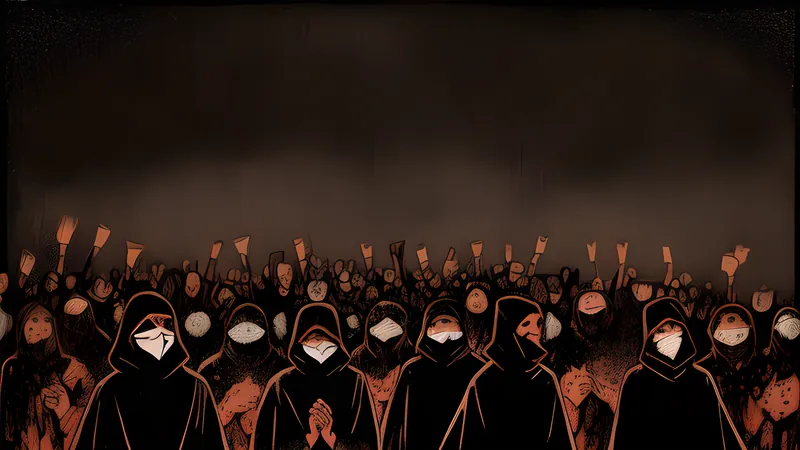
Sleep Token formed in London in 2016 and consist of two core members who perform under the names Vessel and II, plus two touring players known only as III and IV. Nobody outside the band’s inner circle has confirmed a single real name. On stage they wear masks, hooded robes and black body paint, lit so that the audience mostly sees silhouette and gesture rather than features. There is no unmasking moment built into the show, no reveal held back for a big tour. The anonymity isn’t a stunt with an expiry date. It’s the operating system.
That distinguishes them from most of metal’s masked lineage. Ghost’s Tobias Forge spent years denying he was the man behind Papa Emeritus before a lawsuit from former bandmates forced the issue into open court, and once his name was public the theatrical conceit kept going anyway, because with Ghost the mask was always understood as a character performance, closer to King Diamond’s corpse-painted stage persona than a genuine secret. Slipknot’s members wore masks as an identity for the collective, never pretending the world didn’t know who Corey Taylor was. Sleep Token is a different proposition: an actual attempt to keep the people invisible while the music becomes enormous, run with a discipline that has held for seven years and three albums.
The stated reasoning, as much as the band ever explains itself, is that focusing attention on the music rather than on personalities protects the songwriting from the marketing machine — no interviews about lifestyle, no faces to build a cult of personality around, no biography to package. Whether or not you buy that as pure principle, it has had a genuinely unusual side effect: a large, online, deeply engaged fanbase whose primary shared activity for years was trying to work out who Vessel actually is. Amateur voice analysis, old audition tapes, gig footage compared frame by frame — the anonymity generated its own cottage industry of speculation, which is a strange kind of viral engine, since every attempt to unmask the band becomes free promotion for the mystery rather than a threat to it.
That speculation has an uglier edge too, worth naming plainly. Fan sleuths have, on occasion, published names and photographs they believed belonged to band members, and the response from the camp has consistently been to ask press and fans to leave the matter alone rather than to confirm or deny anything. That request deserves respect rather than a shrug. A band choosing privacy is not obliged to spend its career fielding doorstepping questions, and the difference between playful mystery-solving and actually outing someone against their wishes is a line worth the audience policing itself.
A sound built to travel across genres
Musically, Sleep Token do not sit inside any one metal subgenre, which is itself part of the story. The songs move between djent-adjacent breakdowns, atmospheric ambient stretches, straightforward pop choruses and R&B-inflected falsetto vocals, sometimes inside the same track. A song can open on a sung, almost radio-friendly verse, build through a proggy instrumental section, and land on a guttural breakdown, then return to melody as if none of that were unusual. Purists in the harder end of metal have complained for years that this is metal in fancy dress rather than metal proper; fans who came in through pop and R&B have found a way into heavy music they never expected to like. Both reactions are, in a sense, evidence the approach works — it is deliberately built to be a door two very different audiences can walk through.
Holding the songs together is a running mythology. Album and song titles gesture at a private theology — a devotional relationship to a figure called Sleep, worship and surrender rendered as romantic and religious language at once. Sundowning in 2019 and This Place Will Become Your Tomb in 2021 built the vocabulary; Take Me Back to Eden, out as of yesterday, pushes it further into full concept-album territory, its story arc and recurring imagery clearly meant to be picked over the way fans pick over the band’s identities. It gives the anonymity a purpose beyond privacy: if you don’t know who is singing, the character they’re singing as becomes the only thing left to focus on.
The show without a face
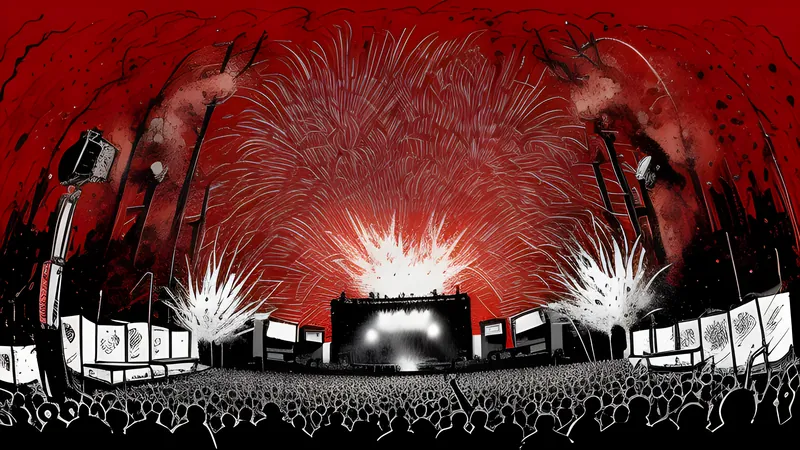
Translating that idea to a stage is its own trick, and it’s one the production side of the band has clearly thought hard about. Rather than lean on pyrotechnics or a giant prop the way a lot of arena-scale heavy bands do, Sleep Token build atmosphere out of low, warm lighting, incense-thick haze and slow, ritual-paced choreography — robed figures moving with deliberate, almost liturgical stillness rather than the usual thrash of a metal frontman working a crowd. It reads less like a rock show and more like a congregation being led through a service, which suits a band whose entire lyrical world is built on devotion and surrender. The mask does real work here too: without a recognisable face to focus a spotlight on, the eye is pushed toward the whole tableau, the robes and the haze and the collective movement, rather than toward one star performer. It is theatre built specifically around the absence at its centre, and it is more disciplined than most bands manage with their faces on full display.
Why this album, why now
Take Me Back to Eden arrives at a moment when the band’s slow-build audience has become impossible to write off as a curiosity. The streaming numbers have been climbing steadily since Sundowning, driven less by radio or press than by clip culture — short, dramatic sections of songs travelling on video platforms among listeners who often have no other reference point for the wider genre. That’s a genuinely new route into the mainstream for a heavy band, distinct from the old ladder of support slots and magazine covers, and Sleep Token have ridden it about as far as anyone currently working in the space. It helps that the band built this audience independently first, self-releasing early material before any label came calling, so the growth was organic rather than manufactured — a slow accumulation of converts rather than a marketing push, which makes the current attention feel earned rather than engineered.
The record itself leans harder into the pop and R&B side of the blend than its predecessors, which will read to some longtime listeners as the anonymity being spent on crossover ambition rather than protected from it. That tension — heavy music’s traditional suspicion of anything that samples too openly from the pop charts — has followed the band since day one, and Eden doesn’t resolve it so much as double down on the bet that the songs are strong enough to survive the accusation. Early impressions suggest the gamble is landing; whether it holds up over a full album’s running time is the more interesting question, and one worth revisiting once the record has had time to breathe rather than being graded on its first spin.
The trade the band actually made
Strip away the mystery and what’s left is a fairly stark trade. Most bands build value in the personalities behind the music — the frontman’s story, the guitarist’s gear talk, the tour diary. Sleep Token removed all of that and bet the entire project on the songs and the concept carrying the weight alone. Seven years in, with a mainstream press starting to pay attention and a fanbase large enough to fill rooms well beyond the metal circuit, that bet looks to be paying off. It is a strange thing to watch a band build a cult of personality around the specific absence of personality, but that is roughly what has happened, and Take Me Back to Eden is the clearest evidence yet that the strategy scales.
Whether the anonymity survives the band’s own success is the open question. Fame has a way of finding out secrets that money can’t buy, and every year Sleep Token grows bigger is another year the temptation to unmask them, officially or otherwise, gets stronger from every direction. Arena tours mean promoters, visas, insurance paperwork and a much larger travelling crew, all of whom will know exactly who they are working for even if the audience never does — the secret has to survive contact with an entire industry built on knowing names. That the project has held the line this long, through two albums and a growing pile of incentives to cash the mystery in for a cover story, is itself the more impressive achievement.
For now, though, the masks stay on, the theology keeps expanding, and a band nobody can name just made one of the most talked-about heavy records of the year. Metal has always had a soft spot for the theatrical unknown — the corpse-painted stranger, the pseudonymous frontman — but Sleep Token have pushed the idea further than anyone since Ghost took a similar disguise all the way to arenas. The difference is that Ghost’s mask was always a wink; Sleep Token are betting the wink never has to come.
Related Content