Roskilde: The Festival That Gives All Its Money Away
Eight days, 130,000 people, 32,000 volunteers, and a profit that vanishes into charity
Contents
The train from Copenhagen Central takes about twenty-five minutes, and for most of them you are looking at ordinary Zealand: fields, a motorway, the odd wind turbine turning over like it can’t be bothered. Then Roskilde station arrives, and the platform is a slow-moving river of people carrying tents, crates of beer, inflatable sofas, one bloke with a full-size road sign he has clearly stolen from somewhere. You follow the river out of town, west across the fields, and after a while the noise starts — not music yet, just the low collective hum of a hundred thousand people who have decided to live in a field for a week. By the time the orange canopy comes into view over the ridge, you have already stopped being a visitor. You are a resident of a city that appears every summer and is gone by August, and the strangest thing about that city is where its money goes. It goes away. All of it.
A festival that is legally forbidden from keeping the money
Here is the thing that reorganises how you see the whole place once you know it. Roskilde Festival is a non-profit. Not “non-profit” in the wink-wink way a lot of big cultural events are, where the surplus quietly funds executive salaries and a holding company in a friendlier tax jurisdiction. Roskilde is run by the Roskilde Festival Group, which has organised it since the early 1970s, and the surplus — after the bands are paid, after the toilets are hired, after the enormous machine of the thing is fed — is donated. Millions of Danish kroner a year, handed out to humanitarian, cultural, and non-profit initiatives, a lot of it aimed at children, young people, and the sort of grassroots arts work that never gets a headline.
The engine that makes that possible is the volunteers. Roskilde runs on roughly 32,000 of them. Thirty-two thousand people who pour your beer, staff the gates, marshal the campsites, run the stages, sort the recycling, and generally hold the whole improvised city together — and are not paid to do it. Some do it for the free ticket. Plenty do it because their parents did, and their friends do, and turning up to work a festival you love is its own kind of holiday. When you buy a beer at Roskilde you are, in a real and traceable sense, funding a youth theatre project somewhere. That is not marketing spin painted over a normal commercial festival. It is the actual legal and financial architecture of the place, and you feel it in the atmosphere, even if you never read a word about the model.
The Orange Feeling, and the canopy that started it
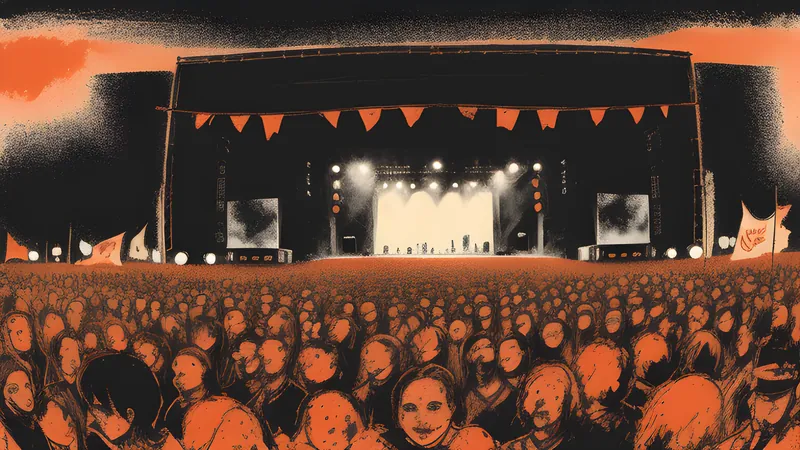
That atmosphere has a name the Danes use without irony: the Orange Feeling. It is named for the Orange Stage, the main stage, and the Orange Stage is named for its canopy — a great orange tensile awning shaped like two arches leaning together, the most recognisable object in Northern European festival culture.
The canopy has a genuinely absurd backstory, and it’s true, which is the best kind. It was designed in the mid-1970s for the Rolling Stones’ European tour, first raised at Knebworth in England, then used in Hyde Park for a Queen show. Roskilde, a small Danish festival with big ideas, bought the second-hand Stones canopy and put it up for the first time in 1978. It has been the festival’s logo and its soul ever since. A hand-me-down piece of British stadium-rock infrastructure became the emblem of Denmark’s great communal summer, and nobody who stands under it caring about the provenance. What they care about is that when 60,000 people are packed onto the slope in front of it at midnight, singing along to something, the sound comes back off that orange awning and lands on you like weather.
The Orange Feeling is the closest thing I know to a mass secular religion that stays friendly. Danes are reserved by reputation, careful, a bit closed until they know you. Put them in this field for a week and something loosens. Strangers share food. Camps adopt you. The general default is that everyone is having the same good time and it would be rude to spoil it. It is the warmest big crowd in Europe, and it is warm on purpose, because the people running the bar you’re standing at are volunteers who chose to be there.
The site, and the temporary city around it
The festival itself — the fenced part, with the eight stages — runs across a few days at the core of the week. But the thing most people mean when they say “Roskilde” is bigger and looser than that: the camping city that surrounds it, west of the actual town of Roskilde, spread across what is farmland the other fifty-one weeks of the year.
That camping city opens days before the music does, and for a lot of Danes the warm-up days are the festival — the part where you build your camp, meet your neighbours, and settle in before a single headliner plays. At its peak the whole gathering pushes past 130,000 people, which would make it, briefly, one of the larger towns in Denmark. It has its own internal geography of camping areas, its own landmarks, its own daft traditions. It has a scale that is genuinely hard to convey until you’ve walked it: you will get lost, you will lose your camp, you will navigate by whichever flag your neighbours have flown, and you will walk further in a day than you thought your legs could manage on that little sleep.
The booking matches the sprawl. Roskilde has never been a rock festival in the narrow sense, and 2026 makes the point loudly: the bill ran to well over a hundred and fifty acts from dozens of countries, and the headline slots included Jennie — the first time a K-pop artist has topped a major Danish festival — alongside The Cure and Gorillaz. You can spend one day in front of the Orange Stage for the big names and the next in a smaller tent watching something from Mali or a Danish punk band nobody outside Copenhagen has heard of, and both days feel like the point. The eclecticism is deliberate and it is old. Roskilde has always treated “discovery” as core business rather than garnish, which is why the smaller stages are where regulars actually spend their time.
Getting there, and staying alive for a week
Logistically it is the easy one, which is part of why it swallows so much of Europe every summer. Fly into Copenhagen, take the train through the city and out to Roskilde station, and from there it’s shuttle buses or a walk across the fields to the site. You can be off a plane and pitching a tent in a few hours, and you can nip back into Roskilde town or all the way into Copenhagen for a real shower and a real bed if you have the money and the discipline to leave. Most people don’t leave. Leaving breaks the spell.
Surviving the week is its own skill set. This is a Danish summer, which means it will be gorgeous and then it will rain sideways and then it will be gorgeous again, sometimes inside the same afternoon. Bring wellies you don’t mind burying. Bring more sun cream than you think and drink more water than you want. The food inside has got genuinely good over the years — Copenhagen’s obsessive food culture leaks into the festival, and you can eat far better than the burger-van baseline — but it costs festival prices, and a week of that adds up fast, so the veterans cook breakfast at their own camps and save the money for the evenings. Sleep is the real currency. You will not get enough. Nobody does. You bank it before you arrive and you claw it back for a week afterwards. Pace the week like a marathon, not a Saturday night, and the eight days feel like a gift instead of a sentence.
On cost: it is not a cheap festival any more, and pretending otherwise would be dishonest. The full-week ticket is a real chunk of money, the beer is Danish-priced, and the slow corporate creep that has come for every big European festival has come for this one too — more sponsor branding, more premium camping options for people who want a bed and a locked gate. But the fundamentals still hold in a way they don’t elsewhere, because the surplus is still going out the door to charity rather than to shareholders. You are paying a lot, but you can see where it lands.
The year everything changed
You cannot write honestly about Roskilde without the 30th of June 2000, and it deserves to be handled plainly. During Pearl Jam’s set on the Orange Stage, a crowd surge in the packed front section led to a fatal crush. Nine young men died and many more were injured. The festival stopped. The official investigation described a chain of circumstances rather than a single villain — a very large, very keyed-up crowd, wet ground, the forward pressure of tens of thousands of people all wanting to be closer.
What followed reshaped live music across Europe. Roskilde and others built new crowd-safety standards out of the worst possible lesson: paved and drained surfaces where there had been churned mud, front areas broken into smaller separated pens so pressure can’t build across a whole crowd, wide cleared channels kept open through the audience, better-trained staff, harder caps on how many bodies go into the front sections. A network of festivals and safety experts formed to share what they learned. If you go to any big festival in Europe now and notice the front pit is divided into blocks, or that there are lanes an ambulance could get down, you are looking at Roskilde 2000’s legacy, paid for in the worst currency there is. The festival has never tried to bury it, and it shouldn’t. The care you feel in the crowd now was rebuilt deliberately after the year the care wasn’t enough.
Who it’s for
Roskilde is transcendent if you want the whole thing — the week in the field, the temporary city, the eclectic bill that drags you out of your genre, the specific Danish warmth of a crowd that has collectively decided to be kind, and the quiet satisfaction that your ticket money is going somewhere decent. It rewards the full commitment and slightly punishes the day-tripper; the Orange Feeling is built over days, and you can’t parachute into it for a headliner and out again.
Skip it if you need a bed, a shower, and control over your week, or if you only want heavy music — for pure volume and darkness, Copenhell across town in the industrial docklands is the Danish counterweight, a metal festival with a completely different centre of gravity. Roskilde is the broad, warm, generous one. It’s the festival that gives all its money away, and after a week in its field, sunburnt and underslept and slightly changed, you understand why that fact is the most important thing about it. Come down off the high with a proper indoor show at VEGA, and file the whole thing under the best kind of exhausting.
Related Content