Roskilde 2025: Still Giving It All Away
Olivia Rodrigo, Charli XCX and Nine Inch Nails on the same bill — and the money still walks out the door to charity
Contents
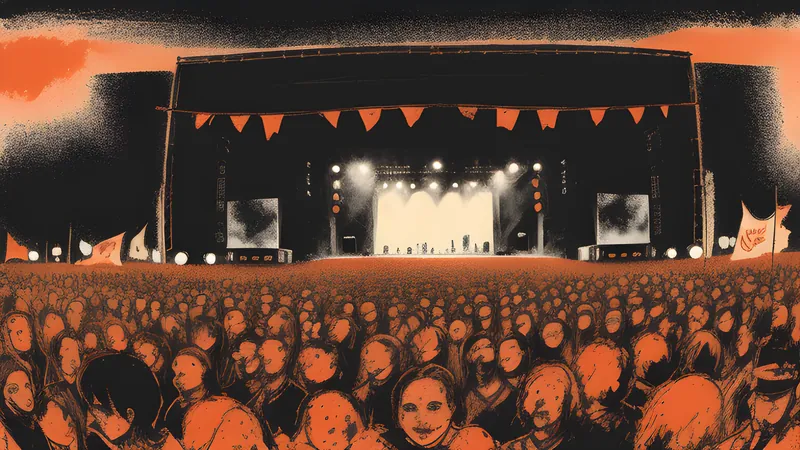
By 2025 the pop takeover of Roskilde was complete, and the strangest thing about it is how little it changed the festival’s soul. The bill that summer topped out with Olivia Rodrigo, Charli XCX and Nine Inch Nails — a Grammy-machine teenager, a hyperpop auteur mid-cultural-moment, and a thirty-five-year-old industrial band who still sound like a threat — sharing a headline tier with Stormzy, Doechii, FKA Twigs and Fontaines D.C. Anyone who thinks a festival is defined by whether its main stage leans rock or pop should have stood on the slope in front of the orange canopy that week and watched 60,000 people give exactly the same devotion to Rodrigo that a Roskilde crowd once gave to Metallica. The festival ran 28 June to 5 July, the full eight days, 185 acts, and it was as much itself as it has ever been.
The bill has always refused to sit still
If Roskilde in 2025 looks like it has drifted away from the loud-rock identity some people project onto it, that is because the projection was always wrong. This festival topped its bill with Bob Marley in the 1970s and has spent fifty years treating “discovery” and genre-hopping as the actual product. I have laid out the full architecture in the portrait of how the place works — the non-profit model, the 32,000 volunteers, the surplus that is legally forbidden from being kept — and the eclecticism is downstream of the same principle. A festival that answers to a charitable mission rather than to shareholders can book what it finds interesting instead of what a demographic spreadsheet demands.
So Olivia Rodrigo headlining the Orange Stage is not a betrayal of anything. It is the same festival that put Kendrick Lamar and Blur up top in 2023 continuing to do the one thing it has always done: put the biggest, most culturally alive acts on the planet in front of a Danish crowd and trust that crowd to show up for a rapper one night and an art-pop act the next. What shifted between 2023 and 2025 was the centre of gravity of global pop itself, and Roskilde simply followed the culture, the way it always has.
Nine Inch Nails as the anchor
For the heavy contingent — and there is always a heavy contingent, this is still the festival that gave us the loud years — Nine Inch Nails were the anchor of 2025. Trent Reznor and Atticus Ross came through on a run that reminded everyone why this band has outlasted almost all of its 1990s peers: the discipline of the show, the physicality of the sound, the way an industrial set built on machinery and menace still lands harder in a field than most of the guitar bands trying to be dangerous. A Nine Inch Nails set at Roskilde is a lesson in how volume and control can coexist. The pop headliners bring joy and mass singalong; NIN brought the reminder that this stage can still be a place of genuine intensity when the right act walks onto it.
Charli XCX arrived as the year’s most-discussed pop figure, her Brat moment having reorganised the entire aesthetic conversation, and a Roskilde night crowd is exactly the kind of audience that turns a hyperpop set into something communal and slightly unhinged. Doechii, Stormzy, FKA Twigs, Fontaines D.C. — the rest of the top tier read like a snapshot of what was actually alive in music that year rather than a nostalgia carousel, which is worth saying because so many big festivals now lean on the same finite pool of legacy headliners that they have started to feel interchangeable. Roskilde books forward. That is increasingly rare and increasingly valuable.
The smaller stages are still the real festival
Here is the thing the headline discourse always misses. The regulars do not spend their week in front of the Orange Stage. They spend it on Avalon and Arena and Apollo and Gloria, the smaller stages where the festival’s discovery mission actually lives, catching a West African band at four in the afternoon and a Danish noise act at midnight and a Balkan brass ensemble somewhere in between. In 2025 those stages were, as ever, where the true believers logged their hours. The headliners are the reason people buy the ticket. The small stages are what they describe when they get sentimental about the place a decade later.
Fontaines D.C. sat in the interesting middle of the 2025 bill — an Irish band who arrived as a spiky post-punk proposition and have grown, record by record, into something that can hold a slot beneath the pop giants without being swallowed by them. They are the sort of act Roskilde has always been good at catching on the upswing: booked before they were inevitable, given a big stage on the strength of what the festival’s programmers could hear coming. Half the pleasure of a proper Roskilde week is watching a band you saw in a small tent two years ago walk out onto a stage five times the size, and the festival’s talent for that early bet is a large part of why the discovery stages carry the reputation they do.
That is the deeper continuity between 2023 and 2025 and every year before them. The top of the bill changes with the culture — rock, then rap, then pop — but the shape of a proper Roskilde week does not. You build your camp in the temporary city west of town. You lose your tent and navigate home by your neighbours’ flag. You walk further on less sleep than you thought a body could take. You let the eclectic bill drag you somewhere you would never have booked on purpose. And the Orange Feeling — the Danes’ own unironic name for the specific communal warmth of this crowd — comes for you somewhere around day three, whether the headliner that night plays guitars or not.
The money still walks out the door
The single fact that anchors all of this is the one that never changes. Roskilde 2025, for all its pop-chart glamour at the top, was still a non-profit giving its surplus away. Millions of Danish kroner, after the acts are paid and the toilets are hired and the enormous machine is fed, donated to humanitarian and cultural and grassroots initiatives, a lot of it aimed at young people. When you bought a beer from a volunteer at Roskilde 2025 — poured by one of the 32,000 unpaid people who hold the improvised city together — you were funding a youth project somewhere in a real, traceable way. Olivia Rodrigo headlining did not change that. The financial architecture is the same one it has been since the 1970s.
That matters more each year, because the corporate creep keeps coming. 2025 had more premium camping tiers, more sponsor presence, ticket prices that have climbed well past cheap. Every big European festival is being sanded down toward the same commercial shape, and Roskilde is not immune to the pressure. What keeps it on the right side of the line is the till: the surplus goes to charity rather than to a holding company in a friendlier tax jurisdiction, and you can see where your money lands. Pay a lot, watch it do good — that trade is the entire moral engine of the place, and it survived the pop takeover intact.
Surviving the week, as ever
The practical truths do not change with the lineup. It is a Danish summer, so it was gorgeous and then it rained sideways and then it was gorgeous again, sometimes inside a single afternoon. Bring wellies you will end up burying. More sun cream than you think, more water than you want. The food inside has become genuinely good — Copenhagen’s food obsession leaks across the fields — but it costs festival prices, so the veterans still cook breakfast at camp and save the money for the evenings. Sleep is the currency you spend and never earn back until the following week. Pace the eight days like a marathon and they feel like a gift; sprint them and they feel like a sentence.
Getting there is the easy part and always has been: fly into Copenhagen, train through the city and out to Roskilde station, shuttle bus or a walk across the fields, tent up within a few hours of landing. Most people never leave the site once they arrive, because leaving breaks the spell.
Who 2025 was for
Roskilde 2025 was for anyone who has stopped believing that a festival needs a fixed genre to have a soul. It was pop-topped and it was still the warmest, most generous, most genuinely purposeful big festival in Europe, and those two facts sit together with no friction at all once you understand the model underneath. If you want the heavy Danish counterweight — pure volume in an industrial shipyard across town — Copenhell is where the loud tribe goes, and it runs a fortnight before this one every June. But if you can take a week without a shower and you want to come out the other side sunburnt, underslept and quietly changed, with the knowledge that your ticket funded something decent, this is still the one. Fifty years in, it is still giving it all away, and that remains the most important thing about it.
Related Content