Rockefeller: Oslo Rock in an Old Bathhouse
How a 1930s public baths on Torggata became the anchor of Norwegian live music
Contents
Rockefeller is Oslo’s main mid-to-large rock hall, and it lives inside a building that used to wash the city. The venue occupies Torggata Bad — a public bathhouse in the centre of the Norwegian capital, the sort of civic swimming-and-hygiene institution that a lot of northern cities built in the early twentieth century so their citizens could get clean. The pool is long gone and the hall now holds around thirteen hundred people yelling at a stage, but the bones of the bathhouse are still legible if you know to look, and the whole place carries the faintly surreal charge of a room whose original purpose was so completely at odds with what it does now.
I have a soft spot for venues built inside buildings that were meant for something else. My home city runs on the trick — Copenhagen’s best rooms are old waterworks and freetown army halls — and there is something about repurposed civic architecture that suits loud music. The hard surfaces, the generous volume of air, the sense that the room was overbuilt for a duller job and is now finally being used properly. Rockefeller is the Oslo entry in that tradition, and a good one.
From bathhouse to rock hall
Torggata Bad opened as a public bath and swimming facility, a solid piece of interwar municipal architecture on Torggata, one of central Oslo’s main streets. It served the city for decades. During the Second World War, when Norway was under German occupation, the baths were requisitioned by the occupying forces for military swimming training — a grim footnote that the building wears quietly. It carried on as a municipal bathhouse until 1980, when it finally closed, leaving a large, oddly shaped, structurally generous building empty in the middle of the city.
In 1986 the company Auditorium AS took the space on and converted it into a concert venue, and Rockefeller was born. The great virtue of a bathhouse for this purpose is the pool hall itself — a big, tall, open volume designed to hold a swimming pool and the galleries around it. Strip out the water, floor it over, put a stage at one end and a balcony around the sides, and you have a natural amphitheatre. That is essentially what Rockefeller is: the old pool hall turned into a room that holds around thirteen hundred standing across the floor, the galleries and the bar levels.
The room and how it works
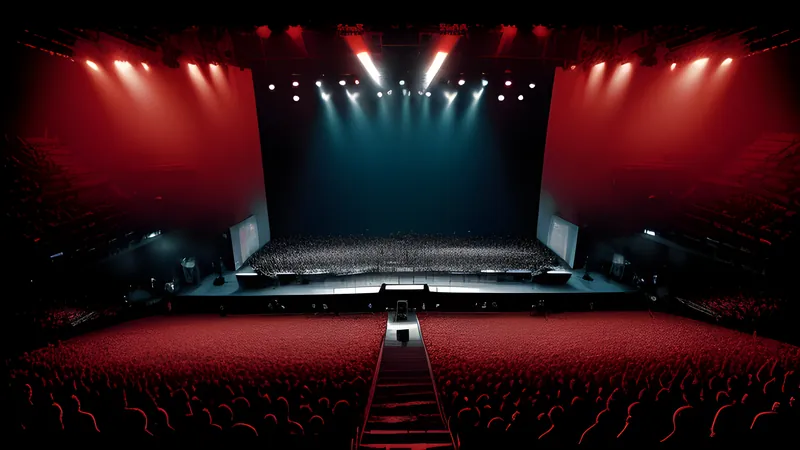
Thirteen hundred is a bigger number than the classic seven-hundred club, and Rockefeller feels it — this is Oslo’s step up from the small rooms into proper mid-size territory, the hall a band plays when they have outgrown the clubs but are not yet ready for an arena. The layout inherited from the bathhouse gives it a good shape for the job: a main floor, raised galleries running around the sides that let a big chunk of the crowd see over the heads in front, and sightlines that stay workable even when the room is full. That gallery arrangement is the single best thing about the place. In a flat-floored club, a full house means the short and the late see nothing; here you can climb to the rail and get a clean view of the whole stage and the churn of the floor below.
The sound is the sound of a large, hard-walled masonry hall, which means it rewards weight and can get boomy if a band or an engineer pushes too much low end into all that reflective stone. On a well-run night with a band suited to the room — and Norway leans hard towards rock and metal, so plenty are — it is a powerful, physical space. The venue has been the default Oslo stop for touring international acts for decades precisely because it hits the sweet spot: big enough to matter, contained enough to stay intense.
Where to stand follows the usual logic with a bathhouse twist. If you want the show and your ribs intact, the galleries are the move — elevated, angled, a clean sightline, and a rail to lean on. The floor down the front is for the committed, and on a heavy Norwegian bill that front can get genuinely physical. A third of the way back on the floor is the honest compromise of sound and survival. Wherever you land, factor the bathhouse acoustics in and expect a room with opinions.
The family of rooms
Rockefeller does not operate alone. The same organisation runs a little sibling venue in the same building — John Dee, a small club room that functions as the intimate space for rising acts and tighter bookings, the natural first Oslo headline for a band on the way up before they graduate to the big hall upstairs. And across the street sits Sentrum Scene, a larger room the company took on in 2006, built inside a former cinema and holding well over a thousand more, which handles the shows too big for Rockefeller itself.
That cluster — a small club, a mid-size hall and a bigger room, all within a few metres of each other in central Oslo — makes the Torggata corner the effective centre of gravity for the city’s live music. It is a smart piece of ecosystem: a band can grow from John Dee to Rockefeller to Sentrum Scene without ever leaving the block, and a fan can map an entire career onto one street corner.
There is a real advantage to that concentration that goes beyond convenience. When one operator runs the whole ladder, a band’s relationship with the city becomes a continuous thing. The promoter who put them in the little room watches them sell it out, moves them up to the bathhouse, and eventually across the road to the big hall, and the audience follows the same path. It is the kind of long-term booking logic that treats a career as something to be nurtured over years, and it is increasingly rare in a live-music economy that often prefers to chase the one-off big night. Oslo, for all that it is a smaller market than Stockholm or Berlin, has a more coherent live-music spine than most cities twice its size, and the Torggata rooms are the reason.
The crowd and the character
Norwegian crowds run to the enthusiastic end of the Nordic spectrum — a little warmer out of the gate than their Swedish or Finnish neighbours, quick to commit, and deeply literate about heavy music, which is unsurprising for a country that gave the world one of the most notorious and influential metal scenes on the planet. A Rockefeller crowd knows the material and means it. The room’s long history as the touring anchor means everybody in Oslo over a certain age has seen something formative here, and that lived-in familiarity gives the place an easy, unpretentious feel even when it is packed to the galleries.
The character overall is workmanlike in the best sense: a serious room run by people who have been doing it a long time, honest about what it is, unbothered about being fashionable. It is a rock hall in an old bathhouse, and it behaves exactly as that description promises.
Getting there, and where it sits
Central Oslo location is the trump card. Rockefeller sits on Torggata, a short walk from the main transit spine of the city, so wherever you are staying you can reach it and get home after the encore — the single most underrated feature of any venue. The surrounding streets are thick with bars and late food for the aftermath, and Oslo is compact enough that the night carries on under its own steam once the set ends.
For a Copenhagen punter, Oslo is a short hop, and Rockefeller is the obvious anchor for a night in the Norwegian capital — the third leg of the great Nordic mid-size triangle alongside Helsinki’s Tavastia and Stockholm’s Debaser. The repurposed-building kinship runs closer to home, too: if you like the idea of loud music inside civic architecture that was built for something duller, Rockefeller’s bathhouse is a direct cousin of Copenhagen’s own Pumpehuset, the rock club housed in a nineteenth-century waterworks. Water buildings, both of them, now moving air with bass guitars.
The verdict
Rockefeller is Oslo’s essential mid-size hall: thirteen hundred capacity, a bathhouse’s worth of generous volume, galleries that solve the sightline problem most clubs never crack, and a family of sibling rooms up and down the same street that make its corner the hub of Norwegian live music. It sounds like the big masonry hall it is — weighty, physical, occasionally boomy — and it rewards the loud, heavy bookings the country produces in such improbable quantity.
Come for a touring rock or metal act, get up to the gallery rail for the clean view, drop to the floor for the songs that demand it, and take a moment to remember that you are standing in a room where the city used to come to swim. Oslo has newer venues and bigger ones. Rockefeller is the one with the history in its bones, and it is still the first place a serious band plays when they come to town.
Related Content