Rock am Ring: The German Ritual
Four decades of rock at a Grand Prix circuit in the Eifel, and the storms that keep testing it
Contents
Germany takes its rock festivals more seriously than almost anyone, and Rock am Ring is the proof. For four decades a chunk of the German summer has belonged to a festival held at the Nürburgring, the legendary motor-racing circuit buried in the forested hills of the Eifel in Rhineland-Palatinate, and generations of Germans have measured out their youth in trips to it. It is a national ritual in the way that Reading is a British one, an event so embedded in the culture that people go to take their place in a long-running tradition as much as to see any particular band. The bands change. The pilgrimage to the Ring does not.
The festival started in 1985, and its choice of home was inspired. The Nürburgring is one of the most storied racetracks on Earth, home of the fearsome Nordschleife circuit, a place already saturated with meaning for anyone who cares about speed and machinery, and dropping a rock festival into its grandstands and paddocks gave the event an instant grandeur. You camp and gather in the infield of a Grand Prix circuit, surrounded by the architecture of motorsport, the pit lanes and the towering grandstands, and the borrowed drama of the place seeps into the festival. Few sites in Europe carry that much accumulated adrenaline in the ground before a single band plays.
The twin-festival trick
Rock am Ring’s cleverest structural move is that it is really one half of a two-headed festival. Since 1997 it has shared its entire lineup with Rock im Park, a sister event held simultaneously in Nuremberg, hundreds of kilometres to the south-east, with bands shuttling between the two sites across the weekend. It is the same model the British later made famous with Reading and Leeds, a single bill serving two crowds in two cities at once, doubling the reach and the revenue while halving the risk of any one site being a washout. The German version predates the British twin by a couple of years, and it works for the same reasons: one booking budget, two audiences, twice the national footprint.
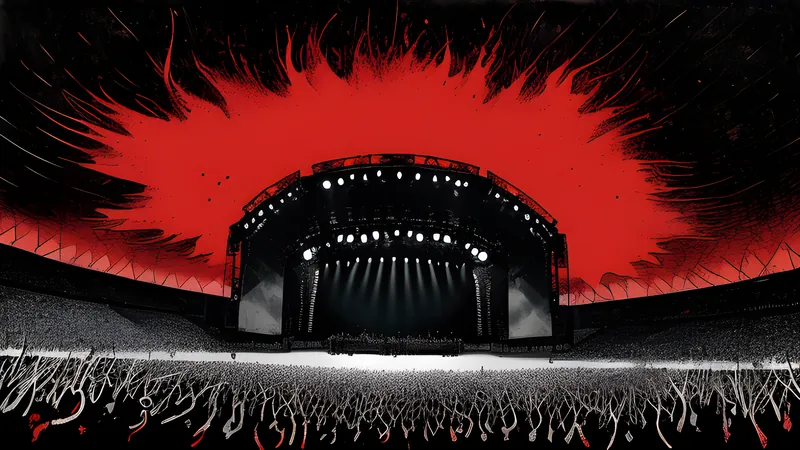
That reach is enormous. Between the two sites, the festival puts something approaching two hundred thousand people through the gates across a weekend, which makes it one of the largest music events in Europe by attendance. The scale gives it the pulling power to book the genuine giants of rock and metal, the Metallicas and Rammsteins and Iron Maidens who can only headline the very biggest stages, and the twin-site structure means those bands can play to two vast German crowds in a single trip. For a promoter, it is an efficient machine. For the crowd, it is the reliable annual chance to see the enormous bands that otherwise only tour every few years.
Four decades of the German bill
Track the Rock am Ring headliners across forty years and you get a fairly complete history of what mainstream rock meant to Germany at any given moment. The eighties and nineties leaned into the hard rock and metal that German audiences have always loved with unusual loyalty, a country where a band like the Scorpions is a national institution and where metal never carried the faintly embarrassing connotations it sometimes did in Britain. As the festival grew it broadened, absorbing alternative, punk, nu-metal and eventually the harder end of the pop-rock mainstream, while keeping the metal spine that its faithful audience demanded.
That loyalty to heaviness is a genuine feature of German taste. Germany sustains more metal, of more subgenres, at more scales, than almost any country in Europe, from arena-filling giants down to the most obscure underground, and Rock am Ring sits at the commercial peak of that pyramid. Its bills reliably feature the biggest names the genre can offer, precisely because the German audience turns out for them in numbers that justify the booking. A country that treats metal as a normal part of the cultural furniture will always be able to fill a racetrack for it.
When the sky attacks
You cannot tell the story of Rock am Ring without the weather, because the Eifel has produced some of the most dramatic festival disruptions in modern European history. In 2016 the festival was hit by severe thunderstorms, and lightning strikes on the site injured dozens of people over the weekend, forcing evacuations and eventually the abandonment of part of the programme. It was a genuinely frightening episode, a reminder that a festival on exposed high ground in an electrical storm is a serious safety problem, and it tested the organisers’ crowd-management and evacuation planning to the limit. The images of a festival crowd being cleared from a field under a black sky went around the world.
The very next year brought a different kind of emergency, when the 2017 edition was evacuated on its opening day over a terror threat, the site cleared as a precaution before the all-clear allowed the festival to resume the following day. Two years running, the festival faced the modern nightmares of the mass event, the storm and the security threat, and both times it got a hundred thousand people to safety and then carried on. That resilience became part of the festival’s story, a grim badge of competence, and the German crowd’s stoic willingness to return the next year is a testament to how deep the ritual runs. A lesser event might have been broken by either episode. Rock am Ring absorbed both.
The Eifel and its moods
The setting that gives the festival its grandeur also gives it its difficulty. The Eifel is a range of forested volcanic uplands, beautiful and green and thoroughly unpredictable, prone to sudden temperature swings and the violent summer storms that have caused the festival such trouble. Camping in the Nürburgring infield means camping at altitude in a region where June can deliver blazing sun or a cold, soaking deluge with little warning. That volatility shapes the experience and the folklore, and the German festival crowd has developed the same weather-hardened stoicism that I recognise from the northern festivals back home, the collective refusal to let a storm ruin the weekend.
There is a particular character to a German festival crowd that is worth naming. It is orderly in a way that a British or Spanish crowd is not, efficient in its chaos, disciplined even at its most abandoned. The camping is organised, the recycling is taken seriously, the whole vast operation runs with a smoothness that reflects something real about German festival culture. It is the same efficiency that lets a village host Wacken’s eighty-five thousand metalheads every year without the wheels coming off, a national aptitude for running enormous gatherings that Germany deploys better than almost anyone.
The corporate era
Rock am Ring has spent its four decades under the wing of major promoters, most associated with Marek Lieberberg, one of the most powerful concert promoters in German history, and in recent years it has sat inside the same Live Nation orbit that owns so much of the European festival landscape. That has brought all the familiar features of the modern mega-festival, the sponsorship, the cashless systems, the steadily climbing prices, and the sense that a beloved national institution is also a substantial commercial asset. The festival even spent a couple of years exiled from the Nürburgring in the mid-2010s over a contractual dispute, relocating temporarily before returning to its spiritual home, a reminder that even the most storied festivals are ultimately subject to the business underneath them.
And yet the ritual survives the machinery, because the meaning is older and deeper than any owner. A German rock fan’s first Rock am Ring is a rite handed down through friends and families, the same way a British fan’s first Reading or a metalhead’s first Donington is passed on. That inherited significance is the thing the corporate owners cannot manufacture and dare not damage. They can sell the sponsorship and set the prices, but a hundred thousand Germans return to a racetrack in the Eifel every June for the ritual itself, whatever the sponsors have printed on the wristbands.
The two ends of German metal
It is worth setting Rock am Ring against the opposite pole of the same national scene. Where the Nürburgring festival is vast, corporate, mainstream and efficient, a small event like Party.San in the former East represents the purist underground end of German metal, a few thousand devotees on an old airfield watching extreme bands with no interest in the mainstream at all. The two exist at opposite ends of the same country and the same passion, and between them they map the full range of how seriously Germany takes heavy music, from the hundred-thousand-strong ritual to the tiny, fiercely curated field.
That range is the real story. A national scene healthy enough to support both a Live Nation mega-festival at a Grand Prix circuit and a stubbornly independent extreme-metal gathering on a Thuringian airfield is a scene with genuine depth. Rock am Ring is the mainstream face of it, the one the whole country knows, the ritual that even non-metalheads have heard of. Underneath it runs a whole ecosystem of smaller, harder, more specialised festivals, and the big one at the Ring effectively acts as the wide base that keeps the whole German metal economy turning over.
Why the Ring endures
What keeps Rock am Ring central to German culture after forty years is the combination of a mythic site, a ruthlessly efficient twin-festival structure, and a crowd that treats attendance as a tradition rather than a transaction. It has weathered lightning, terror threats, exile from its own venue and the slow corporatisation of the whole industry, and it keeps drawing its enormous crowds back to the Eifel every summer. The bands on the poster will be forgotten in a decade. The ritual of the trip to the Ring, the storms, the racetrack, the vast German crowd, will still be there, exactly as it has been since 1985.
From the outside, what stands out is the durability. A festival that has survived everything the weather and the world could throw at it, held its place at one of the most famous sites in motorsport, and kept a nation coming back for four decades has earned its status as an institution. Germany built a ritual out of rock music at a racetrack, and it has proved remarkably hard to break.
Related Content