Rammstein at Parken: Fire as a Civic Event
The Europe Stadium Tour brought its own cargo operation to a Copenhagen football ground in June 2019 — a whole city sanctioning a spectacle of controlled flame
Contents
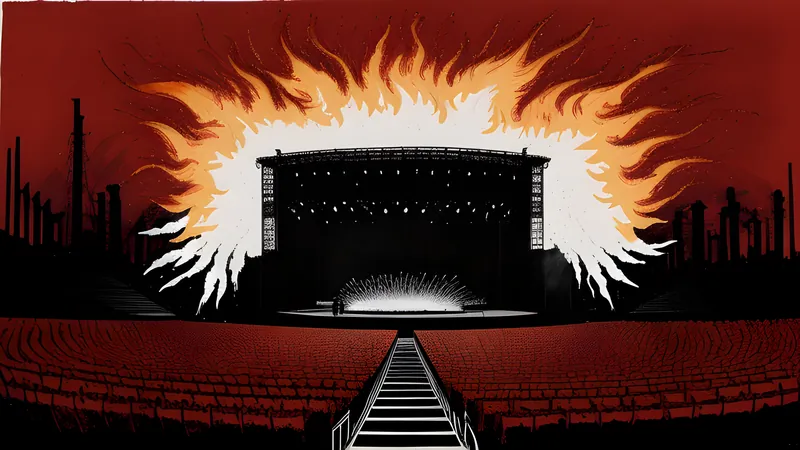
On 19 June 2019, Rammstein brought their first stadium tour to Parken and set a Copenhagen football ground alight. The show sold out. Somewhere in an office in Østerbro, weeks earlier, a Danish official had signed a permit that authorised a German band to burn several hundred litres of propane, in choreographed bursts, in a residential neighbourhood, for two hours, on a Wednesday night. That signature is the thing I keep coming back to. A stadium concert is loud. A Rammstein stadium concert is a small municipal decision to allow fire.
The stadium tour that was its own cargo operation
Rammstein had never headlined stadiums before 2019. For a band that formed in Berlin in 1994 and spent two decades building the most elaborate arena production in heavy music, the Europe Stadium Tour was the graduation to the largest scale on offer — a run that opened in Gelsenkirchen on 27 May and ran through late August, taking a single custom show around the continent’s football grounds. Copenhagen’s date fell on 19 June, roughly a fortnight into the whole enterprise.
The numbers are the story. This was not a band turning up with a backline and some flame bars. The touring production reportedly moved on the order of ninety trucks, carried a crew in the region of two hundred and sixty-five people, and hauled well over a thousand tonnes of steel and equipment from city to city. The stage was a purpose-built industrial gantry, an ugly-on-purpose tower of catwalks and lighting that looked like a decommissioned power station and existed mainly as scaffolding for the pyrotechnics. Rolling that into a working national stadium, assembling it, and stripping it back out inside a few days is closer to a military logistics exercise than a gig. The spectacle you paid for was the visible tip of an enormous freight operation.
The timing gave the whole tour extra charge. Rammstein had just broken a ten-year album silence: their untitled seventh record arrived in May 2019, weeks before the tour reached Copenhagen, trailing the enormous and deliberately provocative “Deutschland” video that had the German commentariat arguing for a fortnight about history, spectacle and taste. So the Stadium Tour was not a heritage act coasting on old hits. It was a band with fresh, contested material and something to prove at the largest scale they had ever attempted, arriving in each city on a wave of the exact controversy they trade in. Copenhagen caught them at that peak, a fortnight into the run, with the new songs still smoking.
What Rammstein do with all that hardware I have written about at length in Rammstein and the art of the flamethrower: fire treated as a language with a grammar, cued to meaning, engineered by a frontman who is a licensed pyrotechnician and legally qualified to run the flames he stands inside. The short version is that the flame is the text and the songs are the excuse to build it. The Stadium Tour scaled that idea up to the biggest canvas the band had ever used. What I want to sit with here is what it means for a city — specifically for orderly, safety-conscious Copenhagen — to say yes to it.
Fire in a residential neighbourhood
Parken is not a purpose-built desert amphitheatre out beyond the ring road. It sits in Indre Østerbro, a dense residential district of apartment blocks and school runs and cargo bikes, on the site of the old Idrætsparken. The stadium opened in 1992, is home to FC København and the national team, holds a little over 38,000 for football, and gained a retractable roof in 2000 and 2001. Floored over for a concert it takes around fifty thousand. People live in the flats overlooking it. On a match day the neighbourhood absorbs a football crowd. On 19 June 2019 the same neighbourhood absorbed a controlled inferno.
That juxtaposition is genuinely striking once you notice it. Rammstein’s show throws real fire — columns, bursts, the flamethrower masks that spit jets several metres from the players’ faces, the reported fuel burn running to hundreds of litres a night. All of it happened a few hundred metres from people’s kitchens, under a roof that had to be managed, inside a set of blast zones marked to the centimetre and cleared with the local fire authority in advance. The danger the audience feels at a Rammstein show is real; the recklessness they assume is not, because underneath the apparent chaos sits an engineering and permitting operation most people never think about. Getting that operation approved for a stadium wedged into a Copenhagen neighbourhood is its own quiet achievement.
The retractable roof adds a wrinkle you would not think about until you had to. A stadium that can close its lid is a stadium where somebody has to decide, on the day, how a fire-based show interacts with an enclosable space — ventilation, heat, the physics of a lot of burning propane under a partial ceiling. For a Danish summer evening the roof stays open and the problem mostly solves itself. The fact that it could close is exactly the sort of detail the safety planning has to account for. None of this is glamorous. All of it is the reason the show can exist at all.
Why a country lets this happen
Here is the part I find genuinely interesting about a Rammstein show landing in Copenhagen specifically. Denmark is a famously ordered society — high-trust, safety-first, allergic to unnecessary risk, the kind of place where the cycle lanes have their own traffic lights and everyone obeys them. And this same society hands over its national football stadium, in a residential district, so that a German band can perform a two-hour spectacle built entirely out of fire and mild menace.
The reconciliation is that the orderliness is precisely what makes it possible. A high-trust, well-regulated system is exactly the environment in which a genuinely dangerous spectacle can be run safely at scale, because the permits mean something, the fire authority is competent, and the production’s own engineering is rigorous enough to satisfy them. The reason fifty thousand people can stand on the FC København pitch and feel the heat of a flamethrower on their faces is that a lot of unglamorous Danish and German professionals spent weeks making sure nobody gets hurt. Spectacle at this level is a product of good regulation. The fire is thrilling because the safety underneath it is boring and total.
So the show becomes a civic event in the fullest sense. The city collectively decides, through its institutions, to permit a controlled transgression — a night when the rules bend just far enough to let real fire into a neighbourhood, under conditions so carefully managed that the transgression is an illusion. Fifty thousand people get to feel like they are watching something genuinely dangerous and forbidden, precisely because a system they mostly trust has quietly made it safe. That is a more sophisticated pleasure than it first appears.
The cathedral of fire comes to town
Rammstein do not get the homecoming that Metallica get at the same stadium, where Lars Ulrich plays the football ground of his own home city and the crowd claims him. Rammstein are the visiting cathedral — six men from a country that stopped existing, arriving with their own portable industrial landscape and their own weather system of flame, entirely foreign and entirely welcome. What Copenhagen gives them instead of hometown pride is something like awe, which is arguably the better fit for what the band actually is.
Because the great trick of a Rammstein show, the thing that makes it export so cleanly, is that the narrative survives the border. The band sing almost entirely in German to a Danish crowd that mostly does not follow the words, and it works anyway, because the meaning is carried by the pictures — the silhouette of a man on fire, the wings, the wall of orange rising on a downbeat. At Parken, in a language nobody around me was reading, the show landed exactly as designed, because the fire needs no translation. The staging is the translation. A stadium is a poor place for lyrics and a superb place for images, and Rammstein figured that out before almost anyone.
I will not pretend I can verify a single unrepeatable thing that happened at the Parken show that specific night, because a stadium production this standardised is deliberately the same devastating machine in every city. What I can tell you is what it means for the machine to arrive here: a Copenhagen football ground, a residential postcode, a signed permit, an open roof, fifty thousand people, and a German band methodically converting hundreds of litres of propane into a language everyone in the bowl could suddenly read. The fire was the spectacle. The permission was the civic act. And for one Wednesday in June the most safety-conscious city I know agreed, on paper and in triplicate, to let the whole neighbourhood watch something burn.
Related Content