Rammstein and the Art of the Flamethrower: Pyro as Narrative
How six men from East Berlin turned stadium fire into a language
Contents
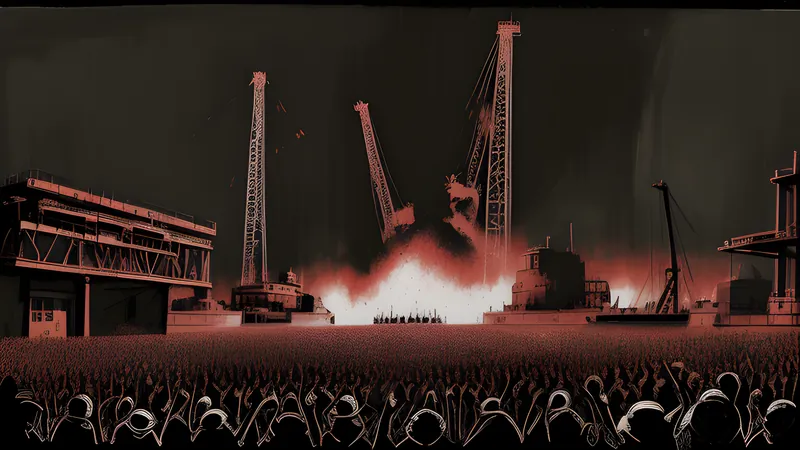
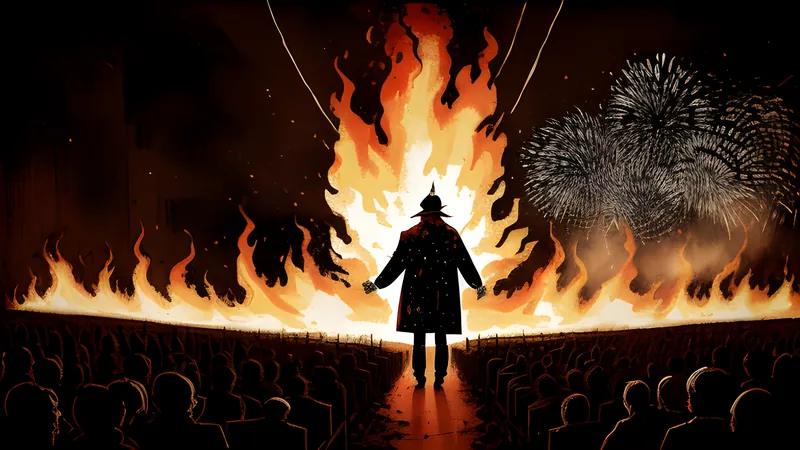
There is a moment near the end of a Rammstein show when a man in a harness rises off the stage floor, spreads a pair of steel wings that reportedly weigh around fifty kilograms, and throws fire out of the wingtips into the dark. The crowd — a hundred thousand people who mostly do not speak German — makes the same noise every time, in every city, in a language older than any of them. That noise is the whole argument for what this band does. You do not need the lyric. The fire has already told you the story.
Rammstein are the loudest, most literal, most expensive punchline in modern rock, and also the most misunderstood. Half the world files them under novelty: the German blokes who set things on fire. The other half treats the pyro as decoration bolted onto a metal band, sparks for the cheap seats. Both are wrong in the same way. The fire is the text. The songs are the excuse to build the fire. Once you see the show as dramaturgy — fire cued to meaning, a flame that arrives because a specific moment demands it — the whole enterprise stops being daft and starts being one of the few genuinely original ideas anyone has had about a stadium stage in forty years.
Six men from a country that stopped existing
You cannot understand the theatre without the biography, and the biography is stranger than the theatre. Rammstein formed in Berlin in 1994, but the more useful date is 1989, because five of the six grew up on the eastern side of a wall, citizens of the German Democratic Republic — a state that dissolved under their feet while they were young men. Several of them came out of the East German punk underground, bands with names like Feeling B and First Arsch, the sort of scrappy dissident noise that got you watched by the authorities.
The origin is almost comically humble. In 1994 there was a contest in Berlin for amateur bands, the prize a week in a proper recording studio. Richard Kruspe, Oliver Riedel, Christoph Schneider and Till Lindemann entered with a four-track demo and won it. Paul Landers heard the tape and wanted in. They talked the keyboardist Christian “Flake” Lorenz — who had played with Landers in Feeling B, and who was initially reluctant — into completing the six. That lineup has never changed. Not once, in thirty years. Vocalist, two guitarists, bass, drums and a keyboard player who spends a good part of each night being chased around a stage: Lindemann, Kruspe, Landers, Riedel, Schneider and Flake. Working with the producer Jacob Hellner, they put out Herzeleid in 1995, and the German music press reached for a label. What they landed on was Neue Deutsche Härte — new German hardness — a genre the band more or less invented by being the first thing that sounded like it.
The sound is the foundation everything else stands on. Down-tuned, mechanical, gigantic — guitars that move like industrial plant, a drum machine’s sense of grid married to a real drummer’s weight, and Lindemann’s voice, a rolled-R baritone that treats the German language as percussion. It is deliberately monolithic. It marches. Every complaint about Rammstein being one-note misses that the one note is the point: it is a wall, and a wall is what you build a spectacle against.
The night the equipment fell, and what came after
Here is the fact that turns Rammstein from a stunt into a craft. In 1996, at a show in Berlin, burning equipment fell onto the stage — an early, under-engineered rig doing what under-engineered rigs do. Lindemann has picked up burns over the years; fire that close to skin is not a metaphor. A lesser band takes that as a sign to dial it back. Lindemann took it as a sign to learn the trade properly. He trained as a licensed pyrotechnician, and by multiple accounts renews the licence every couple of years with a refresher course at Berlin’s Velodrom. The frontman is legally qualified to run the flames he stands inside.
That single decision is why the band is still working and still insured. Everything you see on a Rammstein stage sits on top of a safety operation most audiences never think about because they are not supposed to. The flame effects run on propane, plumbed and valved and cued to a timeline. Reports put the fuel burn somewhere around 265 gallons a show. There is a dedicated pyro crew, blast zones marked to the centimetre, sightlines calculated so the front row feels the heat without wearing it. The flamethrower masks worn during “Feuer frei!” — the ones that shoot fire several metres out from the players’ faces — are not blown into like a party trick; each is fed by a small tank with a controlled nozzle. The danger the audience feels is real. The recklessness they assume is not. That gap, between apparent chaos and actual engineering, is the professional heart of the thing, and it is the part every imitator underestimates.
Fire as grammar, not garnish
Now the interesting bit. What separates Rammstein from every band that has ever hired a flame licence for a festival slot is that they treat fire as language with a grammar, not as punctuation you sprinkle on choruses. The show knows which moments want fire and which moments want dark. It knows when to be a dream and when to be a nightmare.
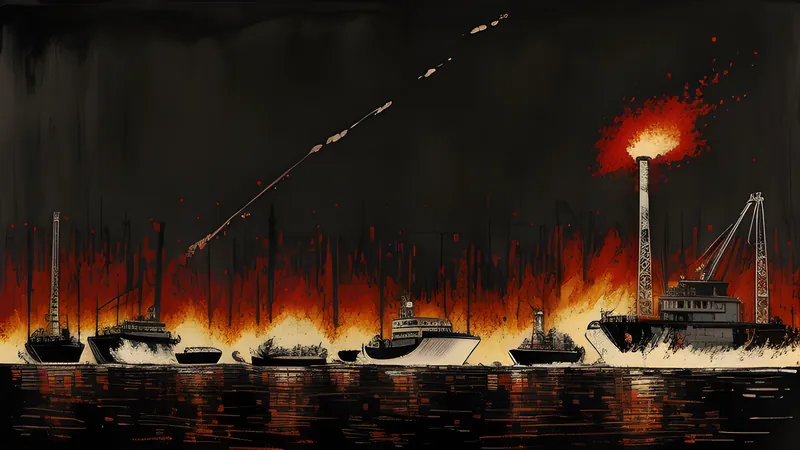
Take the set-pieces, because they are little plays. “Mein Teil” — a song built on a genuinely grim German news story of the early 2000s — is staged as a cannibal cook-out: Flake is wheeled on inside a giant cauldron and Lindemann advances on him with a flamethrower, the keyboard player scrambling to keep his goose uncooked while the frontman plays chef. The comedy and the horror are doing the same job the song does. Then “Engel” — “angel” — brings the steel wings and the harness, Lindemann lifted above the stage throwing flame from his own shoulderblades. A fallen angel who burns. You do not need a translation to read that. The staging is the translation. Elsewhere the flame simulates gunfire and detonation, a militaristic clatter that turns the stage into a small, controlled warzone for exactly as long as the song is about violence, then lets it go dark when the song does.
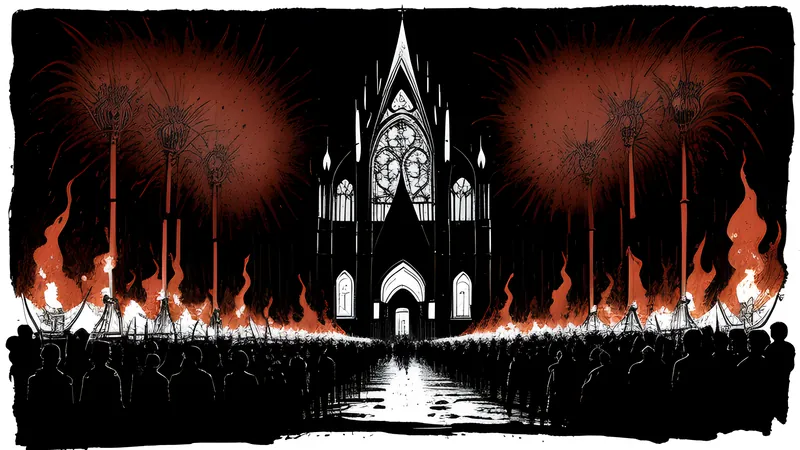
This is the discovery, and it is a real one: fire has semantics. A slow column of flame means something different from a sudden concussive burst, which means something different from a mask spitting a jet across the boards. A wall of it rising on a downbeat lands as an exclamation; a single tongue guttering in a quiet passage lands as dread. Rammstein worked out the alphabet and then wrote in it, matching the flame’s shape and speed and colour to the emotional weather of each song. That is dramaturgy — the same discipline a theatre director brings to lighting — applied to burning gas at stadium scale. Nobody had really done it before them as a designed system, which is why everyone has been quietly borrowing from it since.
Why it plays in a language you don’t speak
The great trick, the one that makes the export possible, is that the narrative survives the border. Rammstein sing almost entirely in German to crowds in Copenhagen, São Paulo, Mexico City and Los Angeles who do not understand a word, and it works anyway, because the meaning is carried by the pictures. The band figured out that a stadium is a bad place for lyrics and a perfect place for images. At two hundred metres the words are gone regardless of the language; what reaches the back is the silhouette of a man on fire, the cauldron, the wings, the wall of orange rising on cue. They built a show that reads at that distance, in that dark, to a crowd that size — a visual grammar engineered for the exact conditions of the enormous room.
That is a specific and hard-won competence, and it is worth naming honestly because so much of the arena business gets it wrong. Most big productions treat the screen as the primary storyteller and the stage as a place the band happens to stand, which is one of the reasons so many festival headliners have started to feel interchangeable — a subject I’ve chewed over in why every festival now feels the same. Rammstein keep the story on the stage, in three physical dimensions, in a medium — fire — that a camera can photograph but cannot fake. The crowd surge that answers a “Feuer frei!” mask ignition belongs to the same family of collective physical events as the wall of death: a body-level response the room performs together because something real just happened in front of it.
The Teutonic-industrial dialect everyone borrowed
Rammstein invented a staging language, and you can now hear its accent everywhere. The vocabulary is precise: monolithic industrial sound; a militarised, faintly totalitarian visual palette that flirts with iconography and then undercuts it with slapstick before it curdles into the real thing; heavy physical props over screens; and fire deployed as narrative rather than as a finale firework. That grammar has leaked into a generation of heavy productions. Walk the main stage at Copenhell or stand in the field at Wacken and count the flame bars, the choreographed bursts timed to a breakdown, the deliberate ugliness-as-aesthetic. Half of it is Rammstein’s dialect spoken with a local accent. Being copied badly is the surest sign you did something original first.
An honest critical read has to concede the limits too. The one-note quality is real; a Rammstein album asks less of you than a Rammstein show, and the provocation can tip from clever to merely loud when the staging idea is thinner than the fire around it. The band trades in shock, and shock has a diminishing exchange rate — what detonated in 1997 can look like brand maintenance by the third stadium lap. There are nights, on record, where the machine grinds without much underneath it. None of that touches the central achievement, which is durable in a way most spectacle is not.
Because here is what they actually did. They took the least literary tool imaginable — a jet of burning propane — and made it carry meaning, reliably, to millions of people who could not read the words. They engineered the danger so thoroughly that the danger could keep being felt for thirty years without killing the frontman. And they proved that a stadium, that cold cynical airport hangar of an economic proposition, could still hold a story if you built the story out of something the back row could see. The flamethrower is a punchline. It is also, in their hands, a sentence — and they are the only band that ever really learned to speak it.
Related Content