Primavera Sound: The Barcelona Sprawl
The taste-making festival on a concrete seafront that turned curation into a competitive sport
Contents
If Copenhell is a festival built to be loud and Roskilde a festival built to be worthy, Primavera Sound is a festival built to be right. For a quarter of a century the Barcelona event has traded on one thing above all others: the sense that its lineup is smarter than yours, that the bookers heard the band before you did, that a weekend on the Catalan seafront is the most reliable way in Europe to find out what actually matters in music right now. It is the connoisseur’s mega-festival, and it has spent twenty-odd years proving that curation itself can be a headline act.
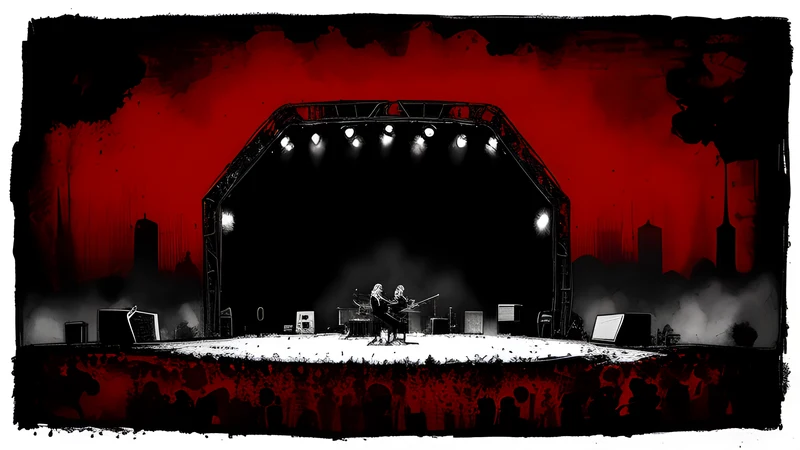
The festival started in 2001, a modest indie affair that grew with startling speed into one of the most respected events on the continent. Since 2005 its home has been the Parc del Fòrum, a vast expanse of concrete and open esplanade at the eastern edge of Barcelona, built for the 2004 Universal Forum of Cultures and given a second life as a festival site. It is an aggressively unromantic place, all hard surfaces, a marina, and a huge cantilevered solar canopy that has become the festival’s visual signature, and yet the combination of the Mediterranean on one side and the city lights on the other produces something genuinely distinctive. You are at a festival, in a city, by the sea, all at once.
The lineup as a manifesto
What made Primavera’s name was the booking. From the beginning the festival cultivated a reputation for lineups that read like a critic’s end-of-year list rendered into a timetable, cult veterans reactivated for a rare set, cutting-edge new acts given prominent slots, and the occasional huge pop name booked with enough irony and enough taste that it felt like a curatorial statement rather than a cash grab. The festival flattered its audience’s intelligence, and the audience responded with a loyalty that turned Primavera into a destination people plan holidays around. The bill is the product, and for years it was the best bill in Europe by a distance.
The most celebrated expression of that ethos came in 2019, when Primavera built its edition around a genuinely gender-balanced lineup, roughly half the acts fronted or led by women, and made an explicit argument out of it. In an industry where festival posters had for decades been overwhelmingly male, it was a landmark and a challenge to every other promoter on the circuit, proof that a balanced bill was a booking choice rather than a talent shortage. Whatever you think of festivals making political statements, it worked as both a principle and a piece of programming, and it cemented Primavera’s self-image as the thinking festival.
Barcelona hours
The single strangest and best thing about Primavera is the clock. This is a festival that runs on Spanish time, which means the headliners often do not start until well after midnight and the smaller stages keep going until the sun is threatening to come up. A Primavera day begins in the late afternoon and ends at dawn, and the whole rhythm of the thing is built around the Mediterranean night rather than the northern-European convention of packing up by eleven. For someone raised on Danish festivals that respect the neighbours and the noise curfew, the experience of watching a major band play at three in the morning to a fully awake crowd is genuinely disorienting and completely addictive.
That nocturnal schedule shapes the crowd and the experience. Primavera is not a place for the early night and the sensible breakfast. It demands you surrender to its hours, sleep through the morning, and treat the festival as an inversion of normal life for a few days. The concrete site, which looks bleak and industrial under the midday sun, transforms after dark into something spectacular, the stages glowing across the esplanade, the solar canopy lit up, the whole sprawl alive at an hour when every other festival in Europe has gone to bed. The place was built for the night.
The city as a stage
Part of what distinguishes Primavera from a festival marooned in a field is that it never fully leaves the city. For years the festival ran a strand of free concerts across Barcelona proper, in squares and clubs and record shops, so that the event spilled out of the Fòrum and coloured the whole city for a week each spring. That porousness matters. A field festival is a sealed world you enter and leave; Primavera is stitched into a functioning metropolis, and the tourists it draws spend the daylight hours in the city’s bars and beaches and galleries before heading east to the site as the sun drops. The festival is an economic and cultural event for Barcelona in a way a rural festival never can be for its nearest village.
That relationship is not frictionless. Barcelona has spent years wrestling with the pressures of mass tourism, and a festival that draws hundreds of thousands of visitors from across the world sits squarely inside that tension. Primavera brings money and prestige and it also brings crowds, price pressure and the familiar complaints about a city being reshaped around its visitors. The festival’s defenders point to the cultural capital and the jobs; its critics point to the same overtourism debates that shadow the whole city. Both are right, and the festival lives in the middle of that argument every spring.
The cashless machine
Primavera is also a case study in the modern festival economy, for better and worse. It was an early and thorough adopter of the cashless wristband, the RFID system that turns your wrist into a payment card and the festival into a closed-loop economy, and I have written about the cashless wristband and what it does to a festival at length elsewhere. Primavera runs that machine at scale, with the efficiency and the frictionless spending, and the queues and top-up frustrations, that come with it. It is one of the most technologically managed festivals in Europe, and the experience is smoother and more surveilled in equal measure.
The commercial sophistication cuts both ways. Primavera has grown into a genuine multinational, exporting the brand to Porto and running or attempting editions across the Americas, from Los Angeles to Buenos Aires to São Paulo. That expansion is the same consolidating logic reshaping the whole industry, the subject I keep returning to in why every festival now feels the same, and Primavera is a fascinating test of whether a festival whose entire brand is discerning curation can be franchised across continents without diluting the very taste that made it worth franchising.
The weekend that broke
No honest read of Primavera can skip 2022, the year the festival’s ambition outran its infrastructure. In a bid to mark its return after the pandemic and to capitalise on pent-up demand, Primavera expanded to two weekends across an enlarged site, and the result was widely reported chaos, sound problems where stages bled into each other, overcrowding, transport bottlenecks, and a crowd that felt processed rather than looked after. It was a chastening moment for a festival that had built its name on getting things right, and a reminder that the curatorial reputation does not automatically extend to the logistics of moving hundreds of thousands of people around a concrete park.
The festival recovered and recalibrated, but the episode lodged in the memory as a warning about the limits of scale. Primavera’s genius was always the bill and the location. When it chased raw size, the things that made it special started to strain. The best editions since have been the ones that remembered what the festival is actually for, which is the feeling that you are exactly where music is being decided, at the front of a crowd, at three in the morning, watching a band you will be telling people about for years.
The other kind of worthy
It is instructive to set Primavera beside Roskilde, the festival that gives its money away, because the two represent competing versions of the serious, grown-up mega-festival. Roskilde earns its moral authority through its non-profit model and its charitable giving, a Nordic idea of a festival as a public good. Primavera earns its authority through taste, through the claim that it books better than anyone else. One festival asks you to admire its ethics; the other asks you to trust its ears. Both are trying to be more than a promoter’s cash machine, and both have to keep proving it against an industry that would happily strip either one for parts.
The comparison flatters neither and illuminates both. Roskilde’s virtue is structural and permanent; the money goes to good causes whatever the lineup does. Primavera’s virtue is renewable and fragile; it lasts exactly as long as the bookers stay ahead of the curve, and a couple of dull years would puncture the entire premise. That is a riskier foundation to build an institution on, which is precisely what makes Primavera’s long run of getting it right so impressive. Taste is harder to sustain than a charitable constitution, and Barcelona has sustained it about as long as anyone could reasonably ask.
What Barcelona proves
Primavera matters because it argues, more persuasively than any other big festival, that taste is a thing worth building an institution around. Most mega-festivals compete on scale, on headliners, on spectacle. Primavera competed on being right, on hearing it first, on assembling the weekend that the rest of the industry would spend the next year catching up to. That is a fragile thing to stake a festival on, dependent entirely on the bookers staying sharper than everyone else, and the fact that Primavera has largely managed it for a quarter of a century is a real achievement in an industry that mostly rewards playing safe.
It could not be more different from the metal pilgrimages and Nordic gatherings I usually write about, and that is exactly why it is worth understanding. A festival on a concrete seafront, running until dawn, built on nothing more solid than the promise of a superior lineup, has become one of the most influential events in European music. The Mediterranean helps. The late nights help. But the thing that made Barcelona the festival other festivals watch was always the bill, and the nerve to trust that being right would be enough.
Related Content