Posten: Odense's Loyal Little Rock Room
A converted postal package house by the station has been Odense's rock stronghold for nearly forty years — the third pillar of provincial Danish live music
Contents
Denmark’s live-music strength has never been about Copenhagen alone, and the proof sits next to the railway station in Odense in a building that used to sort parcels. Posten — properly Musikhuset Posten — has been the rock stronghold of the country’s third city for close to forty years, a converted postal package house that turned into a stage and never looked back. It’s the kind of loyal, unglamorous, essential room that keeps a national scene honest, and if you only ever gig in the capital you’re missing half of what makes Danish live music work. Here’s the case for the little room in the middle of Funen.
Posten matters for the same reason the Aarhus clubs matter: it gives a real city its own front door to live music, so a Danish band on the way up has somewhere to prove itself in Odense as well as the big rooms east and west. That density of provincial venues is the quiet engine under the whole scene. Posten has been running that engine on Funen since the 1980s, and it’s still going.
From parcels to power chords
The building started life as a postal package house beside Odense Central Station, and the venue was set up inside it in 1984 under the name Rytmeposten. It took a couple of years to find its feet as a proper concert room — the first real gig landed on 26 December 1986 — and it’s been Odense’s rock address ever since, tucked at Østre Stationsvej 35, a short walk from the trains. The postal bones are half the charm: a solid, functional, workmanlike building that was never meant to be pretty and grew into its second life as a music room without pretending to be anything grander.
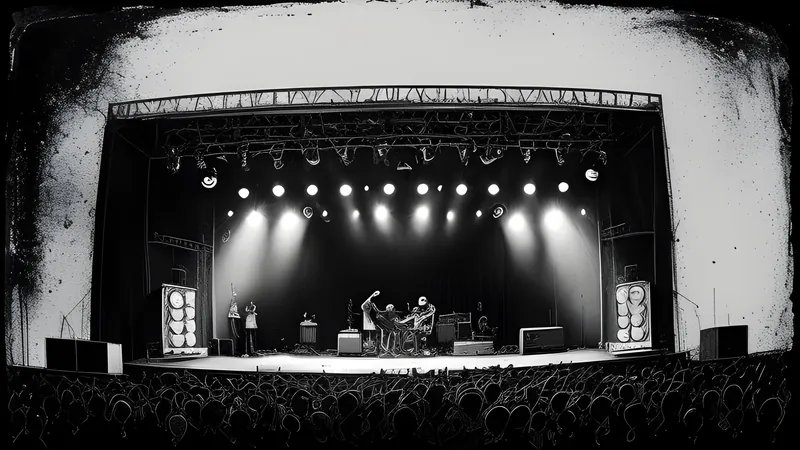
The place got a serious upgrade in 2007, when a new extension added a large hall and the venue relaunched — the main room now takes around 900 standing, or 350 seated, while the original older stage handles the smaller shows at about 300 standing. That two-room setup is exactly what a provincial venue needs: a big room for the touring headliner and an intimate one for the local support and the emerging act, under the same roof, so a band can grow through the building rather than outgrow the town.
The programming keeps a wide net but the heart of it is rock and everything adjacent to rock — the loud, guitar-driven end of the spectrum that gives Posten its identity. It’s an unashamed rock room in a city that isn’t always associated with the loud stuff, and that slight underdog quality is part of why the crowd is so devoted.
The name is worth a footnote, because it tells you what the place is. Posten simply means “the post” — it kept the identity of the building it took over, the way the best converted venues do, wearing its former life as a badge rather than hiding it. There’s something apt about a room named for a package house: a place whose whole original job was to receive things from elsewhere and pass them on to the city. It does exactly that now, only the deliveries are bands. Rytmeposten, the original name, tied it to the rhythmic-music movement that Danish cultural policy spent decades supporting — the network of publicly-backed venues, the spillesteder, that gives even mid-size Danish towns a professional stage. Posten is one of the flagships of that system, and understanding it explains a lot about why Denmark’s live scene is so unusually deep for the size of the country.
The room, and why 900 is the right number
Nine hundred capacity is a lovely size to see a band, and Posten’s main hall makes the case for it. It’s big enough that real touring acts will route through — bands that would otherwise skip Funen entirely — and small enough that there’s no bad spot and no distance to speak of between you and the stage. Stand anywhere and you’re in it. Get down the front and you’re close enough to see the setlist taped to the monitor.
As a physical room it’s honest and functional rather than acoustically pampered — a converted package house, not a purpose-built concert hall, so the sound depends more than usual on the touring engineer and how hard the desk is being pushed. A well-mixed loud show sounds properly good in here; the modest scale means the PA never has to work miracles to fill the room, and a 900-cap hall is far more forgiving than a cavernous exhibition space. What you get is the mid-size club virtue in full: volume you feel in your chest, a crowd pressed close, and none of the airless processing of a big arena. It’s the opposite end of the scale from a room like Royal Arena, and gloriously so.
The smaller original stage is the secret weapon. That’s where the local support bands and the emerging Danish acts cut their teeth, in front of a hometown crowd, in a room intimate enough that a good set travels by word of mouth by the next morning. Rooms like that — the small back stage inside a bigger venue — are where a national scene actually renews itself, one 300-capacity night at a time.
The two-room arrangement also solves a problem that kills a lot of single-hall venues: the mismatch between a band’s draw and the size of the space. A club with only one 900-capacity room has to either turn away the act that will only pull 200 or watch it die in a cavern. Posten just moves that band to the small stage, sells it out at 200, and gives everyone a good night — the band plays to a full room, the crowd gets an intimate show, and the venue keeps its lights on. Scale the same act up over a couple of years and it graduates to the big hall without ever leaving the building. That flexibility is unglamorous and enormously important, the sort of practical design decision that separates a venue built by people who understand the business from one built by people who just wanted a stage.
The loyalty of a provincial crowd
The thing you notice at Posten is the devotion. A capital-city crowd is spoiled — there’s a gig every night and any given show is one of dozens on offer. In Odense a good touring band coming to Posten is an event, circled on the calendar, and the crowd shows up like it matters, because it does. That gives a Posten show a warmth and a commitment that the jaded big-city rooms sometimes lack. People are genuinely glad the band came, and the band feels it.
That devotion runs both ways, and it’s worth being clear about the mechanism, because it’s the same one holding up small venues across the country. A room like Posten doesn’t survive on ticket sales alone — mid-size venues almost never do, the margins are too thin. It survives on a combination of a loyal base, public cultural funding through the Danish rhythmic-venue system, a bar that turns a profit, and the stubborn institutional will of the people who run it. Take any one of those legs away and the whole thing wobbles. That’s why a room like this is more fragile than it looks and more precious than it seems: it’s a piece of civic infrastructure disguised as a rock club, and when one closes, a city doesn’t just lose a venue, it loses the only rung on the ladder where a local band could ever have started climbing.
That loyalty is what keeps a room like this alive across forty years and a changing industry. Provincial venues survive on a devoted local base and a canny two-room economics — the big hall pays the bills, the small stage grows the future, and the whole thing runs on the goodwill of a city that would notice, sharply, if its rock room ever closed. Posten is woven into Odense’s cultural life in a way a shiny new arena never manages, precisely because it’s old, unglamorous and theirs.
Set it alongside the other provincial strongholds and the picture snaps into focus. Aarhus has its central pair, covered in the guide to Voxhall and Train; Odense has Posten; and this spread of loyal mid-size rooms across the country is exactly why Denmark exports so much more loud music than a nation of six million has any right to, the argument I made in full in little country, loud export. The band that will fill a big room in a few years is, right now, playing the 300-cap back stage at a place like this in front of 200 devoted locals.
The verdict
Posten is the loyal little rock room every real city deserves and not every city has — a converted postal package house by Odense station that’s been the loud heart of Funen since the mid-1980s. The main hall’s 900 capacity is a near-perfect size to see a band, the small original stage keeps the local scene renewing itself, and the crowd’s devotion gives every show a warmth the big-city rooms can’t buy.
Go when a band you love routes through Odense, and go early enough to catch whatever local act is opening on the small stage — that’s where the future of Danish rock is being auditioned, one hometown night at a time. Posten isn’t famous and doesn’t need to be. It’s the third pillar holding up a national scene, and it’s been doing the job, quietly and stubbornly, for the better part of forty years.
Related Content