Myrkur: Black Metal and the Backlash
Amalie Bruun made a fine black-metal record and the genre's gatekeepers lost their minds
Contents
The Myrkur story is really two stories running side by side. One is about a genuinely gifted Danish musician who made a striking, atmospheric fusion of black metal and Nordic folk and grew, record by record, into an artist of real distinction. The other is about the ugliest reflexes of a subculture — a wave of gatekeeping, harassment and bad faith that greeted her arrival and revealed a great deal about who black metal thinks it belongs to. You cannot honestly write about Myrkur without telling both, because the backlash became part of the work, and the way Amalie Bruun rode it out is a large part of why she matters.
I come down firmly on one side of this, so I will say it plainly: the music was good, the objections were nonsense, and the scene embarrassed itself. But the episode is worth examining in detail, because it is one of the clearest case studies going of how a subculture polices its borders, and of what it costs the people caught on the wrong side of that policing.
Amalie Bruun and the arrival of Myrkur
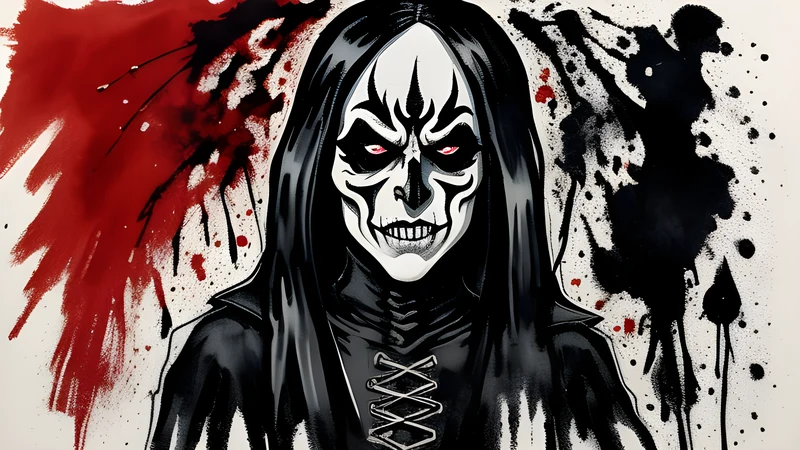
Myrkur — the Old Norse and Icelandic word for “darkness” — is the solo project of the Danish musician and actor Amalie Bruun, who launched it with a self-titled EP in 2014, initially anonymously. The music was atmospheric black metal woven through with Nordic folk melody and clean, choral singing: shrieked passages set against soaring, hymn-like vocal lines, the cold and the beautiful sharing the same songs. It was accomplished, distinctive, and clearly the work of someone with real melodic gifts and a genuine feel for the genre’s atmosphere.
Then her identity came out, and with it the details the gatekeepers seized on. Bruun was a woman. She was classically trained and came from a pop and indie background, having released more mainstream music and appeared in fashion and advertising work. She was, in other words, an outsider by the narrow standards of a scene that prized a very particular kind of underground authenticity — and the reaction was immediate and vicious.
The backlash
What Bruun walked into was a torrent. She faced sustained online harassment, dismissive “she’s not real black metal” pile-ons, sneering about her looks and her background, accusations that she was an industry plant, that a woman from pop could not possibly mean it, that the whole project was inauthentic by definition. The volume and nastiness of it went well beyond ordinary critical disagreement into something closer to a coordinated attempt to drive her out.
Strip away the specifics and the objections came down to a single anxiety: Bruun did not fit the template of who was allowed to make this music. She had arrived from outside the underground’s approved path; she had a public, feminine, commercial past; and she was a woman entering one of the most aggressively male spaces in music. The black metal scene had always guarded its borders jealously, obsessed with authenticity and quick to reject anything it deemed a poser or a tourist, and Bruun triggered every one of those reflexes at once.
The double standard
The harshest light on the whole affair comes from a simple comparison. Black metal is full of musicians with unlikely, incongruous or downright disreputable backstories, and the scene has always been happy to accommodate them when it wanted to. Male musicians with pop pasts, with classical training, with side careers in wildly different genres, have been welcomed as evidence of range and seriousness. The genre’s most celebrated figures have committed real crimes and been mythologised rather than exiled. Yet a woman with a background in indie pop and some modelling work was treated as a fatal threat to authenticity. The inconsistency is the whole story. The “rules” Bruun supposedly broke were never rules at all; they were a pretext, applied selectively, and the selection principle was that she was a woman and an outsider who had not asked permission.
It is worth being precise about the harassment too, because “backlash” can sound abstract. Bruun received threats. She was mocked in coordinated campaigns. Her appearance was dragged into what should have been arguments about music. Interviews from the period show her having to defend her right to exist in the genre rather than discuss her actual work, an indignity her male peers were never asked to endure. That is the reality the word gatekeeping tends to sanitise, and it should be named for what it was.
Why the objections were nonsense
Here is the thing that makes the whole episode so revealing: the gatekeeping arguments collapse the moment you examine them. The complaint that Bruun came from outside the scene ignores that black metal was invented by teenagers with no scene to come from — the genre’s founders made it up as they went, and there is no apostolic succession that confers legitimacy. The complaint about her pop background ignores that plenty of respected extreme musicians have eclectic pasts, and that Ulver, one of the scene’s most revered names, spent their career fleeing black metal into pop and electronica to near-universal acclaim. The complaint that she was a woman needs no rebuttal beyond stating it out loud.
And crucially, the music was good. Whatever you think about scene politics, the songs stood up. The debut EP led to the full-length M in 2015, produced by Kristoffer Rygg of Ulver — a serious figure lending his imprimatur — and it was a strong, atmospheric record that would have been well received had it appeared under a different name and backstory. The gatekeepers were responding to the wrong person having made decent music, which is the tell that the whole thing was about identity rather than quality.
The music that outlasted the noise
The best rebuttal to a backlash is a body of work, and Bruun built one. Mareridt in 2017 (the title is Danish for “nightmare”) deepened the folk and atmospheric elements and was widely regarded as a step up, darker and more assured. Then Folkesange in 2020 dropped the metal almost entirely for an album of Nordic folk sung in Danish and other Scandinavian languages — a beautiful, traditional record that connected Myrkur explicitly to the wider Nordic folk revival and demonstrated that the folk element had never been a costume. Spine in 2023 brought the heaviness back in a more integrated form. Across four records Bruun proved she was a real, evolving artist with a clear vision, and the early “not real black metal” noise came to look exactly as small as it was.
It is telling, too, that the establishment figures who actually knew the genre backed her. Rygg’s production work on M was an endorsement from precisely the kind of unimpeachable underground name the gatekeepers claimed to speak for, and other respected musicians lent their support over the years. The people with the deepest claim to the scene’s authority mostly recognised the talent in front of them; the loudest objectors tended to be anonymous accounts with far more investment in policing than in music.
Live, Myrkur grew into a compelling proposition, the recorded layers translated to the stage with real presence and Bruun a commanding focal point. The folk material in particular works beautifully in a room, and the shows drew audiences well beyond the black-metal core — folk listeners, the curious, people who had followed the story and stayed for the songs. The project outgrew the scene that had tried to reject it, which is the most satisfying possible outcome.
The folk thread, and what it proves
The single most effective answer Bruun gave her critics was Folkesange. By making an entire album of Nordic folk — traditional songs, old instruments, no metal to hide behind — she demonstrated that the folk sensibility running through Myrkur from the start was the real core of her artistry rather than an affectation grafted onto black metal for effect. It reframed the whole project retrospectively. The clean, hymn-like vocals that gatekeepers had sneered at as un-black-metal turned out to be the thing Bruun did best, rooted in a genuine Scandinavian folk tradition she had every claim to. Far from being a tourist, she was drawing on the same deep well that the wider Nordic revival draws on, and doing it with real command.
That record also placed Myrkur firmly in the company of the serious modern Nordic folk artists rather than as a black-metal curiosity. The connection between the extreme scene and the folk revival is well established — a striking number of the folk musicians came up through metal — and Bruun’s trajectory fits that pattern exactly, moving from the harsh end of the spectrum toward the traditional. Seen in that light, the early controversy looks even smaller: the scene was busy arguing about whether she belonged while she quietly built a body of work that transcended the argument entirely.
There is a wider lesson here about how genres grow. Every healthy musical form eventually absorbs outsiders who bend its rules, and those outsiders are usually the ones who push it somewhere new. The gatekeepers who tried to wall black metal off from a talented newcomer were, in effect, trying to freeze the genre at a particular moment and ban it from developing. Bruun’s success is a small victory for the opposite principle: that a living art form belongs to whoever can do something worthwhile with it, credentials and permission be damned. The Nordic folk and black-metal fusion she helped popularise has since become a well-populated field, and the borders the gatekeepers fought to defend turned out to be entirely imaginary.
What the episode says
The Myrkur backlash is worth remembering as a document of subcultural gatekeeping at its worst — a case study in how a scene that fancies itself rebellious and free-thinking can be reflexively conservative and cruel about who gets to belong. The irony is thick: a genre built on transgression and outsider status turned around and policed its own borders with the zeal of the establishment it claimed to despise. The people shouting loudest about authenticity were enforcing conformity, and they did it in the name of a music whose whole point was supposed to be that it answered to no one.
Bruun’s answer was the right one. She kept making the music she wanted to make, ignored the noise, and let the work accumulate until the objections looked absurd in hindsight. A decade on, Myrkur is an established and respected project, and the gatekeepers who tried to run her off are a footnote — remembered, if at all, as the people who got it wrong. That is how these things should end, and it is a useful thing to hold onto the next time a scene starts deciding, loudly, who is and is not allowed to belong. The gate was never theirs to keep.
Related Content