Motörhead in Copenhagen, 2015: The Last Time Lemmy Came North
The fortieth-anniversary tour crossed Scandinavia at the end of 2015 and skipped Denmark — an elegy from Copenhagen, weeks before the end
Contents
In the first days of December 2015, Motörhead’s fortieth-anniversary tour crossed Scandinavia and left Denmark off the map. The routing went Gothenburg on the first, Oslo on the third, Stockholm on the fourth, Helsinki on the sixth — a tight little arc across the top of Europe that came within sixty kilometres of the Danish coast and never touched it. From Copenhagen you could stand on the Øresund shore and more or less watch the tour bus pass on the Swedish side. We got nothing. And because of what happened three weeks later, we now know that nothing was final.
The tour that went round us
Ian Fraser Kilmister — Lemmy to everyone alive — died in Los Angeles on 28 December 2015, four days after his seventieth birthday, of a cancer that had been diagnosed only days before. The band’s manager confirmed the illness had moved with brutal speed. By the time anyone outside the inner circle understood how sick he was, the fortieth-anniversary tour was already the last one, and the Nordic swing at the start of December was already the last time Lemmy came anywhere near the north.
There had been a Danish date pencilled into the wider itinerary earlier in the run, and it evaporated the way a lot of that autumn evaporated — guitarist Phil Campbell had been hospitalised in November, shows were shuffled and dropped, and Lemmy himself was visibly failing on the nights he did make. Drummer Mikkey Dee, a Scandinavian himself, put it plainly afterwards: Lemmy was terribly gaunt, spent everything he had on stage, and was wiped out the moment he came off. Watch the Helsinki footage from 6 December and you can see it. The voice is still there. The man is disappearing behind it.
So Denmark’s last chance to see Motörhead had quietly already passed, some earlier year, without anyone in the room knowing it was the last one. That is the cruel arithmetic of a band that toured this relentlessly for four decades: you assumed they would always come back, because they always had, and then one December they went round you instead, and then Lemmy was gone. Copenhagen spent Christmas 2015 realising it had missed a goodbye it never knew was being offered.
Who Lemmy actually was
For anyone who came to this late, it is worth being exact about what was lost, because the caricature — the warts, the mutton-chops, the bottle of bourbon, the mole you could set your watch by — buried a genuinely serious musician under a cartoon.
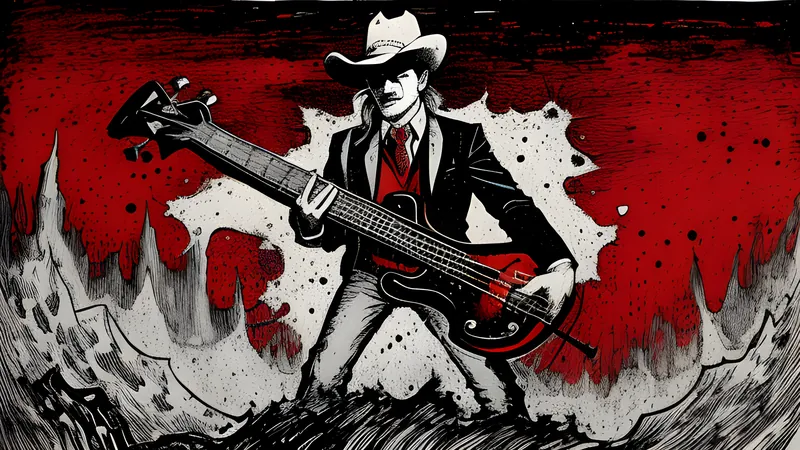
Lemmy formed Motörhead in 1975 after being sacked from the space-rock band Hawkwind, and he built the new group around a simple, radical idea about volume and speed. He played bass as if it were a rhythm guitar and a lead guitar at once, all treble and distortion and chords, through a wall of Marshall stacks, standing with the microphone tilted down so he had to crane his neck up to sing into it. The gravel in that voice was real and permanent. The band’s self-description became a genre in one sentence: they were Motörhead, and they played rock and roll — faster and louder than the definition strictly allowed.
The classic run of records did the rest. Ace of Spades arrived in 1980 with a title track that compressed everything the band was into two minutes and forty-nine seconds of downstroke velocity, and it became the thing every speed-metal, thrash and hardcore band that followed had to reckon with. Metallica reckoned with it. Every European pit that ever ran itself into a blur reckoned with it. Motörhead sat at the exact hinge between the biker rock of the seventies and the extreme metal of the eighties, and half the loud music made since has Lemmy’s fingerprints on the amp.
The late-period line-up — Lemmy on bass and vocals, Phil Campbell on guitar, Mikkey Dee on drums — held remarkably steady from the mid-nineties until the end, and it was a formidable live band right up to the point the body gave out. This was the outfit that kept coming through Copenhagen, year after year, until the year it couldn’t.
Copenhagen and the warlord
Because Motörhead did come here, over and over, and the record proves it long before I ever bought a ticket. They played Saga Rockteater in 1986, KB Hallen in 1999, Vega in November 2000. When I moved to Copenhagen in 2011, one of the first big shows I caught in my new city was Motörhead back at Store Vega that December — the band tearing the paint off the best-sounding room in Denmark on a filthy winter night, Lemmy already in his mid-sixties and giving no ground whatsoever. I am not going to dress that evening up with invented drama. What I remember is the plainness of it: three men, a mountain of amplifiers, and a volume that reorganised your ribcage. He did not perform being Lemmy. He simply was it, at that decibel level, for ninety minutes, and then he went to the bar.
That is the thing Copenhagen understood about him and mourned properly when he died. This is a city that takes its loud music seriously and tends its own institutions carefully, the same civic seriousness that fills Copenhell every June. Lemmy was an honorary member of that congregation. He had been playing Danish stages since before half the Copenhell crowd was born, and he treated a sweaty Wednesday in a converted warehouse with exactly the same gravity as a stadium. There was no off night, no phoning-in, no sense that the provinces of the touring map got a lesser version. You got the whole thing every time, which is precisely why his death landed as heavily here as it did in Britain.
And there is a direct through-line from that band to the physical culture of the Danish pit. The mechanics of a Motörhead crowd — the surge, the collective velocity, the way a room converts speed into motion — is the ancestor of everything that happens on a modern festival field. When I write about the wall of death as a thing crowds do to each other on purpose, I am describing a behaviour that bands like Motörhead spent forty years teaching audiences was expected, even demanded. He handed the north a vocabulary of noise, and the north kept using it.
The last months
The end came fast enough to be merciful and slow enough to be public. Through the autumn of 2015 the cancellations mounted and the reasons stayed vague — exhaustion, a chest thing, Lemmy’s own stubbornness about admitting weakness. The band finished the tour it could finish. The final Motörhead concert took place in Berlin on 11 December 2015, seventeen days before Lemmy died. He had turned seventy on Christmas Eve. Two days after that, the diagnosis; two days after that, he was gone, at home in Los Angeles, reportedly with his favourite video-game machine wheeled to his bedside.
The speed of it is what stayed with people. He had been an apparently indestructible fixture for so long — the man who outlived every prediction and buried a fair few of the doctors who made them — that his mortality arrived as genuine shock rather than slow decline. Copenhagen had assumed, the way everyone assumed, that there would be another Vega show, another festival slot, another chance. The Scandinavian arc of early December had gone round Denmark, and then the map closed for good.
What he left in the room
Here is the honest reckoning, and it is not a sad one, exactly. Lemmy got seventy years and forty of them on stage, living precisely as he intended, and he was still audibly a great band’s engine on the night in Helsinki that turned out to be one of his last. Very few people get to do the thing they love at full volume until nearly the final week. He did.
What Copenhagen lost in December 2015 was a musician and, beyond that, a kind of permission — the standing proof that you could refuse to soften, refuse to slow, refuse every reasonable instruction to grow out of it, and keep the whole edifice standing on sheer volume and conviction for four decades. That is a rarer thing than a hit single. The bands that fill Danish stages now, the emerging acts sweating it out in the back rooms of the loud circuit, are all working inside a template he did more than almost anyone to build.
The tour went round us that winter. It is the one routing decision I would undo if I could, the missing Danish date that turned out to be the missing goodbye. But the city had already got its share of Motörhead across thirty years of shows, and the sound he made is not going anywhere — it is baked into every downstroke and every surge on every field where the north gets loud. He was Motörhead. He played rock and roll. And the last time he came anywhere near here, he was still, right to the edge of it, giving us all of it.
Related Content