Mayhem: Black Metal's Grim Institution
The band that gave a genre its sound, its imagery, and its most notorious history
Contents
Every genre has a band that is less a band than a foundation stone — the group whose name you cannot say without invoking the whole thing behind it. For black metal that band is Mayhem, and the weight it carries is heavier than any group should have to bear. Mayhem gave the genre its sound, its visual language, and, in the early 1990s, a chain of real-world horror so extreme that it still distorts how the outside world sees the entire scene. Four decades on, the band is a going concern that tours arenas and headlines festivals. Getting your head around that requires holding several very different things in your mind at once.
I want to write about Mayhem as a critic rather than a true-crime narrator, because the true-crime version has been told to death and it flattens the music into a lurid anecdote. The murders and the church fires are real and I will not pretend they are not part of the story. But the reason we are still talking about Mayhem is that they made one of the most important extreme records ever committed to tape, and everything the genre became was drawn from a template they built first.
Oslo, 1984: the blueprint
Mayhem formed in Oslo in 1984, founded by guitarist Øystein Aarseth, who took the stage name Euronymous and, more than any single person, functioned as black metal’s ideologue-in-chief. The early band was cruder and thrashier than the sound they would become famous for — their 1987 EP Deathcrush is a raw, primitive blast that owes as much to Hellhammer and Celtic Frost as to anything Norwegian. What Deathcrush established was attitude and intent. The sound came later, and it came out of a specific set of choices: trebly, deliberately thin guitar tone, blast-beat drumming, shrieked rather than growled vocals, and an aesthetic of coldness, misanthropy and winter.
Euronymous ran a record shop in Oslo called Helvete (Norwegian for hell), and its basement became the physical and social hub of the emerging scene. Members of Emperor, Burzum, Darkthrone and the rest passed through; the shop was the meeting point where a loose group of young musicians talked themselves into a movement. If you want the wider picture of how that circle turned into a genre, the story of Norwegian black metal is really the story of the people who orbited that basement, and Mayhem sat at the centre of it.
Dead, Euronymous, and the horror years
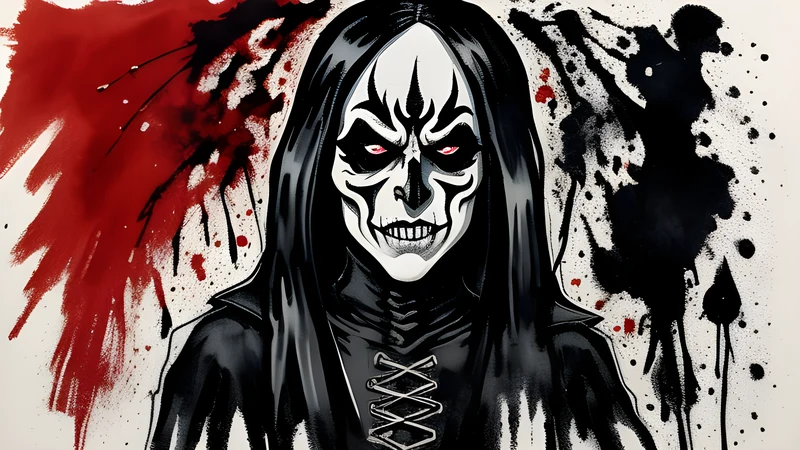
Here the story turns dark, and there is no way around it. In 1988 the band recruited a Swedish vocalist, Per Yngve Ohlin, who performed as Dead — an intense, troubled figure who introduced the corpse-paint style that became the genre’s signature and who was, by every account, genuinely committed to a bleak world-view rather than performing one. In April 1991 Dead took his own life. The events surrounding his death, and the choices Euronymous made in their aftermath, are among the most disturbing in music history and I will leave the details in the record where they belong.
Then came the church burnings — a wave of arson attacks on historic Norwegian stave churches between 1992 and 1993, carried out by figures connected to the scene — and finally the murder of Euronymous himself in August 1993 by Varg Vikernes of Burzum, following a poisonous falling-out between the two men. Vikernes was convicted and served over a decade in prison. In the space of two years the band’s founding vision and its founding musician were both gone, one to violence he helped inspire and one to violence he inflicted. The scene’s fascination with darkness had collided with the real thing, and people were dead.
De Mysteriis Dom Sathanas
Out of that wreckage came the record. De Mysteriis Dom Sathanas, released in 1994, is the album on which the whole genre is arguably still standing. It was recorded in fragments before and after Euronymous’s death, and its line-up is a grim historical footnote in itself: guitar by the murdered Euronymous, bass by his murderer Vikernes (later re-recorded, in disputed circumstances), drums by Hellhammer, and vocals by the Hungarian Attila Csihar, whose otherworldly, ritualistic delivery gave the album a quality no shrieked-vocal record had managed before.
Set the history aside for a moment and simply listen. The record is cold, vast, controlled and genuinely frightening in a way that has nothing to do with knowing the backstory. The guitars shimmer rather than crunch; the atmosphere is cathedral-sized; Csihar’s voice sounds like something addressing you from inside a wall. It is the moment black metal stopped being fast thrash with corpse paint and became its own art form, with its own logic of texture and dread. Every atmospheric black-metal record since — and there are thousands — owes it a debt.
The institution that kept going
Most bands would have ended there, and by every reasonable measure Mayhem should have. Instead Necrobutcher, the bassist who had walked away during the worst years, returned, and Hellhammer kept the drum stool, and the band simply carried on. The post-tragedy Mayhem is a real, evolving group rather than a nostalgia act. Grand Declaration of War in 2000 was a wildly divisive, almost avant-garde record that fractured the song structures into something clinical and strange. Chimera and Ordo Ad Chao followed, the latter a murky, difficult 2007 album that reunited them with Attila Csihar as full-time vocalist and won them a new critical standing. Esoteric Warfare in 2014 and Daemon in 2019 kept the run going, and by the 2020s Mayhem were performing De Mysteriis Dom Sathanas in full to festival crowds who were children, or unborn, when it came out.
That is the strangest part of the whole saga. The band that once burned outside the mainstream now headlines the very festivals the mainstream attends. I have watched a corpse-painted Attila conduct a field of thousands through that record’s rituals, complete with impaled pig heads and clouds of incense, and the striking thing is how well the theatre holds up — how a genre built on being genuinely dangerous has become genuinely great at spectacle. Attila’s stagecraft, in particular, is a masterclass; he treats the show as a ceremony, and the crowd, half-ironic and half-devout, plays along. The Oslo festival circuit treats Mayhem as elder statesmen now, which would have been unthinkable, and probably repellent, to the teenagers in the Helvete basement.
The sound, in detail
It is worth being precise about what Mayhem actually invented sonically, because “it sounds evil” is not a description. The signature Norwegian black-metal guitar tone is thin, bright and cold — the opposite of the thick, scooped murk the Swedish death-metal bands were chasing at exactly the same moment a few hundred kilometres away. Where death metal wanted weight, black metal wanted a kind of freezing shimmer, guitars tuned close to standard and drenched in high-end distortion so that fast tremolo-picked riffs blur into a single sustained wash of sound. Over that wash you lay blast beats — the drummer’s hands and feet moving in a continuous roll rather than marking out grooves — and the effect is less a series of riffs than a weather system. It is music built to sound vast and impersonal, like standing outside in a Norwegian winter, and that atmospheric ambition is the genre’s real inheritance from Mayhem.
Hellhammer’s drumming deserves singling out. He is one of extreme metal’s genuinely great technicians, and part of what makes De Mysteriis hold together is the precision underneath the chaos — the sense that however unhinged the atmosphere gets, there is an iron pulse holding it in place. A lesser drummer would have let the record collapse into noise. Hellhammer gave it architecture, and thirty years of black-metal drummers have measured themselves against him.
What Mayhem actually gave us
Strip away the crimes and the mythology and ask the plain question — what did this band contribute? — and the answer is enormous. They fixed the visual identity of a genre; the history of corpse paint essentially begins with Dead. They set the template for the vocal style, the guitar tone, the atmosphere and the ideological posture that a thousand bands adopted. They made a record that remains a genuine artistic peak. And they demonstrated, catastrophically, what happens when a subculture’s flirtation with real darkness stops being a flirtation.
That last lesson is the uncomfortable one, and honest writing about Mayhem cannot dodge it. The romance around the early years — the corpse paint, the isolation, the against-the-world purity — is inseparable from the fact that it produced arson and murder. Plenty of people have died younger and sadder than the myth admits. I love the record and I will not pretend the history is anything other than a warning.
The problem of the myth
There is a cottage industry now — books, films, endless documentaries — built on the Mayhem legend, and most of it gets the emphasis exactly wrong. The murders and the arsons are treated as the point, the music as a soundtrack to the crimes. That is backwards. Nobody would have made a film about a group of squabbling Oslo teenagers if the group had not also produced a record that changed an art form. The horror is what makes the story sell; the music is what makes it matter. When outsiders reduce Mayhem to a true-crime curiosity they are, ironically, doing exactly what the band’s most cartoonish tendencies invited, and they miss the thing worth preserving.
It also does a disservice to everyone else in the scene, most of whom burned no churches and killed no one, and who spent the 1990s quietly making extraordinary music. The lurid version turns an entire generation of Norwegian musicians into suspects. The fairer version treats Mayhem as what they were: pioneers who made a landmark record and who were also, in their worst years, at the centre of a genuine tragedy that the genre has spent three decades living down.
Where they stand now
Four decades in, Mayhem occupy a peculiar and probably permanent position: the most influential band in their genre, a functioning live act with a genuinely strong latter-day catalogue, and a walking piece of history whose worst chapters they can never outrun and, to their credit, rarely try to sanitise. They remain grim by design, theatrical by evolution, and essential by any measure that takes extreme music seriously. The institution stands. It was built on frozen ground and terrible events, and it produced one of the defining works of its art form, and both of those things are true at once. That contradiction is Mayhem, and it is black metal, and you do not get to keep one without the other.
Related Content