Loppen: Christiania's Sweatbox Where the Sound Still Wins
A few hundred bodies, one low attic room, and a PA that refuses to lose

Contents
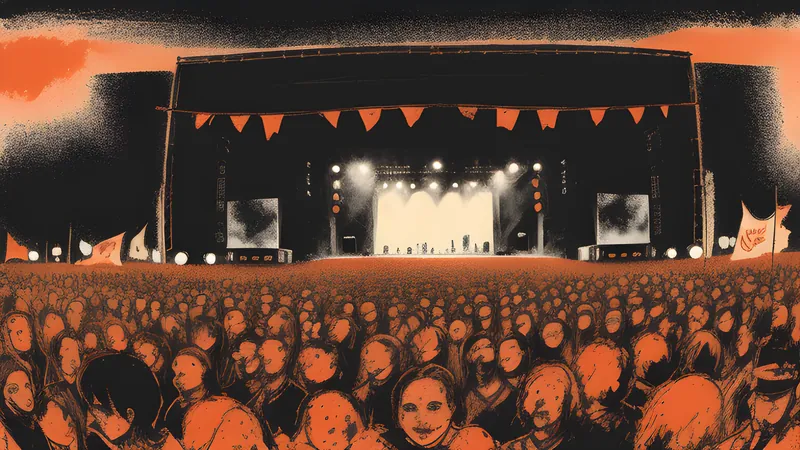
You climb a narrow staircase in an old military warehouse, push through a door, and the ceiling drops on you like a lid. Timber beams a hand’s width from your skull. A stage barely raised off the floor. A few hundred people already generating the kind of collective body heat that fogs the windows within twenty minutes of doors. This is Loppen — “the flea” — on the first floor of a warehouse on Bådsmandsstræde, deep inside Freetown Christiania, and it has been sweating out loud music since roughly 1973. The room is small, hot, and cramped, and it is one of the best places in Copenhagen to stand three metres from a band that is about to become your new favourite thing.
The climb, and what waits at the top
Loppen doesn’t announce itself. You walk into Christiania — no cars, you’re on foot or you’ve chained a bike outside the gates — and the venue sits in one of the long yellow warehouse buildings near the main entrance off Prinsessegade. The ground floor of the block hosts a flea market, a restaurant, gallery space, the ordinary daytime hum of the place. The music room is upstairs. You find the stairwell, you go up, and the whole geometry of the evening changes.
The staircase matters more than it sounds. It funnels everyone through a single choke point, which means load-in and load-out are a proper physical negotiation for touring crews — amps and cabs hauled up a warehouse stair by hand. For punters it sets the tone: you’re being admitted into an attic, somewhere slightly hidden, slightly above the street. By the time you emerge into the room you’ve already left the city behind.
And the room, when you reach it, is low. The building is old — an 18th-century warehouse repurposed when the Bådsmandsstræde barracks were abandoned and squatters founded Christiania in 1971 — and the first-floor space keeps the bones of a working loft. Exposed timber, plank floors that have flexed under fifty years of jumping, walls layered so thick with stickers, posters and paint that they’ve become a kind of archaeological record. Nobody decorated Loppen. It accreted.
Everywhere is close
Here is the whole case for the place in one sentence: there is no bad spot, because there’s barely any spot at all. Capacity sits somewhere around the three-to-four-hundred mark depending on who you ask and how the stage is set, and the depth of the room is so shallow that the back wall is still well within throwing distance of the vocal mic. Sightlines are a non-issue for the simple reason that everybody is basically on top of the band. Stand anywhere and you can see the guitarist’s fretting hand.
That closeness is the product. Loppen books the loud and the strange — punk, hardcore, garage, psych, weird international underground acts routed through Copenhagen on tours that skip the bigger rooms — and those bands live or die on immediacy. Put a hardcore band on a stage forty metres from the front row and something evaporates. Put them at Loppen, where the singer can and will end up in the crowd because there’s nowhere else to go, and the barrier between stage and floor stops existing. On the right night the pit and the band are one weather system.
If you want a sightline you can plan around, this is the wrong room and you should look at VEGA across town in Vesterbro, where the raked Store Vega floor and the deco balcony give you an actual designed view of the stage. Loppen offers the opposite arrangement: no plan survives, you go where the crowd lets you, and the reward is proximity that a purpose-built hall can’t buy.
The sound, which is the surprise
You’d forgive a room this shape for sounding like a biscuit tin. Low ceiling, hard timber, a shoebox footprint — every acoustic instinct says it should be a boxy, boomy mess. It mostly isn’t, and that’s the quiet miracle of Loppen. The low ceiling that threatens your head also keeps the PA honest: the sound arrives fast and direct, there’s no cavernous reverb tail to smear it, and because you’re standing so near the source the mix hits you with its edges intact.
It runs hot, of course. This is a small room being asked to hold a wall of amplified noise, and on a busy night the volume is a physical pressure against your sternum. Bring earplugs; the good foam ones you can talk through. But hot isn’t the same as bad, and Loppen’s engineers have spent decades learning what this specific box can and can’t do. Guitars sit forward, vocals cut, low end is controlled rather than allowed to swamp the floor. For aggressive music played by people who want you to feel it, the room is nearly ideal. For anything that depends on delicate dynamics and long decays you’d want a different building — the volatility of a packed sweatbox is not a subtle place.
Compare the two Christiania rooms and you’ve got the whole spectrum of the freetown in one short walk. A few hundred metres away sits Den Grå Hal, the cavernous old riding hall that swallows two thousand people under a vaulted roof and turns big touring shows into cathedral events. Loppen is its opposite number: the small hot upstairs club where the same community books the acts too raw, too niche, or too new to fill the big hall. One venue for the spectacle, one for the intimacy, both run in the same anti-commercial spirit, a two-minute stroll apart.
The crowd, and the code of the place
The crowd at Loppen skews toward people who actually came for the band. It’s a heads’ room — punks, older Christiania locals who’ve been coming since the reggae-and-punk seventies, curious internationals, students, the touring-band diaspora who know that the good weird shows land here. There’s a warmth to it that surprises people expecting menace. The pit can get genuinely rough on a hardcore night, but it’s the self-policing kind: someone goes down, four hands haul them up.
Getting there means walking into Christiania, and Christiania comes with etiquette that a first-timer should take seriously. It’s a self-governing community that runs on its own rules, so turn up respectful. The single hard rule everyone repeats, and the one you must not treat as a joke, is no photos on Pusher Street — the trade there has always been legally fraught and the no-cameras norm is enforced by the community for real reasons. Keep the phone away in that stretch. Once you’re at the venue, normal gig manners apply, but the walk in is a small lesson in reading a place on its own terms. Get it right and Christiania is one of the most welcoming corners of the city.
Getting out is the same route in reverse: a walk back through the freetown to the gates, then a bike or the short hop to Christianshavn metro. There’s no car park, no drop-off, no valet fantasy — you arrived on your feet and you leave on them, which is exactly correct for a place like this.
The bar, the beams, the honesty of it
The bar is a bar. It pours beer and the basics without ceremony, prices land in the fair-not-gouging zone that Christiania tends to hold to, and nobody is upselling you a cocktail programme. This is a functional room where the drink is fuel for the night, and the total absence of gastro-pub pretension is part of why the place feels honest. What you’re paying for is the band and the proximity, and both deliver.
The building’s past life sits in the timber over your head the whole time. These warehouses served the naval fortifications and barracks that occupied this ground for centuries before the squatters arrived; when the military left and Christiania was declared in 1971, the community took the empty structures and filled them with the things a city wasn’t providing — housing, workshops, galleries, and a music room in the loft. Loppen has been that room, more or less continuously, for over fifty years, run collectively in the Christiania style where the programme is decided by consensus rather than by a booking corporation chasing the biggest draw. That’s why the calendar is genuinely strange in the best way: acts get booked because the collective thinks they should be heard, and a room run on that principle throws up shows you’ll get nowhere else.
The verdict
Loppen is for the person who wants to be in the show rather than watching it from a comfortable distance. If your ideal night is a raw band at close range, a room that runs hot, and a walk home through the strangest neighbourhood in Scandinavia, there is nothing better in Copenhagen. Go for the punk, the hardcore, the international underground names you half-recognise; go when the bill looks weird, because weird is what the collective books best.
Skip it if you want a seat, a sightline you can plan, clean dynamics, or a night without sweat. For that, aim at VEGA or one of the mid-size rooms like Pumpehuset, where an old waterworks gives you rock at a scale you can breathe in. Loppen asks more of you — the climb, the heat, the crush — and hands back the thing those bigger rooms can only approximate: a band so close you could reach out and stop them, playing to a few hundred people who came all the way into Christiania to hear it. The room is small and it always wins.
Related Content