Las Fallas: Valencia Builds Giants for a Year, Then Burns Them in a Night
A whole city sculpts satirical giants for twelve months, parks them at the crossroads, and sets the lot alight on 19 March
Contents
Somewhere in Valencia right now, a workshop the size of an aircraft hangar holds a thirty-foot cartoon politician with the head of a pig, and the people who built him already know the exact hour they are going to set him on fire. That is the deal. That is the whole engine of Las Fallas, and once you understand it the festival stops looking like a party and starts looking like something closer to a religion with better pyrotechnics.
I have never stood in the Plaça de l’Ajuntament at two in the afternoon while the ground tried to leave without me. Valencia in mid-March collides head-on with the festivals I actually work — it sits weeks before Roadburn opens the season and a clean quarter-year before Copenhell — so this is a dispatch from the record, from photographs and firsthand accounts and the plain arithmetic of what the city does to itself every spring. But I have spent a professional life around loud, controlled, communal fire, and I can read the shape of this one from Copenhagen. It is the largest and most reckless bonfire in Europe, and it is also an art exhibition, and those two facts are the same fact.
A year of work, built to be kindling
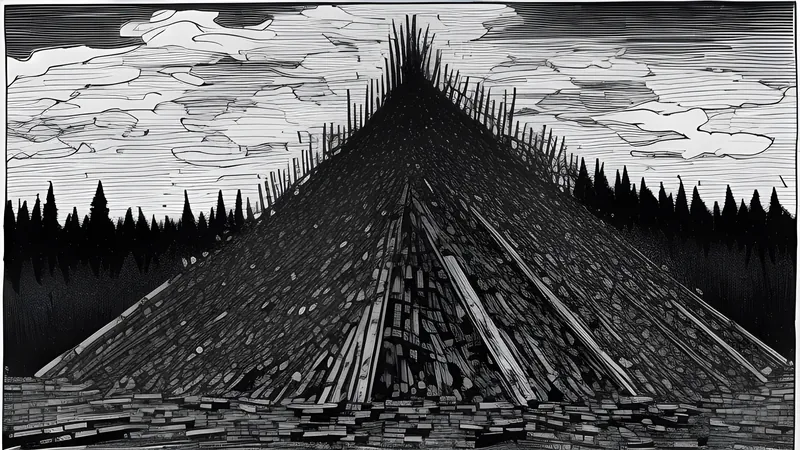
Start with the object, because the object is genuinely bewildering. A falla is a monument — a towering tableau of sculpted figures, some of them several storeys tall, assembled at a road junction or a plaza. The individual figures are the ninots, and they are the point. They are caricatures: bloated tycoons, sweating footballers, whichever minister disgraced himself that year, mythological beasts wearing the face of a local scandal. The satire is the tradition’s spine and always has been. A good falla is a political cartoon you can walk around and underneath.
They are built by comissions falleres, neighbourhood associations — hundreds of them across the city — that fundraise all year, commission an artist, and pour the proceeds into a structure engineered to look permanent and last less than a week. The bigger commissions spend into six figures on a single monument. The materials evolved from wood and wax and papier-mâché toward cork, polystyrene and painted resin, which is what lets the artists get the impossible smirk on a giant’s face and the exact curl of a caricatured lip. Cranes lift the tallest sections into place during La Plantà, “the planting,” when the finished giants appear overnight at their crossroads and the city wakes up surrounded by them.
Then everyone spends four days admiring work that has been condemned from the sketch stage.
The soundtrack is a weapon: the mascletà
Here is the detail that made me sit up, because it is the most Encore thing about a festival I have never seen. Every day from the first of March, at two in the afternoon, Valencia holds a mascletà in the town hall square. It is a firecracker display, but calling it that is like calling a wall of Marshall stacks “a speaker.” The mascletà is not built for the eyes. It is built for the chest and the sternum and the fillings in your teeth.
A pyrotechnician — the pirotècnic — choreographs a sequence of ground-level firecrackers that climbs in density and rhythm until it becomes a single sustained percussive roar, the terratrèmol, the “earthquake,” that you feel through the soles of your feet more than you hear through your ears. People compress into the square specifically to be inside the pressure wave. Every account I have read describes the same thing: a physical, whole-body concussion that a good crowd receives the way a metal crowd receives the first downbeat of a set they have waited a year for. I know that feeling from the pit at Copenhell and from the front rail at Den Grå Hal. The mascletà is that feeling, delivered by gunpowder, to an entire city, at lunchtime, for nineteen days running. It is gloriously insane and I respect it enormously.
Where it comes from
The origin story is beautifully mundane, and Valencia has the good sense not to over-sell it. The festival grows out of the carpenters’ guild and the feast of Saint Joseph on 19 March — Joseph being the patron saint of carpenters. The workable tale is that carpenters cleared out the wooden lamp-stands, the parots, that had propped up their candles through the dark working winter, and burned the scrap in the street at winter’s end. Over the eighteenth century those spring bonfires acquired figures — dummies, ninots, often mocking a neighbour or an official — and the fire that had been mere housekeeping became a stage for satire. The dummies got bigger. The satire got sharper. The city got competitive. Two-odd centuries later you have polystyrene giants and six-figure budgets, and the through-line back to a carpenter burning his winter clutter is still perfectly legible.
UNESCO inscribed Las Fallas on its list of Intangible Cultural Heritage in 2016, which is the sort of official blessing that can embalm a living tradition. It hasn’t here. The thing is too big and too locally owned to be turned into a museum piece — though the festival keeps its own museum in a way I find quietly moving, and I will get to that.
Flowers, fire, and one giant that gets to live
The days between the Plantà and the burning stack ritual on ritual. There is La Ofrenda, the flower offering, when the falleres — the participants, the women in extraordinary silk-and-brocade traditional dress, the men beside them — process for hours to build an enormous cloak of flowers on a wooden frame of the Virgin in the Plaça de la Mare de Déu. There is La Nit del Foc, the Night of Fire, a genuine aerial fireworks assault in the small hours before the finale. The city runs on woodsmoke and cordite and the particular exhaustion of people having the time of their lives on no sleep.
And there is the one merciful loophole in a festival otherwise built on destruction: the ninot indultat, the “pardoned ninot.” By public vote, a single figure is spared the flames each year and retired to the Museu Faller, the festival’s own museum, where the pardoned survivors line up across the decades. I love this detail without reservation. A festival whose entire premise is that beauty should be temporary keeps one small room where it admits, once a year, that it can’t quite bear to lose everything. It is the same instinct that makes people film a set they will never rewatch — the human refusal to let a great night vanish completely.
La Cremà: the point of all of it
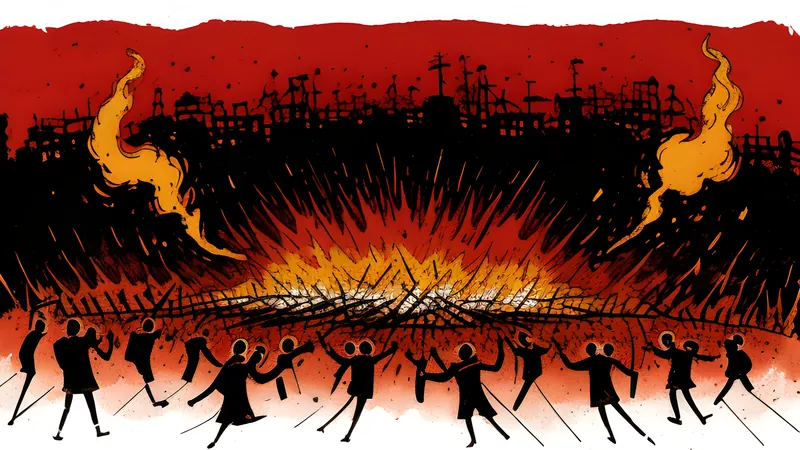
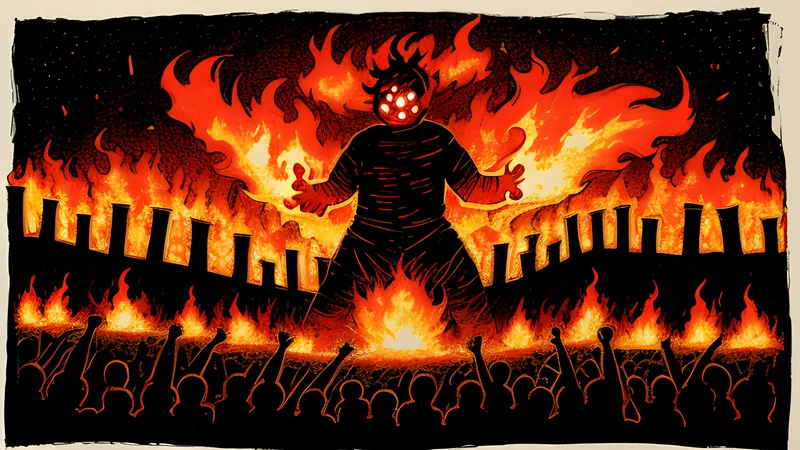
Then comes the night of 19 March, and the reason the giants were ever built. La Cremà, “the burning.” Across the whole city, in a staggered sequence through the night, the fallas are packed with fireworks and set alight. The children’s fallas go first, then the adult monuments, and last the great prize-winning falla in the town hall square. A year of work, hundreds of monuments, thousands of hours, six-figure budgets — reduced to ash and a scorch mark on the tarmac by dawn. Firefighters stand by to referee the blazes rather than prevent them, hosing the surrounding buildings so the intended inferno stays intended.
This is the part outsiders find hardest and locals find obvious. Why build something so extraordinary only to destroy it? The answer is that the destruction is the meaning. The falla was always a condemned thing; its whole life is lived in the four days it stands. Burning it isn’t the loss of the artwork — it is the artwork’s purpose completing. Winter clutter goes up, the pig-faced politician goes up, the year’s grievances and vanities go up, and the city walks home lighter through the smoke. Next morning the commissions are already sketching next year’s giant.
The oldest human trick
What Valencia is doing on 19 March is the same instinct that lights the hill on Calton in Edinburgh at Beltane, the same one that puts a straw witch on a Danish beach fire at Sankt Hans, the same one that sends Nordic bonfires up on the last of April for Valborg and stands a Viking longship ablaze in the Shetland dark at Up Helly Aa. Build a thing that stands for the winter, the fear, the old year, the enemy — and then, all together, in front of everyone, burn it. Valencia has just industrialised the impulse and given it satirical genius and a firecracker section that could level a small building.
I will get there eventually, in a March that doesn’t fight my calendar, and I will stand in that square at two in the afternoon and let the mascletà rearrange my internal organs. Until then I will keep telling people the truest thing I know about Las Fallas: it is a city that spends a year making something magnificent for the specific pleasure of watching it burn, and it is right to. The best nights are the ones you can’t keep. Valencia just refuses to pretend otherwise, and sets a match to the proof.
Related Content