Lamb of God: American Groove Metal's Angriest Engine
How a band from Richmond, Virginia turned precision, fury and one genuinely dark chapter into the standard-bearer of a whole American movement
Contents
Lamb of God make anger sound engineered. Where a lot of heavy bands aim for chaos, this five-piece from Richmond, Virginia builds fury like a machine shop builds an engine, every part machined to tolerance, every explosion timed. They spent the 2000s becoming the flagship of an entire American metal movement, they survived a courtroom tragedy that would have ended weaker bands, and they remain one of the most physically overwhelming live acts you can stand in front of. This is how a group of Virginia art students became the angriest precision instrument in the genre.
Burn the Priest and the Richmond crucible
The band began in the early 1990s in Richmond under the deliberately provocative name Burn the Priest, formed by musicians who had met at Virginia Commonwealth University. That origin matters, because Lamb of God have always carried a slightly art-school seriousness under the brutality, a sense that the aggression is composed rather than merely vented. They released a self-titled album as Burn the Priest in 1998, then changed the name to Lamb of God in 1999, partly because the old one was getting them refused bookings.
The classic line-up that carried them to prominence was Randy Blythe on vocals, Mark Morton and Willie Adler on guitars, John Campbell on bass and Chris Adler on drums. That last name is central to the band’s identity. Chris Adler’s drumming, a blur of technical, jazz-informed precision welded to punishing power, became the metronomic heart of the whole operation and one of the most admired drum styles in modern metal. When he departed in 2019 and Art Cruz took the stool, it was a genuine changing of the guard, and the band’s ability to continue at full power afterwards said a lot about how solid the rest of the machine was.
Their run of albums through the 2000s is a near-textbook rise. New American Gospel in 2000 laid down the sound, As the Palaces Burn in 2003 sharpened it, and Ashes of the Wake in 2004 broke them wide, an unusually angry record to reach a mainstream metal audience. Sacrament followed in 2006 and gave them their calling-card song, “Redneck”, the track most likely to open a pit anywhere on earth. They kept the standard up through Wrath, Resolution and VII: Sturm und Drang, and by the 2010s they were a genuine arena-scale headliner.
The New Wave of American Heavy Metal
Lamb of God are usually filed as the definitive band of what got labelled the New Wave of American Heavy Metal, the turn-of-the-millennium American groove-metal surge that also carried Pantera’s descendants, Killswitch Engage, Shadows Fall and their peers. The sound is built on the groove-metal foundation Pantera laid in the early 1990s, mid-paced, brutally heavy, riff-driven, with the emphasis on physical impact rather than blistering speed, but Lamb of God added a technical rigour and a rhythmic complexity that set them apart from the pack.
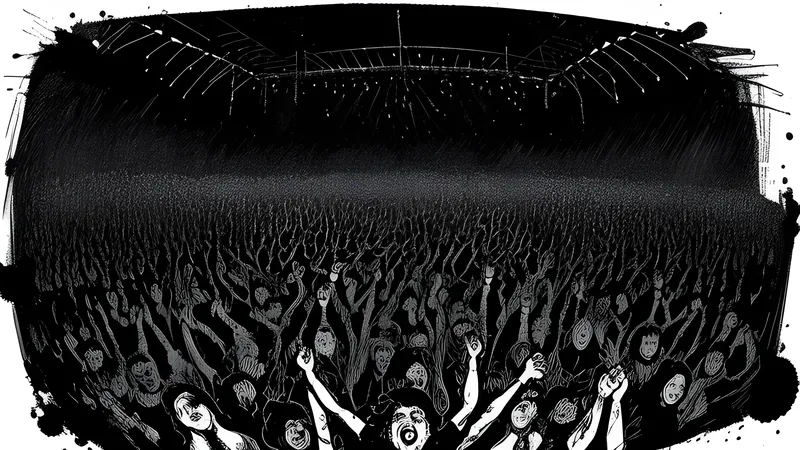
That American groove approach is a useful contrast with the melodic-death lineage coming out of Sweden. Where the Gothenburg sound chased harmony and twin-guitar melody, the American wave chased weight and swing. Lamb of God sit at the heavy, unmelodic end of that spectrum, and their songs are engineered to make a large field of people move in unison. Live, that translates into some of the most reliably enormous crowd reactions in the genre, walls of people surging on cue.
Blythe’s vocal is a huge part of it. He does not sing so much as bark, roar and command, a genuinely powerful low shout with real diction, so the words land as instructions the crowd can follow. Combined with the surgical rhythm section, the effect on stage is close to militaristic, a room being conducted through its own controlled riot.
Prague, 2010: the chapter that has to be told honestly
No account of this band is complete without the events that unfolded around a 2010 concert in Prague, and this desk’s rule is to handle real, documented tragedy factually and with care rather than sensationalise it. At a Lamb of God show in the Czech capital in 2010, a nineteen-year-old fan named Daniel Nosek suffered fatal head injuries after coming onto the stage and falling back into the crowd. He later died. It is, first and before anything about the band, the death of a young man at a concert, and it should be held as that.
In June 2012, when Lamb of God returned to Prague to play, Randy Blythe was arrested at the airport and charged in connection with Nosek’s death. He spent more than a month in a Czech prison before being released on bail, then made the striking decision to return voluntarily to the Czech Republic in 2013 to stand trial rather than remain safely in the United States. The trial began in February 2013. On 5 March 2013 the Prague court found that Blythe bore moral responsibility but was not criminally liable, placing most of the blame on promoters and security, and he was acquitted; the acquittal was upheld on appeal that June.
Blythe wrote about the whole ordeal at length afterwards in a memoir, and the episode changed how a lot of the metal world thinks about the physical contract between a band and its crowd, about stage-diving, security and duty of care. It is a genuinely dark chapter, and the humane response is not to fold it into the band’s mythology as an edgy anecdote but to remember the person at the centre of it and the questions it raised about safety at shows.
The riffs, and the craft under the fury
It would be a mistake to reduce Lamb of God to anger and controversy, because the thing that actually made them last is the songwriting, specifically the guitar work of Mark Morton and Willie Adler. Their riffs are the real signature of the band, a distinctive style built on syncopation and groove, riffs that lurch and swing and stop-start in ways that make a crowd move in unpredictable, physical patterns. Morton in particular is a genuinely gifted writer with a bluesy, Southern-rock streak that surfaces in his solos and side projects, and that melodic instinct stops the band’s brutality from becoming monotonous.
The rhythmic complexity is the technical heart of it. A lot of heavy bands play fast; fewer play with the kind of intricate, shifting, groove-based timing that Lamb of God built their identity on, where the whole band locks into a lurching pattern that feels physically wrong-footing and yet completely controlled. It is difficult music to play well, and the fact that they make it sound punishing rather than fiddly is a mark of how tight the unit is. Blythe’s lyrics, meanwhile, are angrier and more literate than the genre average, full of social fury and personal reckoning delivered in that commanding bark, and he has grown into one of metal’s more thoughtful public figures, a sober, articulate man who writes books and talks candidly about his own history.
That combination, technical rigour welded to genuine emotional weight, is why Lamb of God transcended the movement that spawned them. Plenty of New Wave of American Heavy Metal bands had the aggression. Fewer had the craft to still sound essential twenty-five years on, and fewer still survived a catastrophe like the one that engulfed them and came out the other side making some of the best work of their career.
The live machine, still running
For all that history, Lamb of God remain, in the present tense, a formidable working band. They put out a self-titled album in 2020 and Omens in 2022, both proving that the departure of a founding drummer had not blunted the engine, and they continue to headline the large European metal festivals and the loud rooms in between. On a summer bill, a Lamb of God set is one of the reliable peaks, the point where a field of tired festival-goers finds a last reserve of violence and spends it all at once.
What is striking, watching them now, is how little the passing years have softened the attack. Some veteran metal bands mellow, slow their tempos, let the edges round off. Lamb of God have done the opposite, staying lean and vicious into their fifties, and the recent records stand up honestly beside the ones that made their name. That refusal to coast is part of why younger bands still cite them as a benchmark, and why a summer festival still slots them near the top of a bill rather than into a nostalgia slot.
They belong to the same physical, communal end of the culture this desk keeps circling, where the crowd is a participant and the music is a machine for moving bodies, the world of the wall of death and the organised chaos of a big outdoor pit. Lamb of God are the American masters of that mode: anger machined to tolerance, fury with a blueprint, a band who made precision the most brutal weapon in the room and have kept it sharpened for a quarter of a century.