Kvelertak: Six Norwegians and a Very Loud Owl
How a Stavanger sextet welded black metal, punk and classic rock into one enormous, gleefully unserious sound
Contents
The word “kvelertak” is Norwegian for a stranglehold, which is either a threat or a promise depending on how you feel about being pinned to the wall by a riff. The band from Stavanger has spent its whole career doing exactly that: grabbing you by the collar with black metal tremolo, then hitting you with a chorus that belongs on classic-rock radio, then flooring you with a punk breakdown, all inside the same song and usually inside the same ninety seconds. On paper it should be a mess. In practice Kvelertak are one of the most purely joyful loud bands to come out of Scandinavia this century, and they got that way by refusing, absolutely and on principle, to pick a genre.
Three guitars and a stranglehold
Kvelertak formed in Stavanger in 2007, a six-piece with three guitarists, which tells you most of what you need to know about their ambitions. Three guitars is a declaration. It says this band intends to be enormous, layered and maximal, that it wants harmony lines and riff stacks and walls of sound, and that restraint is not on the menu. The founding frontman was Erlend Hjelvik, whose voice was a genuine black-metal shriek rather than a clean rock bellow, and that single decision is the key to the whole band. Kvelertak sing in Norwegian and top their music with a harsh extreme-metal rasp, and then underneath that ferocity they play some of the catchiest, most classic-rock-indebted songs in modern heavy music.
That collision is the entire proposition. Take the vocal approach of Norwegian black metal, a scene defined by frostbitten atmosphere and grim seriousness, and bolt it onto riffs that owe more to Thin Lizzy and AC/DC and Turbonegro than to anything in a corpse-painted tradition. The tension between the two is what makes the band thrilling. A newcomer expecting the misery that a shriek usually signals gets, instead, a party, and the surprise never quite wears off. Kvelertak took the most forbidding vocal in heavy music and used it to sell some of the most fun.
The debut that arrived fully formed
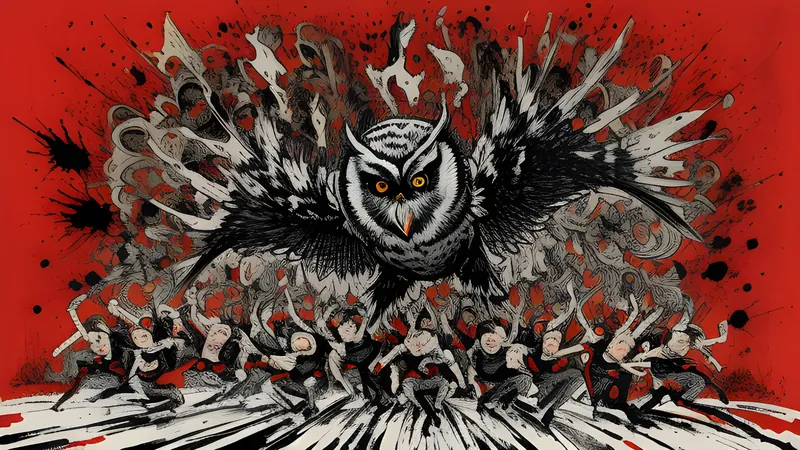
Their self-titled debut landed in 2010 and did something debuts rarely do: it arrived complete. Everything the band would become was already there, fully realised, on the first record. It was produced by Kurt Ballou of Converge, whose fingerprints are all over the modern heavy underground, and it came wrapped in cover art by John Dyer Baizley of Baroness, whose ornate, mythic illustration style gave the band an instant visual identity. The centrepiece of that identity was an owl — a great, fierce, crest-headed bird that became the band’s emblem and turned up on merchandise, backdrops and the arms of the faithful. Of all the animals a heavy band could pick, the owl is a wonderfully odd choice: nocturnal, silent, and then suddenly lethal, which is not a bad description of the music.
The record was a genuine phenomenon at home, selling well over fifteen thousand copies in Norway, an enormous figure for a debut by a heavy band singing entirely in Norwegian. In early 2011 it earned the band two Spellemannprisen awards, the Norwegian equivalent of a Grammy, for Best Newcomer and Best Rock Band. That second category is the interesting one. A band with a black-metal vocalist won Best Rock Band, which is the establishment quietly conceding that Kvelertak had built something too big and too catchy to file under extreme metal. They had smuggled the underground into the mainstream by making it sound like a good time.
The choice to sing in Norwegian deserves its own moment, because it is braver and stranger than it looks. The default assumption in heavy music is that you sing in English if you want to travel, that your own language is a ceiling on your ambitions. Kvelertak ignored that entirely and built an international career on lyrics that most of their growing foreign audience could not understand a word of. It turns out that when the vocal is a shriek and the songs are this physical, comprehension is beside the point; the voice functions as another instrument, a texture rather than a text, and a field full of Germans or Brits will bellow along phonetically to a Norwegian chorus without the faintest idea what it means. If anything the mystery adds to the appeal. The band sound rooted, specific and unmistakably from somewhere, and that rootedness travelled better than a bland English lyric ever could have.
Meir, Nattesferd and the road
The follow-up, Meir, arrived in 2013 — the title means “more”, which is the only acceptable sequel to a debut this maximal — and doubled down on everything. Nattesferd in 2016 pushed further into the classic-rock and 1970s-hard-rock end of their palette, letting the songs breathe and the twin-and-triple guitar harmonies stretch out, a record that made the band’s love of the old gods of riffing impossible to miss. By this point Kvelertak were a serious live proposition across Europe and beyond, the kind of band that turns a festival tent into a single heaving organism.
The touring reached a peak most heavy bands never get near. Kvelertak spent a long stretch as the opening act on Metallica’s WorldWired tour through Europe between 2017 and 2018, playing arenas to tens of thousands of people every night, and they also opened for Ghost on the Popestar run in 2017. Warming up a Metallica arena is one of the hardest jobs in music — you are playing to a crowd that did not come for you, in a cavernous room, while people are still finding their seats — and doing it night after night across a continent is a trial by fire that either breaks a band or hardens it. Kvelertak came out of it a genuinely formidable live act. I’ve written elsewhere about Metallica’s long, deep relationship with the Nordic countries over at Metallica’s Danish Accent; handing a support slot of that scale to a Norwegian band singing in its own language was its own small statement about where the centre of gravity in loud music now sits.
A new voice and the long game
In 2018 Hjelvik left the band, a real hinge moment given how central his shriek had been to the sound. He was replaced by Ivar Nikolaisen, a well-regarded figure in the Norwegian scene, and the band carried on without missing a step, releasing Splid in 2020 and Endling in 2023. A frontman change of that kind is a genuine risk — the vocal was so distinctive that losing it could have hollowed the whole thing out — but Kvelertak had built a sound sturdy enough to survive it, because the songs were always the foundation and the shriek was the finish on top. That is the mark of a band with real bones under the spectacle.
Why the refusal to choose is the whole point
What I love about Kvelertak is that they solve, almost by accident, a problem that ties a lot of heavy bands in knots: the tyranny of the genre. Metal in particular is a world obsessed with subgenre purity, with staying in your lane, with fans who will tell you at length why one band is “real” black metal and another is not. Kvelertak walked in and treated the whole taxonomy as a buffet. Black metal vocals, punk energy, classic-rock songcraft, arena-sized choruses — take what works, leave the dogma, and let the only test be whether the song hits. It is a deeply unpretentious approach to a scene that can be crushingly pretentious, and it is why the band feels like a release valve every time.
They belong to a specific Norwegian lineage, too, one that runs from the deadly-serious extremity of the early black-metal years toward something more expansive and self-aware. The grim end of that tradition is a real and heavy history, one I dig into over at Enslaved, a band that spent thirty years growing black metal outward into progressive, exploratory territory. Kvelertak took the opposite exit from the same roundabout, dragging the genre toward fun, hooks and swagger, and both directions prove the same point: the most interesting Norwegian bands are the ones that treated black metal as a starting position rather than a cage. The same anything-goes maximalism drives the Oslo deathpunk of Turbonegro, Kvelertak’s clearest spiritual predecessor, a band that also decided provocation and enormous choruses were not mutually exclusive.
There is a broader argument buried in all of this about how the loud world works. The bands that last tend to be the ones with a clear internal identity and a loose external one, sure of who they are and relaxed about what genre box that lands them in. Kvelertak know exactly what a Kvelertak song is — the shriek, the harmony guitars, the swing, the payoff — and precisely because that core is so secure they can raid black metal, punk and 1970s rock without ever sounding confused. The confidence is the glue. A less certain band trying the same trick would sound like a covers act flailing between styles; Kvelertak sound like a single thing that happens to contain multitudes.
Fifteen years on from that debut, Kvelertak remain gloriously themselves: six Norwegians, three guitars, a shrieked vocal, a crest-headed owl and no interest whatsoever in being any one thing. In a scene that spends a great deal of energy policing its own borders, that refusal is the most punk thing about them. They play a stranglehold, and they mean it, and somehow the whole room comes out grinning.
Related Content