Kvelertak: Norway's Party-Riff Machine
Three guitars, a Norwegian tongue and the best time in heavy music
Contents
Some bands make you think and some bands make you move, and every so often one comes along that does the second so hard it forgets to bother with the first. Kvelertak is that band. The six-piece from Stavanger took black metal’s tremolo fury, hardcore’s forward momentum and classic rock’s swagger, threw them in a blender, and produced the most purely joyful noise in modern heavy music. They sing entirely in Norwegian, they carry an owl into battle, and they are one of the best live acts on the planet. This is the party machine, read from the record.
Kvelertak are a festival-circuit fixture, the kind of band who turn up on European bills every summer and reliably win over crowds who cannot understand a word they are singing. I write this as someone who has watched a lot of loud bands from a lot of festival fields, and who rates Kvelertak among the most reliable good times in the business — a read from their catalogue and their formidable live reputation rather than a claim on any single night.
The Stavanger blender
The band formed in Stavanger, on Norway’s west coast, in 2007. The name is Norwegian for a stranglehold — a chokehold, the grip that cuts off the air — and it is a fair description of what the band does to a room. The line-up is a six-piece, and crucially it runs three guitars. That is the engine of the whole thing: three players trading and layering riffs, one carrying a black-metal tremolo line while another lays down a classic-rock boogie and a third fills the gaps, so the songs are constantly moving, constantly handing off, never sitting still.
The fusion they landed on had no obvious precedent. Norwegian black metal, which the country practically invented, is cold, grim and serious — the Norwegian black metal tradition is built on frost and misanthropy. Kvelertak took its speed and its tremolo attack and welded them to something completely opposed in spirit: the good-time, beer-soaked energy of hardcore punk and 1970s hard rock. The result got tagged “black-n-roll,” which undersells it. It is party music with the ferocity of extreme metal, and the combination should not work as well as it does.
Singing in Norwegian was a deliberate choice and a defining one. Most bands with international ambitions default to English; Kvelertak decided their own language was part of the identity, and it turned out to be no barrier at all. The vocals function as another rhythmic, aggressive instrument, and audiences across Europe roar along phonetically without the faintest idea what the words mean. If anything the Norwegian makes them more distinctive, a band that could only have come from where it came from.
The owl and the Baizley connection
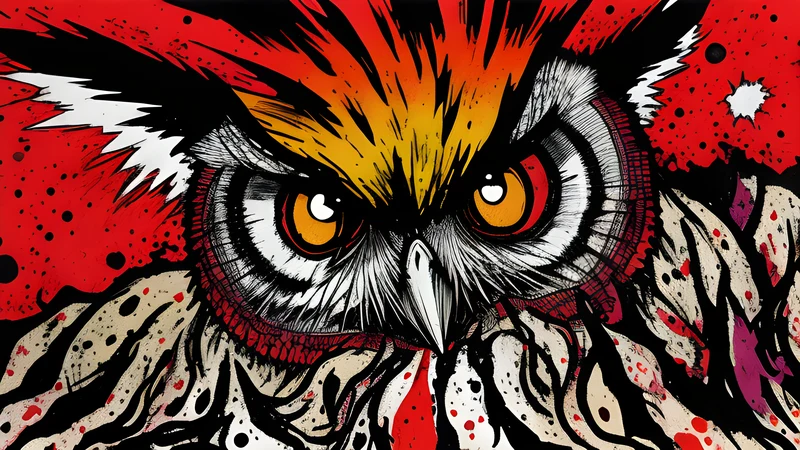
You cannot talk about Kvelertak without talking about the owl. The band’s imagery centres on a great horned owl-god, and it came from the artwork for their self-titled debut, designed by John Baizley — the frontman and visual artist of Baroness. Baizley’s ornate, art-nouveau-tinged illustration gave the band an instant visual identity, and the owl has been their totem ever since, looming over stages and album covers like a heraldic beast.
That connection to Baroness is telling, because it places Kvelertak in a particular international network of heavy bands who care about craft and aesthetics as much as aggression. The debut album, released in 2010, had another significant name attached: it was produced by Kurt Ballou of Converge, the hardcore guitarist turned in-demand producer whose muscular, aggressive studio sound is all over the best heavy records of the era. Ballou also produced the follow-up, Meir (2013). Having those two figures — Baizley on the art, Ballou on the sound — shaping the early Kvelertak records tells you the band arrived with serious taste and serious connections.
The records and the reinvention
The self-titled debut is a genuine landmark, an album that announced a fully formed band and won the Norwegian Spellemannprisen, the country’s equivalent of a Grammy. Meir (2013) pushed the same formula harder and broader. Nattesferd (2016) leaned further into the classic-rock and Thin Lizzy-style twin-guitar melodicism, a warmer and more expansive record that showed the band could stretch beyond the pure assault of the debut.
Then came a real test. In 2018 the original vocalist, Erlend Hjelvik, left the band. For a group so defined by its frontman’s roar, that could have been the end. Instead they recruited Ivar Nikolaisen, a Norwegian punk singer with the lungs and the stage presence to carry it, and got straight back to work. Splid (2020) — the title means discord — was the first album with the new voice, and it landed hard, proving the band was bigger than any single member. It even featured a guest appearance from Troy Sanders of Mastodon on a rare English-language track. Endling (2023) continued the run. The reinvention worked, which is rarer than it sounds; plenty of bands never survive losing their singer.
Why they own the live stage
Kvelertak’s records are excellent, but the live show is where the legend lives. This is a band built for the stage — six people generating chaos, three guitarists in constant motion, a vocalist who has been known to appear in a stuffed owl’s head, the whole thing pitched at a level of celebratory mayhem that is genuinely rare. There is no darkness to their live presence, no grim posturing; it is pure communal release, a room full of strangers losing their minds together to riffs they cannot translate.
That is why they are such a reliable festival draw and why they connect with the Copenhell kind of crowd — an audience that came for heaviness but is more than happy to have a party while getting it. They occupy a specific and valuable niche: heavy enough for the metalheads, fun enough for everyone else, Norwegian enough to be unmistakable. In the lineage of Norwegian bands who prized energy and swagger over solemnity, they are the natural heirs to Turbonegro’s denim-clad theatre, and the polar opposite of the frost-bitten Enslaved end of the national tradition.
The case for joy
There is a snobbery in heavy music that equates seriousness with worth, that treats fun as a lesser thing than misery. Kvelertak are the standing rebuttal to that. They play with the technical ferocity of any extreme band, they write riffs as sharp as anything in the genre, and they aim all of it at the simple goal of making a room of people feel alive. That is a harder thing to pull off than misery, and a more valuable one.
Fifteen-odd years and five albums in, having survived the loss of their original singer and come out swinging, Kvelertak remain one of the great live acts and one of the most distinctive bands to come out of Norway. They took the coldest music their country ever produced and set it on fire for warmth. Every festival needs a band like this — the one that reminds you, after a day of doom and darkness, that heavy music is allowed to be the best time you will have all year.
From clubs to stadiums
The scale of what Kvelertak pulled off becomes clear when you look at the rooms they have played. A band singing in Norwegian and trafficking in black-metal riffs is not an obvious candidate for stadium exposure, yet in 2017 Kvelertak spent a chunk of the year opening for Metallica on European dates of the WorldWired tour, playing to arenas and stadiums full of people who had turned up for the biggest metal band on earth. Winning over a Metallica crowd as the support act is one of the harder gigs in music — those audiences are notoriously there for the headliner and nobody else — and the fact that Kvelertak thrived in that setting says everything about the universality of what they do.
That is the tell of a genuinely great live band: the songs work in a sweaty two-hundred-capacity club and they work in a fifty-thousand-seat stadium, because the appeal is fundamental rather than dependent on intimacy. The riffs are big enough to fill any room, the energy is infectious at any distance, and the language barrier that might have limited a lesser band turns out to be irrelevant when the music is this direct.
Where to start
For the newcomer, the self-titled debut remains the essential document — the sound arriving fully formed, Baizley’s owl on the cover, Ballou’s production giving it teeth. From there, Nattesferd is the record to reach for if you want to hear the band stretch into their classic-rock, twin-lead instincts, and Splid is the proof that the reinvention with a new singer lost none of the fire. Play any of them loud and the appeal is instant.
What you are hearing across all of them is a band that solved a problem nobody else even thought to pose: how to make extreme metal that is unambiguously fun without diluting the extremity. Fifteen years on, plenty have tried to copy the formula and none have matched it, because the secret was never the formula. It was six people from Stavanger who genuinely love playing together, carrying a giant owl into every field in Europe and daring you not to have the time of your life.
Related Content