Kreator: Teutonic Thrash's Tireless Engine
Four decades out of Essen, and Mille Petrozza still has not slowed down
Contents
Some bands are events; Kreator are a certainty. If there is a metal festival happening anywhere in Europe in a given summer, there is a fair chance Kreator are on the bill, somewhere in the golden late-afternoon-into-dusk slot where the light drops and the pit finally means business. They have been doing this since Ronald Reagan’s first term, and the remarkable thing is not that they have survived — plenty of eighties thrash bands are still technically operational — but that they have stayed genuinely dangerous, a live act that can still take the roof off a field full of ninety thousand people who have seen everything. Four decades in, Mille Petrozza is still leaning into the front rows with that circular-saw voice, and the machine still runs hot.
Essen, 1982, and the birth of Teutonic thrash
Kreator came out of Essen, in Germany’s industrial Ruhr valley, formed in the early eighties by a teenage Miland “Mille” Petrozza. This matters, because Kreator are one of the founding pillars of what became known as Teutonic thrash — the German answer to the Bay Area, harder and uglier and more extreme than most of what was coming out of California at the time. If the American thrash of Metallica and Megadeth was built on precision and songcraft, the German strain was built on velocity and menace. It was faster, filthier, and closer to what would soon become death metal than anyone quite realised.
The Teutonic scene had its own big four — Kreator, alongside Sodom (also from the Ruhr), Destruction, and the beer-soaked Tankard — and among them Kreator quickly became the flagship, the band with the biggest reach and the longest arc. Their early records are foundational documents of extreme metal. Endless Pain announced them; Pleasure to Kill (1986) is the one that echoes down the decades, an album so relentlessly fast and vicious that it drew a direct line from thrash toward the death metal that was about to be born. Ask a death metal musician of a certain age about their roots and Pleasure to Kill comes up again and again. Then Terrible Certainty and Extreme Aggression refined the attack, and Coma of Souls (1990) closed out their imperial era as one of the finest thrash records of its generation.
The wilderness, and the return
The nineties were unkind to thrash, and Kreator were not spared. As grunge swallowed the mainstream and the scene that had raised them collapsed, the band spent the middle of the decade experimenting — flirting with industrial and gothic textures on records that split the fanbase and, with hindsight, were the sound of a band trying to find a reason to keep going when the ground had shifted under them. It is a period a lot of fans skate over, and Petrozza himself has been candid that they lost their way for a spell.
What brought them back is one of the great second acts in metal. Violent Revolution (2001) was the comeback record, the sound of Kreator remembering exactly what they were for — thrash, played with total conviction, but now with a melodic and anthemic dimension the eighties records never had. It reset the band completely, and everything since has built on it. Enemy of God, Hordes of Chaos, Phantom Antichrist, and then Gods of Violence (2017), which did something no Kreator album had done before — it went to number one on the German albums chart. A thrash band from Essen, thirty-five years into its career, outselling everything else in the country for a week. Hate Über Alles (2022) kept the run going. The late-period Kreator is arguably more popular than the band ever was in its supposed heyday, which almost never happens in this genre.
Why the later material rules the live show
The anthemic turn that started with Violent Revolution is the key to understanding a modern Kreator set, and it is what separates them from the thrash bands who are effectively their own tribute acts. The old material is furious and beloved, and the pit lives for Pleasure to Kill and Coma of Souls deep cuts. But the newer songs are built for the festival stage in a way the eighties records simply were not. They have choruses you can throw a fist to, gang vocals that a whole field can bellow back, and the kind of soaring melodic leads that turn a thrash gig into a communal event.
Petrozza worked this out early and has leaned into it ever since. A Kreator headline set now is structured like a proper arc — the vicious old stuff to establish the threat, the anthems to lift the crowd, and a sequencing that understands the difference between fast and relentless. That instinct for building an evening, treating a headline slot as a shape rather than a shopping list, is the same craft you see in bands like Sabaton, who turned the anthem into an entire live identity. Kreator got there from the opposite end, sharpening a genuinely extreme band until it could command a crowd that size without softening a single edge.
The live animal
See Kreator on a good night and the first thing that strikes you is how tight they are. Forty years of near-constant touring will do that. The line-up has turned over across the decades — Petrozza is the one constant, the sole original member and the band’s entire identity — but the current outfit is arguably the best live version Kreator have ever fielded, a genuinely ferocious unit that plays the fast material clean and hits the anthems like a wall.
Petrozza is a magnetic frontman in an old-school way that has nothing to do with theatrics. There are no costumes, no pyro gimmicks doing the emotional work; there is a man who has been screaming these songs for forty years, still fully committed, still visibly furious about the state of the world in the way the lyrics have always been. His voice is one of the most recognisable in metal — that dry, shredded rasp that sits somewhere between a shout and a snarl — and it has held up remarkably well. Live, he is a bandleader in the truest sense, conducting the crowd, dragging the tempo up, feeding off the pit.
The other quiet weapon is the guitar work. Kreator have never been a shredder’s showcase in the American mould, all sweep-picked solos and clinic-ready technique. The leads serve the songs — the melodic, almost mournful lines that came in with Violent Revolution and now thread through the whole modern catalogue, giving the fury somewhere to resolve. Petrozza’s own rhythm playing is the real backbone, that scything downstroke attack that has to be airtight for the fast material to land, and live it stays airtight even at the tempos that would derail a lesser band. There is a reason the newer songs translate so well to a stadium field: they are written by people who have spent forty years learning what a huge crowd can actually hold onto.
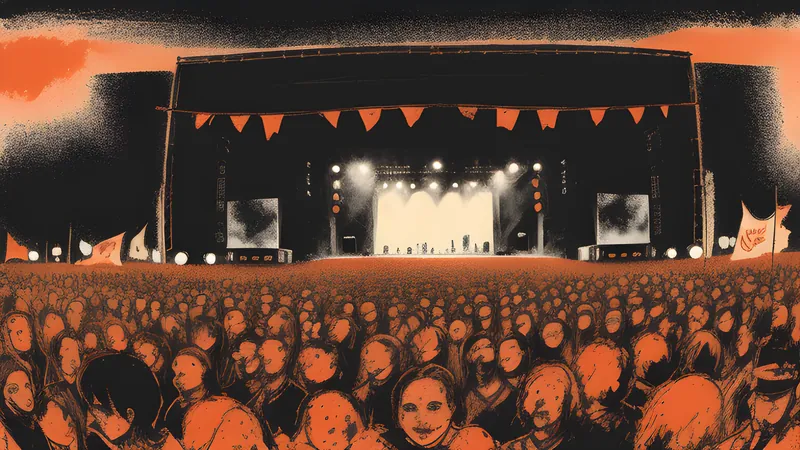
And the pit is the point. Kreator draw the kind of circle that separates the tourists from the faithful, a churning, generous chaos that is as much a part of the show as anything happening onstage. It is fast music made for fast bodies, and a good Kreator crowd understands the physics of the wall of death and the mosh as instinctively as the band understands the physics of the riff. The circle pits at a Kreator show are enormous, and they open on command — Petrozza only has to gesture and half the field starts revolving.
A fixture of the European festival summer
If you have spent any real time on the European festival circuit you have almost certainly caught Kreator, because they are as reliable a presence as the beer tents. Wacken, in particular, treats them close to home royalty — a German extreme-metal institution playing to a German extreme-metal crowd in a German field, which is about as natural a fit as this music offers. They have been a mainstay across the whole continental circuit for decades, from the big German gatherings to the specialist thrash-heavy bills like With Full Force, where a band of Kreator’s pedigree is exactly what the punters have come to see.
That festival ubiquity is not laziness on the promoters’ part. It is because Kreator deliver, every time, with a consistency that borders on the mechanical. You do not book them and hope; you book them and know. The set will be fast, it will be tight, the pit will open up on cue, and Petrozza will send the field home hoarse. In a genre that has watched a great many of its founders coast into comfortable nostalgia — the farewell-tour circuit that swallowed even Slayer — Kreator keep making records that matter and playing them like their reputation depends on it, because Petrozza plainly still believes it does.
Four decades out of Essen, and the engine has not so much as coughed. There is no farewell tour on the horizon, no obvious slackening of pace, no sign that the man at the front is anywhere near done. Kreator remain what they have always been — Teutonic thrash’s tireless engine, still running hot, still the safest bet on any festival bill in Europe. Catch them at dusk in a field full of the faithful, and you will understand exactly why they never had to reinvent a thing.
Related Content