The Krampus Runs: The Alpine Night the Devils Take the Street
On the eve of St Nicholas, the Alps hand the dark half of Christmas a set of horns and a licence to charge
Contents
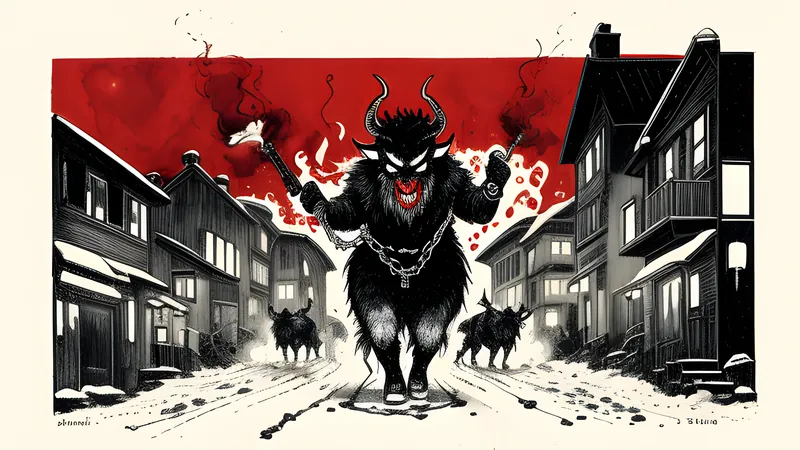
On the evening of 5 December, in Alpine towns from Salzburg down through the Tyrol and across into Bavaria and South Tyrol, the streets fill with horned devils. They stand two and a half metres tall in matted fur, faces carved from limewood into something between a goat and a nightmare, cowbells the size of buckets slung around their waists, and they come at the crowd swinging birch switches and roaring. This is the Krampuslauf — the Krampus run — and it is the loudest, strangest, most physical Christmas tradition in Europe. I have not stood in an Alpine square while a Krampus singled me out, so this is a correspondent’s read from history and reportage rather than a night I have survived. What it is, where it comes from, and why a region would build this into its December, is worth the walk through.
Nicholas and his shadow
To understand Krampus you have to understand that he does not work alone. He is the companion — the enforcer — of Saint Nicholas, and the pair are a good-cop, bad-cop act that predates the word. On the night of 5 December, Krampusnacht, the eve of the Feast of St Nicholas on the 6th, the two travel together through the Alpine villages. Nicholas is the bishop in white and gold, mitre and staff, and he rewards the children who have been good with nuts, oranges and small gifts. Krampus handles the rest. The badly behaved get the switch, a shake, a fright they will remember until next December, and — in the oldest and most theatrical versions — a threatened one-way trip in the basket strapped to Krampus’s back.
The genius of the arrangement is that it splits Christmas cleanly into its light and its dark, and gives the dark half a body. Most of Europe’s midwinter did this in some form; the Alps just kept the teeth. Where the modern Anglophone Christmas has softened Santa into pure benevolence and quietly retired the punishment, the Alpine version still runs the full moral circuit, reward and consequence, on consecutive nights, with the consequence given horns and a name.
The mask, the fur, and the price of looking like a demon
Get close to a Krampus costume and the craftsmanship stops the fear for a second. The mask — a Larve — is hand-carved from a single block of soft Alpine wood, usually lime or stone pine, by carvers who have often learned the trade from a parent and who supply the local Krampus associations year after year. A good one takes weeks: the leering face, the fangs, the ram or goat horns fitted and lacquered, the whole thing painted and oiled until it catches torchlight like wet skin. A serious carved mask can cost the better part of a thousand euros, and a fully kitted Krampus — mask, hand-stitched goat- or sheepskin suit, the belt of heavy iron cowbells, the tail, the switches — represents a genuine investment. People save for these. They are heirlooms.
The bells are their own language. A Krampus group announces itself long before you see it, a wall of low clanking iron rolling down the street as thirty or forty devils move together, and the sound is deliberately used to build the dread. When they arrive they arrive as a pack, and the physical contact is real: a Krampus will grab, shove, sweep a birch switch across the legs of anyone who lingers at the front. The crowd knows this and presses forward anyway, which is the entire social contract of the night. You stand at the barrier precisely because you might get swatted. It is the same bargain a mosh pit runs on, and I have written before about what the pit is actually for — the consented danger, the trust that the person about to slam into you will also pick you up.
How old is any of this, really?
Here is where an honest account has to slow down, because the internet will tell you Krampus is an ancient pagan god thousands of years old, and the historical record does not support that. The romantic version — Krampus as a survival of a pre-Christian horned deity, a solstice spirit driven out to dispel the dark — is popular, atmospheric, and largely unprovable. Folklorists and anthropologists have floated pagan roots, but historians generally treat the figure as first clearly attested only in the sixteenth or seventeenth century, woven into the Christian St Nicholas custom rather than smuggled in from a lost religion.
What is documented is fascinating enough without the myth. Krampus appears across a wide Alpine belt — Austria, Bavaria, South Tyrol and the neighbouring Italian provinces, Slovenia, and pockets of Hungary and Croatia — with local variation in the mask style, the number of horns, and the ferocity of the run. In parts of Austria the Krampus overlaps and blurs with the Perchten, the masked figures of the Perchtenlauf run later in the Twelve Nights around Epiphany, who chase out the winter spirits; the two traditions are distinct in origin but share carvers, aesthetics and a taste for terrifying the young. The Church, at various points, tried to suppress the whole business as unruly and un-Christian, and under Austrian fascism in the 1930s Krampus was officially discouraged. It kept coming back, because a tradition this physically rooted in a community does not die by decree.
The revival, and the tourists it brought
The Krampuslauf you can go and watch today is, in its scale and organisation, a fairly modern thing. The runs have exploded in size over the past few decades, professionalising into registered associations — Passen — with hundreds of members, insurance, matching costumes, and a competitive edge to who has the most fearsome carve and the most disciplined pack. Big-city runs in Munich, Graz and Salzburg now draw crowds in the thousands, some of them locals who have watched since childhood and some of them tourists chasing the photograph.
That popularity brings the familiar tension. Purists in the mountain villages grumble that the tourist-facing city runs have swapped folk terror for spectacle, that a tradition meant to discipline actual children has become a horror show for phone cameras. There have been real debates about the level of violence — how hard a costumed Krampus should be allowed to hit a stranger — and some events now draw a firmer line around the switching, especially with children present. It is the same argument I keep running into at every gathering that gets popular enough to sell tickets: the moment the outside world arrives with money, the community has to decide how much of the wildness to keep. The Alpine devils are having the conversation that Ivrea’s orange-throwers and Shetland’s fire-Vikings are having too.
Why the Alps keep the teeth
I think the reason Krampus endures — the reason a modern, prosperous, thoroughly Christian region keeps sending horned demons down its main streets every December — is that he does a job the sanitised Christmas cannot. He gives the season a shadow, and a shadow you can see and hear and be lightly assaulted by is easier to live with than a shapeless dread. Midwinter in the mountains is long and dark and genuinely dangerous, and the run is a way of meeting that dark head-on: dressing it up, naming it, letting it charge the crowd, and then watching Nicholas arrive right behind it with the oranges and the light. The devils always come, and Nicholas always follows. That order is the whole message.
There is also, plainly, joy in it. Under the fearsome mask is very often a local teenager or a fireman or a schoolteacher having the time of their life, and the terror is a game everyone has agreed to play. The best Alpine runs hold both at once — a real fright and a shared grin — the way the best loud, physical traditions always do. If you want the same instinct without the horns, the Danish fire nights I keep returning to run the calmer version: Sankt Hans, the bonfire that burns the darkness back on midsummer’s eve, is the summer solstice answering the winter one.
If you go
The runs cluster around 5 and 6 December, with some regions starting parades in late November and a second wave of masked figures — the Perchten — appearing around Epiphany in early January. Salzburg, Graz, the Tyrol and the villages of South Tyrol are the heartland; the Munich run is the easiest big one to reach. Stand near the front if you want the full experience and are willing to be swatted for it, keep small children back a row, and do not wear anything you would mind seeing bruised or muddied. And take the mask seriously when the run is over: ask a Krampus about the carve and you will get a proper answer, because the person under the fur usually paid a month’s wages for the face they are wearing, and they are quietly, rightly proud of it.
Related Content