Kirkpinar Oil Wrestling: Turkey's Slippery Championship
Olive oil, leather trousers, and a tournament Guinness calls the oldest continuous sporting event on Earth
Contents
Later this July, close to a thousand wrestlers coated head to waist in olive oil will gather on a field outside Edirne, in Turkish Thrace, for a tournament that Ottoman court records place at 1362 without a serious break since. Guinness World Records has accepted that lineage and credits Kırkpınar as the oldest continuously run sporting competition anywhere on Earth. Nothing else on this desk’s beat comes close to that kind of age, and the strangeness only compounds once you understand what actually happens on the field.
An origin story with soldiers in it
The tournament’s founding legend involves forty Ottoman soldiers rather than forty ordinary wrestlers, which is fitting for a competition whose name literally means “forty springs.” As the story goes, Sultan Orhan Gazi despatched his brother Süleyman Pasha and a company of forty men to besiege a Byzantine fortress near Edirne. Soldiers being soldiers, they wrestled each other between engagements, and two of them were so evenly matched that their bout reportedly ran on for a full day and night without either man yielding, ending only when both collapsed from sheer exhaustion. Local tradition holds that forty natural springs later bubbled up on the spot where they fell, giving the tournament its name and its origin story in one stroke.
Whether that particular tale is literal history or a satisfying legend built around a real founding, the documentary record backs the tournament’s antiquity regardless: Ottoman chronicles and administrative documents confirm the games running near Edirne from 1362 onward, through the empire’s rise, its long decline, and the Turkish republic that succeeded it. Six and a half centuries of continuity, even allowing for wartime interruptions along the way, is the kind of claim that would be laughable from almost any other event and is simply documented fact here.
Oiled, leathered, and grappling for the sky
The format bears almost no resemblance to Olympic wrestling, which is rather the point. Competitors, called pehlivans, wear the kispet — heavy, hand-stitched trousers made from buffalo leather that run from the waist to below the knee, built without a single buttonhole or fastening seam, sewn from around 58 metres of thread and weighing as much as 13 kilograms once complete. Before a bout, wrestlers oil themselves methodically, working olive oil into the left shoulder, chest, arm, and both the inside and outside of the kispet with the right hand, then repeating the whole sequence with the left. The oil is the entire technical challenge of the sport, since it strips away almost every conventional wrestling grip and forces competitors to fight for control almost entirely through the kispet itself.
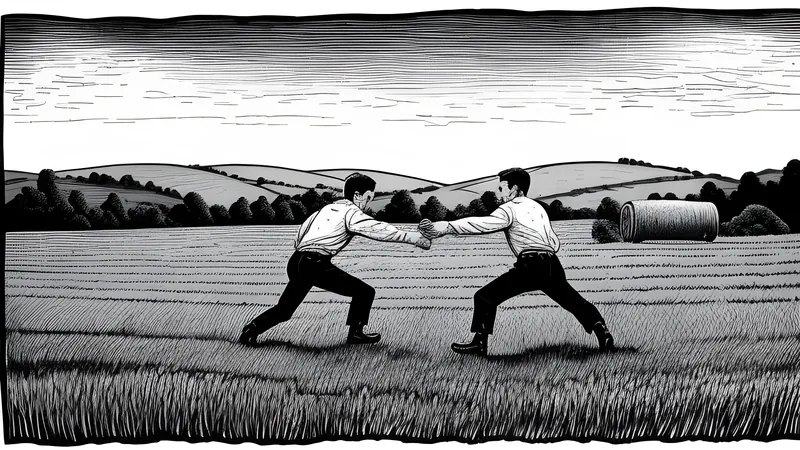
That single garment becomes the match’s real battleground. A wrestler can win by pinning an opponent flat on his back so his belly faces the sky — the traditional, decisive fall — but the sport’s signature manoeuvre is subtler: driving an arm deep into the front of an opponent’s kispet to seize effective control of his entire body from the waistband, a technique called paça kazık. Because oil defeats grip almost everywhere else, the kispet is often the only handle a wrestler has left, and matches can run long as two exhausted, slippery competitors search for a hold that will actually stick.
The announcer who makes the match a performance
No bout starts cold. A cazgır — a kind of tournament herald and hype-man in one — opens proceedings with a prayer for the wrestlers, then works through each combatant’s career and reputation in rhythmic, improvised verse, building the crowd’s anticipation before a single hold is attempted. Once the introductions finish, wrestlers perform the peshrev, a ritualised warm-up danced to the beat of davul drums and zurna pipes: slapping their thighs, sweeping their arms and legs in time with the music, kneeling to trace a circle from the ground to the knee, and touching belly, mouth and forehead before stretching an arm skyward in a gesture of respect. Only after that full ceremonial sequence does the actual grappling begin. The whole structure treats a wrestling match as a performance with a proper overture, the walk to the first hold staged as carefully as the hold itself.
A Golden Belt and a chief wrestler’s title
The tournament runs across several days each summer near Edirne, drawing a field of around a thousand pehlivans from across Turkey. Survive enough rounds and a wrestler earns the title başpehlivan — chief wrestler — the highest individual honour the sport confers, along with the tournament’s Golden Belt. Win that belt three times in a row and it becomes the wrestler’s permanent property rather than a trophy that returns to the organisers, a rule that turns Kırkpınar into as much a test of sustained dominance across years as of a single afternoon’s strength.
This year’s field includes Recep Kara, a three-time başpehlivan from wins in 2004, 2007 and 2008, and a wrestler with real pedigree beyond Kırkpınar itself — a European junior freestyle wrestling gold medallist in his youth and a multiple-time Turkish national champion before he ever set foot in a kispet. Whether he adds a fourth title to his collection this July is still to be decided when this piece goes out; what’s already established is the scale of what a repeat başpehlivan is chasing — a select company of wrestlers whose names carry weight in Thrace the way a boxing champion’s name might carry weight anywhere else.
The bracket runs on height
Olympic and collegiate wrestling sort competitors by body weight, on the logic that a bout should pit roughly equal mass against equal mass. Kırkpınar does something more unusual: the main adult categories are sorted primarily by height, running from başaltı up through büyükorta and küçükorta to the top-tier baş category that produces the başpehlivan title itself, with youth wrestlers competing in their own separate age brackets — yıldızlar, ümitler and gençler — before they’re old enough to challenge in the adult ranks. The logic makes a kind of sense once you think about what oil actually does to a match: a slippery, grip-denying surface rewards leverage and reach as much as raw mass, so a tournament built around the kispet and the paça kazık grip sorts its wrestlers by the dimension that actually predicts how a bout unfolds, rather than importing a weight-class system built for a different sport with different physics.
That structure also means a single afternoon at Sarayiçi — the purpose-built wrestling ground on the outskirts of Edirne where the tournament has been staged since the early 1960s, after decades of moving between smaller meadows around the city — runs dozens of bouts in parallel across multiple categories rather than a single elimination ladder working through one weight class at a time. Spectators wander between rings the way you’d wander between stages at a festival, catching a başaltı bout finishing on one patch of grass while a full başpehlivan contender is still being oiled down on another.
What a pehlivan eats and trains on
The kispet and the oil get most of the attention, but the sport asks just as much of a wrestler’s conditioning as any Olympic combat discipline, stretched across a much longer competitive lifespan. Pehlivans train year-round rather than building to a single peak, since Kırkpınar itself is only one tournament in a wider annual circuit of smaller oil-wrestling meets held across Thrace and beyond through the spring and summer. Traditional training emphasises strength married to flexibility and stamina over pure bulk, because a match can run long once both wrestlers are too slippery for a quick pin, and a wrestler who gasses out in the second half of a protracted bout loses to a lighter, better-conditioned opponent as often as to a stronger one. Diet talk among pehlivans and their trainers leans heavily on protein-rich, calorically dense traditional Turkish dishes — lamb, rice, and the bone-broth soup paça among them — the same foods that show up across Turkish sporting culture generally, but discussed here with the specific, practical seriousness of people who need to carry real muscle through a multi-day tournament without losing the mobility oil-wrestling demands.
Başpehlivans in particular can sustain competitive careers across a decade or more, which is unusual for any full-contact combat sport and part of why a handful of names — this year’s Recep Kara among them — accumulate multiple titles rather than the field turning over every year or two the way individual-weight-class combat sports often do elsewhere.
Recognised by UNESCO, still run by the wrestlers
UNESCO added Kırkpınar to its Intangible Cultural Heritage list, official recognition of exactly the kind of living, community-sustained tradition the list is designed to protect. In recent decades the tournament has also grown outward from a purely local wrestling contest into a week-long regional festival around the matches themselves, with folk dance performances, food markets and concerts filling the days around the bouts. That expansion hasn’t diluted the core event; the wrestling remains the reason a thousand pehlivans and a serious crowd turn up to a field outside Edirne every summer, oil ritual, kispet, cazgır and all, exactly as it has for the better part of seven centuries.
I write this from Copenhagen, and Turkish Thrace sits well outside the range this desk usually covers in person — this is a cultural read built from Kırkpınar’s own extensive documented history rather than a trackside account of a bout I watched. But the sheer continuity of the thing earns it a place alongside the rest of Europe’s oldest, strangest, most fiercely kept sporting traditions, the kind that outlast every empire and committee that ever tried to organise them and simply keep going because the wrestlers keep turning up.
Related Content