King Diamond & Mercyful Fate: The Corpse-Paint Originators the World Forgot Were Danish
How a Copenhagen falsetto in white face-paint quietly drew the blueprint half of extreme metal still works from
Contents
Play a certain kind of metal fan a burst of high, keening falsetto over galloping twin guitars, show them a face painted white with black around the eyes and a microphone stand built from what looks like a human femur and an inverted cross, and they’ll nod along to a story about Norwegian forests, church fires and the early 1990s. They’ll be wrong by roughly a decade and about 900 kilometres. The man who assembled most of that vocabulary was a Copenhagen singer named Kim Bendix Petersen, and he’d finished doing it before anyone in Bergen or Oslo had recorded a note. That the wider public still can’t place him — or his country — is one of the stranger accounting errors in heavy music.
A Copenhagen kid who studied Kiss like scripture
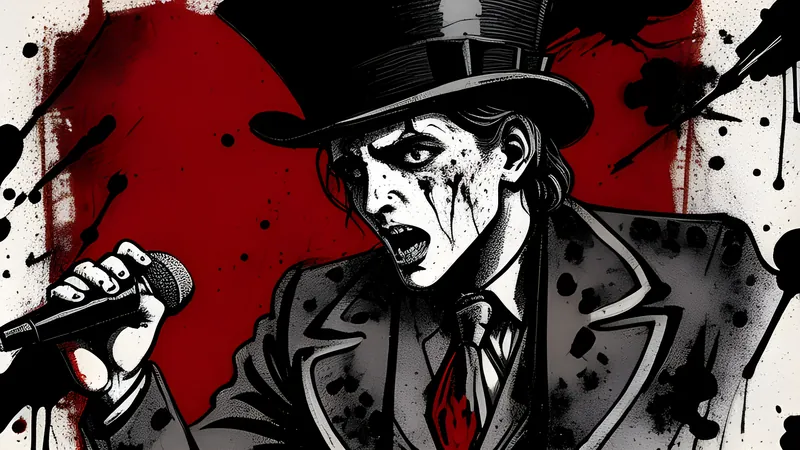
Kim Bendix Petersen was born in Copenhagen on 14 June 1956, and like a lot of Danish teenagers in the mid-1970s he watched Kiss and Alice Cooper turn a rock concert into a horror pantomime and decided that was the job he wanted. What separated him from the thousands of other kids who had the same thought was that he took the theatre completely seriously and the make-up even more so. He built the King Diamond persona — the split white-and-black face, the top hat, the graveyard props — as a deliberate character, an actor’s mask he could disappear behind, and he committed to it with a discipline that most shock-rock acts never bothered with.
The other half of the equation was the voice. Petersen sings in a full operatic falsetto that vaults up into a register most metal singers can’t reach and don’t try to, then drops into a low, sneering baritone for the villains and the narration. It is genuinely divisive — some listeners find it thrilling, some find it faintly ridiculous, and honestly both reactions are fair. What isn’t up for debate is that nobody else was doing it. In a genre that was fast standardising around either a thrash bark or a clean melodic wail, a man deploying his voice like a horror-film cast of characters was a category of one.
Mercyful Fate formed in Copenhagen in 1981, built around Petersen and guitarist Hank Shermann, whose riffing was as important to the band’s identity as the singing. Shermann and second guitarist Michael Denner wrote intricate, harmonised, almost progressive parts — this was not three-chord bludgeoning but arranged, sectioned, ambitious music with tempo shifts and long instrumental architecture. Underneath it, bassist Timi Hansen and a rotating drum stool held down a groove tight enough to make the theatrics land rather than collapse into camp. The band was tight in a way that the lyrics and the make-up sometimes disguised.
Two albums that quietly wrote the rulebook
Mercyful Fate’s reputation rests, absurdly, on a very small pile of recordings made in a very short window. There was a self-titled EP in 1982, then two studio albums: Melissa in 1983 and Don’t Break the Oath in 1984. That’s essentially it for the band’s foundational run — two records, both from before the mid-decade, both of which turn out to have been carrying an enormous amount of downstream influence.
The lyrics leaned hard into occult and Satanic theatre — Petersen has been open across his career about a genuine LaVeyan Satanist worldview, which is to say a philosophical, atheistic one rather than anything involving literal devils, and that sincerity is part of why the imagery never read as a cheap gimmick. The songs told stories: possession, ritual, curses, a witch named Melissa. This was concept-driven horror writing at a time when most of the band’s peers were writing about, at most, going to a party and possibly a war.
Musically the two albums did something that mattered more than any single riff: they proved you could weld genuine songcraft to genuinely extreme presentation. The harmonised guitars pointed one way, toward the melodic thrash and power metal that would flower later in the decade. The imagery and the atmosphere pointed another way entirely, toward something colder and more ritualistic that hadn’t been named yet. Very few bands sit at that particular fork. Mercyful Fate stood on it in 1984 and both roads led somewhere important.
The corpse-paint accounting error
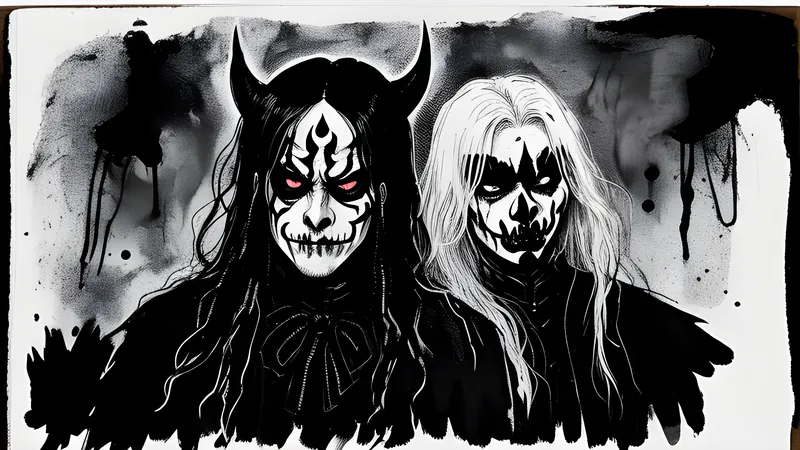
Here is the part that gets misfiled. The face-paint that the world associates with Norwegian black metal — the white base, the black around the eyes and mouth, the deliberately corpse-like death mask — did not originate in Norway. King Diamond was among the very first metal musicians to wear it, years before the Norwegian scene existed as a scene. His version descended from Kiss and Alice Cooper by way of his own horror-theatre instincts, and he was doing it on stage in Copenhagen in the early 1980s.
When the young Norwegian musicians who built black metal in the early 1990s reached for their references, Mercyful Fate was squarely among them. The Danish band is routinely cited as a formative influence on the imagery and atmosphere of that scene, alongside Britain’s Venom, whose 1982 album handed the genre its name. Mayhem’s guitarist Euronymous, the central organising figure of the Norwegian movement, drew on that earlier generation even as he pushed the philosophy somewhere more extreme and, ultimately, more dangerous than anything Petersen — a theatre man, not an ideologue — ever intended.
I want to be careful about the size of this claim, because metal fans love to overstate lineage. King Diamond did not invent black metal single-handedly, and the corpse-paint look has several fingerprints on it, Venom’s included. But the specific, now-iconic death-mask face, worn with total commitment as a character rather than a smear of theatrical gunk, has an unusually clear early exponent, and he sang in Danish-accented English from Copenhagen. The genre’s visual identity was substantially drafted in a country that the genre’s mythology almost never mentions.
Abigail, and the pivot to pure horror storytelling
Mercyful Fate splintered in 1985 over the usual band fault lines — musical direction, the pull between Shermann’s instincts and Petersen’s. Rather than vanish, Petersen kept the King Diamond persona and turned it into a solo band bearing that name, and in doing so he found the format that suited him best: the full-length concept album as horror novel.
Fatal Portrait arrived in 1986, but the piece that defines this run is Abigail, released on 29 May 1987 — his first album built as a single continuous story from beginning to end. It’s a haunted-house ghost tale, complete with a stillborn child, spectral horsemen and a doomed couple, narrated in Petersen’s shifting voices so that the falsetto and the baritone become different characters in the same scene. As a piece of writing it is committed, coherent and genuinely creepy in a way concept albums frequently aren’t, and it remains the record most people reach for when they want to explain why he matters. The King Diamond band kept the thread going through “Them” and Conspiracy into the late 1980s, each a self-contained horror narrative with the same theatrical scaffolding.
The stagecraft grew to match. The King Diamond live show is a proper set piece — props, lighting, a stage dressed like a Hammer horror set, and that microphone stand assembled from crossed bones and an inverted crucifix that has become a signature object in its own right. It is deliberately over the top, and it’s supposed to be. This is a man who understood, from watching Alice Cooper as a teenager, that metal at its best is a form of theatre, and who never once apologised for treating it that way.
Revered by the players, unknown to the public
Mercyful Fate reformed in 1993 and produced a run of solid albums through the decade, and Petersen has kept both projects alive across the years with the persistence of someone who was never chasing the mainstream in the first place. Metallica’s public affection helped — their fondness for Mercyful Fate, eventually expressed in a medley that stitched several of the old songs together, sent a lot of curious listeners back to the source. That the endorsement came from Denmark-adjacent quarters is a nice accident of the map, given that Metallica’s own frontman carries a Danish passport and a Danish upbringing.
This is the essential shape of King Diamond and Mercyful Fate: an influence-to-fame ratio that is almost comically lopsided. Ask working metal musicians — thrash players, death-metal writers, an entire generation of black-metal bands — and the name comes up with real reverence. Ask a general audience and you’ll mostly get blank looks, or a vague association with the wrong country. He never had the crossover hit, never softened the presentation, never became a household name outside the genre. He simply drew a large part of the blueprint and let other people get famous building on it.
Denmark has an odd habit of producing outsized loud-music exports while the rest of the world files them elsewhere or forgets the postcode entirely — a pattern worth its own accounting, and one you can trace forward to the rockabilly-metal machine of Volbeat, whose Michael Poulsen came up through the same national scene. King Diamond is the sharpest example of the type. If you’ve ever watched a corpse-painted figure on a festival stage and thought “Norway,” take the thought back about a decade and move it to Copenhagen. The man who got there first is still touring, still in the make-up, still committing to the bit with a straight face. He earned the credit. He’s just never much cared whether he got it.
Related Content