Jokkmokk Winter Market: The Sámi Gathering Above the Arctic Circle
For four hundred winters, the far north of Sweden has emptied into one small town on the first weekend of February
Contents
Every year on the first Thursday of February, a town of a few thousand people north of the Arctic Circle swells to tens of thousands, in temperatures that regularly sit at minus thirty, because the Jokkmokk winter market has been the great gathering of the Sámi world since 1605 and four centuries of cold has never once been reason enough to cancel. This is Swedish Lapland — Sápmi, in the Sámi tongue, the land that stretches across the top of Norway, Sweden, Finland and the Kola Peninsula of Russia — and Jokkmokk’s market is its oldest continuous appointment.
I write this as an outsider looking in with a lot of respect and no claim to belong. I am a Dane who likes loud music and cold festivals; the Sámi are Europe’s northernmost Indigenous people, with their own languages, their own reindeer-herding livelihood, their own long and difficult history with the Nordic states that carved up their land. The market is theirs. What a visitor owes it is accuracy and humility, so let me give you the record straight.
A market the Crown invented to count people
The founding is not a romantic one, and the Sámi are the first to say so. In 1605 the Swedish king Karl IX decreed that fixed marketplaces and churches be established across Lapland. The motive was administrative: the Crown wanted the scattered, mobile Sámi gathered in one place at a predictable time so its bailiffs could tax their trade and its priests could preach to them. February was chosen deliberately, the coldest, darkest stretch of the year, when the reindeer-herding families were down in their winter forest settlements and the frozen rivers and lakes made hard, fast highways for merchants and officials to reach them.
So the market began as an instrument of control, a way for a southern king to inventory a northern people. The turn in the story is what the Sámi did with it. The gathering has been held every year since 1606, and across those four centuries the Sámi reclaimed it — turned an imposed collection point into one of the most important social events in Sápmi, the winter meeting where families separated by enormous distances see one another, where marriages were arranged and news exchanged and reindeer bought and sold. The Crown built the frame; the people made it home. That reclamation is the whole meaning of the modern market.
What actually happens on the ice
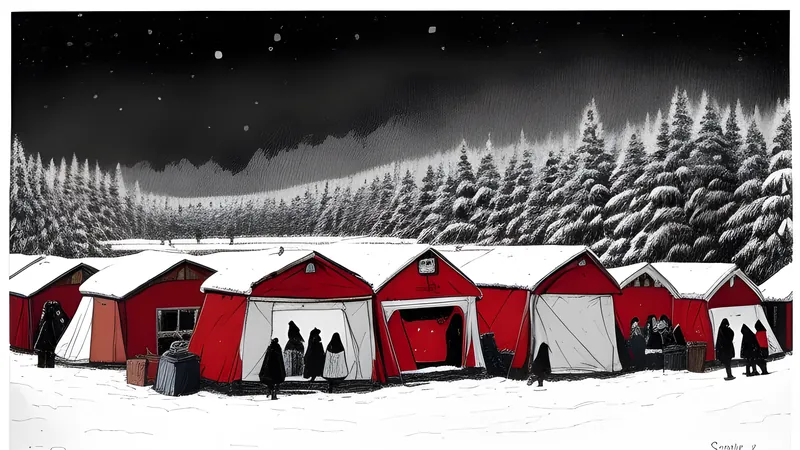
The market proper runs Thursday to Saturday of the first February weekend, and it has a texture unlike any festival I know. Stalls line the snow-packed main street selling Sámi handicraft — duodji, the traditional craftwork, is the word, and it is protected and taken seriously: knives with reindeer-antler handles, carved wooden cups called guksi, silverwork, and the distinctive blue-red-yellow braided bands and pewter-thread embroidery of Sámi dress. Alongside it is the food: reindeer in every form, smoked and dried and stewed, suovas (smoked reindeer meat) in flatbread, cloudberries, cured Arctic char, coffee drunk scalding against the cold.
The reindeer themselves are part of it. There are reindeer-racing displays where the animals pull a skier or a sled down a frozen course, and there is a genuine reindeer market where herders trade stock, because this is a working culture and the market still does its original job. Reindeer husbandry in Sweden is a legally protected Sámi right, and the herds that gather near Jokkmokk in winter are the living reason the market exists at all — the calendar of the animals sets the calendar of the people, and always has. There are joik performances — the joik being the traditional Sámi song-form, a way of vocally evoking a person, an animal or a place rather than singing about it, and one of the oldest surviving musical traditions in Europe. There are exhibitions, church services in the Sámi languages, seminars on land rights and reindeer husbandry and the pressures of a warming Arctic. It is a trade fair, a family reunion, a cultural festival and a political forum stacked into three days on the ice.
The cold is not incidental; it is the whole architecture. In 2021 the market went fully online for the first time in over four centuries, forced there by the pandemic, and everyone understood it as a wound. A Jokkmokk market you attend from a screen is a contradiction, because the entire point is bodies gathered in one freezing place, breath fogging, hands wrapped round hot cups, the specific physical fact of having travelled a long way through deep winter to stand together.
Around the official market runs a second, unofficial one, and the two are not the same thing. The historic market — the Sámi trade, the duodji stalls, the reindeer, the joik, the seminars — is the heart. Alongside it has grown a larger commercial fair of the kind any big event attracts, with general traders, fast food and stalls selling things that have nothing to do with Sápmi. Some in the community keep a wary eye on that creep, protective of the market’s meaning, and the town works to keep the Sámi core distinct and central rather than drowned by the carnival that has attached itself. It is the same tension every living tradition faces once the outside world decides it is worth visiting: how to stay yourself while the crowds arrive. Jokkmokk has managed it for centuries, which is a track record worth trusting.
The town itself is tiny and remote — Jokkmokk sits on the Lule River, just north of the Arctic Circle, hundreds of kilometres from any large city, reached by a long drive or a train to Murjek and a bus beyond. That remoteness is part of the pilgrimage. You do not stumble into Jokkmokk; you commit to it, through short daylight and deep snow, and the effort is baked into the experience. The Ájtte museum in the town — the main museum of Sámi culture and the Swedish mountain region — anchors the whole thing year-round, so a February visitor is arriving at a place that takes its own heritage seriously every day of the calendar, not only for market weekend.
Getting the respect right
There is a version of Arctic tourism that turns Indigenous people into a photo opportunity, and Jokkmokk is a place to be conscious of that. The Sámi flag — quartered red, green, yellow and blue with a circle for the sun and moon — flies over the market, and it flies for a people who spent a long time being told their culture was backward, whose children were sent to state boarding schools, whose language was suppressed, whose grazing lands were and are cut by mines, dams, logging and railways. The market’s political seminars are not a sideshow. They are the community using its biggest annual gathering to argue, publicly, for its future.
For a visitor the etiquette is simple. Buy duodji from Sámi makers and pay what it is worth, because the craft label protects livelihoods. Ask before photographing people in traditional dress. Listen more than you talk at the seminars. Understand that the joik is not folk entertainment laid on for you; it is a living form with meaning attached. Treat the whole thing as someone else’s home that you have been generously allowed to visit, and it opens up.
Where the market sits among the North’s winter gatherings
The instinct behind Jokkmokk — people crossing hard country in the dead of the year to trade, to meet, to be a community for a few days — is one you find echoed all across the North, in very different keys. Denmark’s living-history Viking markets chase something adjacent: the reconstructed trading fair as a place where craft, food and identity get performed and passed on, though those are heritage re-enactments where Jokkmokk is an unbroken working tradition four centuries deep. The difference is worth holding onto — one is a culture remembering, the other a culture continuing.
The seasonal rhythm rhymes too. Where the far north gathers in the black of February around fire and trade, the Nordic calendar swings to the opposite pole in spring and summer, when the light comes back and the bonfires go up — the Walpurgis Night fires of Valborg that Sweden lights on the last night of April to burn out the winter are the same people, half a year and a whole mood away. Jokkmokk is winter’s version of the same human need: gather, mark the season, be together against the dark.
If you can bear the cold — and it is a serious cold, the kind that demands proper Arctic layers and respect — the first weekend of February in Jokkmokk is one of the most singular gatherings in Europe. Book a bed months out, because they are scarce and they vanish. Come to buy, to eat, to listen. And remember whose gathering it is: a people who took a king’s tax-collection point and turned it, over four hundred winters, into the beating heart of their year.
Related Content