Into the Grave: Leeuwarden's Metal Field
A death-metal festival dropped into the middle of a Frisian city, banners and all
Contents
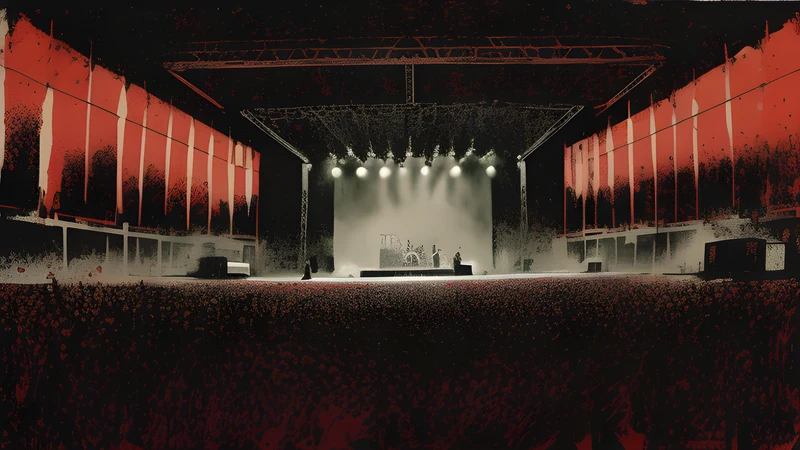
There is a particular pleasure in a metal festival that refuses to hide itself away. Into the Grave does not sit on some isolated field an hour from anywhere; it plants itself in the middle of Leeuwarden, the capital of the Dutch province of Friesland, and holds a death-metal festival in the city’s central square. The banners go up over the Wilhelminaplein, the stages face the old buildings, and a Frisian market town spends a day being overrun by exactly the kind of music polite society tends to keep at arm’s length. That civic boldness is the first thing to admire about it. Somebody in Leeuwarden decided the death-metal underground deserved a day in the city centre, and that decision tells you everything about the festival’s character.
From Copenhagen the Netherlands is the foreign country I read most closely after Germany, and Into the Grave occupies a corner the bigger Dutch festivals leave open. This is not the broad-church metal weekend of FortaRock or the mainstream-heavy sweep of the field festivals. This is the underground getting its own event — old-school death metal, the harder end of the spectrum, the bands that the mega-festivals bury at noon on a side stage given the run of a city square. It is a festival with a clear allegiance, and the allegiance is to the heavy end.
A city square with the banners up
The siting is the whole identity. Most metal festivals happen out of sight, on farmland or industrial ground where the noise offends no one, and there is a good practical reason for that. Into the Grave took the opposite gamble and won it: a death-metal festival in the historic heart of a provincial capital, framed by centuries-old Frisian architecture, with the crowd spilling through streets that spend the other 364 days a year being thoroughly respectable. The contrast is glorious. A wall of guttural riffing bouncing off a gabled Dutch façade is a sight and a sound that a remote field can never offer.
That urban setting shapes the experience in ways beyond the visual. The festival is walkable, embedded in the city’s bars and infrastructure, easy to reach by public transport into the centre of Leeuwarden. You are not trapped in a temporary tent city with overpriced burger vans; you are in a working city with actual restaurants and shops and trains, watching death metal in the town square between them. For an international punter that accessibility is a real draw. A festival you can reach on a train and leave on a train, with a real city around it, is a festival you can actually do.
Leeuwarden, of all places
The choice of host city rewards a second look. Leeuwarden makes an unlikely metal capital. It is the quiet provincial seat of Friesland, a region with its own language and a strong independent streak, a city better known for its canals, its leaning tower and its history than for extreme music. In 2018 it served as a European Capital of Culture, a designation that put a small Frisian city briefly at the centre of the continent’s cultural map. A death-metal festival in that same civic centre is a reminder that culture is a broad church, and that the loudest, most confrontational music has as much claim on a city square as any gallery opening. Leeuwarden, to its credit, seems to agree.
The Frisian independent streak may be part of why it works. This is a region comfortable with going its own way, unbothered by what the rest of the country thinks, and there is something fitting about the underground finding a home in a place with that temperament. A festival that refuses to apologise for what it is, in a city that refuses to be anywhere’s second thought — the two suit each other. Into the Grave feels less like an event imposed on a town and more like a town and a scene recognising something in each other.
The underground gets a stage
Into the Grave’s booking is where its heart shows. This is a festival built around old-school death metal and the broader heavy underground, the kind of programming that treats the extreme end as the main event rather than the garnish. The bands it books are the ones the committed travel for — the death-metal veterans and the newer bands carrying that tradition forward, drawn from the deep and healthy European scene. The Netherlands sits in the middle of a continent’s worth of extreme metal, close enough to the German, Belgian and Scandinavian scenes that a festival with the right booking can pull the best of all of them.
For anyone who follows the death-metal world, the appeal is obvious. This is music that rewards commitment — the riffs, the blast beats, the sheer physical density of it — and a festival that programmes for people who already love it can go deeper than one hedging for a casual crowd. The Danish and wider Nordic death-metal scene has its own strong hand in bands like Baest, part of the same European underground that Into the Grave draws from, and the connective tissue between these scenes is exactly what a festival like this strengthens. When the underground gathers, the bands find their people and the people find their bands.
The crowd and the pit
A death-metal festival crowd is a specific animal, and Into the Grave gets a good one. This is an audience that came for the heavy specifically, which means the pits are enthusiastic and the reception for the underground bands is warm in a way a mainstream festival’s could never be. Dutch metal crowds are among the best in Europe — knowledgeable, unpretentious, up for it — and concentrated for a day of death metal in a city square, that energy has nowhere to go but into the music. The bands feel it and play harder for it, and the loop feeds itself.
There is also a camaraderie to the underground-festival crowd that the bigger events lose. When a festival books a specialised, demanding kind of music, the people who turn up are self-selected — they are there because they genuinely love this obscure, demanding music for its own sake. That shared, slightly obsessive devotion makes for a friendly, tight-knit atmosphere, the kind where strangers in band shirts fall into conversation because they came a long way for the same obscure reasons. The etiquette of the pit — the unwritten rules that keep the violence communal rather than genuinely dangerous — runs strong at a festival like this, where the crowd knows exactly what it is doing.
The economics of staying underground
Running a festival for the underground is harder than running one for the mainstream, and it deserves acknowledgement. Death metal is a passionate audience but not a vast one, the ticket revenue is thinner, and the pressures on any mid-size or small festival in the current European market are punishing — costs climb, margins shrink, and every edition is a bet. That a festival like Into the Grave exists at all, holding a specialised bill in a prime city-centre location, is a small triumph of will over economics. The people who run these events are rarely getting rich; they are doing it because they believe the scene deserves it.
That belief is the thing that keeps the underground alive. The mega-festivals will always book the big names because the big names sell tickets, but a healthy metal ecosystem needs the smaller, specialised events that take the harder music seriously and give the underground bands a proper platform. Into the Grave is part of that vital layer — the festivals that are not chasing the crossover crowd, that book what they love and trust an audience to love it too. Every scene needs its true believers, and the ones running Into the Grave clearly qualify.
Built by people who mean it
Festivals like this are almost never the product of a big promoter’s spreadsheet. They start with a handful of people who love a kind of music enough to take on the enormous, thankless work of putting it in front of a crowd — the permits, the sound, the safety plans, the endless negotiation with a city that has to be persuaded every year. Into the Grave carries the fingerprints of that kind of origin: a festival grown out of genuine scene devotion rather than corporate strategy, run by people for whom the booking is a labour of love. You can feel it in the coherence of the thing, the way every choice points in the same direction.
That grassroots character is fragile and worth protecting. The events that get bought up, franchised and optimised tend to lose exactly the quality that made them matter, sanding off the sharp edges until they are indistinguishable from every other summer festival. The ones that stay small and stubborn keep their soul at the cost of never being safe. Into the Grave lives in that second camp, and the trade is the right one for what it is. A death-metal festival in a city square was never going to be a safe business. It was only ever going to be a good one.
Where it sits
For a Copenhagen punter mapping the Dutch heavy year, Into the Grave is the underground’s day out — the festival you go to when you want the extreme end taken seriously in a setting that makes it feel like an event rather than an afterthought. It complements the broader Dutch calendar precisely by being narrower: where FortaRock and the field festivals cast wide, Into the Grave goes deep into one corner and does it justice. Between them, the Netherlands covers every register of the genre, which is why it remains the most complete metal country in Europe for its size.
The image that stays with me is the one the festival was built to create: a death-metal band at full tilt, banners flying, in the central square of a handsome old Frisian city, the historic architecture watching a crowd do things that architecture was never designed to witness. Most festivals hide the loud away. Into the Grave puts it in the middle of town and dares the neighbours to complain. That confidence — the refusal to treat the underground as something to be ashamed of — is exactly what the death-metal scene deserves, and Leeuwarden, improbably, is the city that gives it to them.
Related Content