Hellfest: France's Cathedral to Loud
How a Muscadet wine town of 7,500 became the loudest place in France every June
Contents
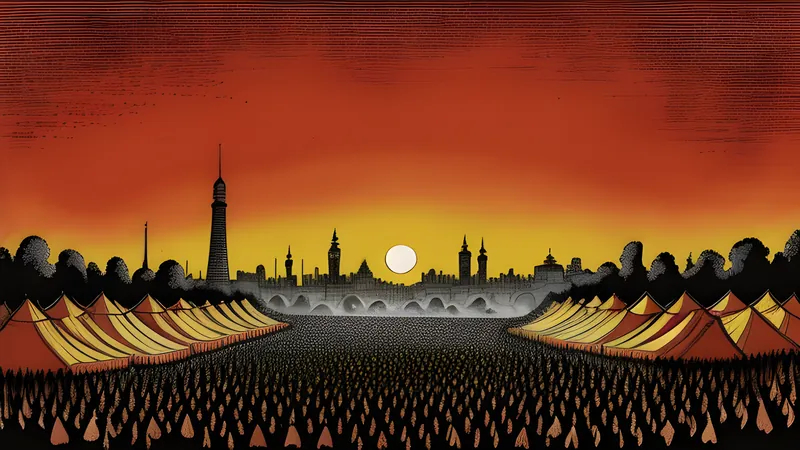
Clisson is the kind of town French tourist boards photograph at golden hour. Seven and a half thousand people, a ruined medieval castle on a rocky spur where the Sèvre Nantaise meets the Moine, and — this is the strange part — a skyline of Italianate loggias and terracotta arcades, because a sculptor named Lemot came home from Italy in 1807 and rebuilt the place to look like Tuscany. Around it spread the vineyards of Muscadet Sèvre-et-Maine, Clisson itself now a named cru of the appellation, the white wine that goes with the oysters up in Nantes. It is bucolic, Catholic, deeply provincial western France. And for four days every June it becomes the loudest square kilometre on the continent.
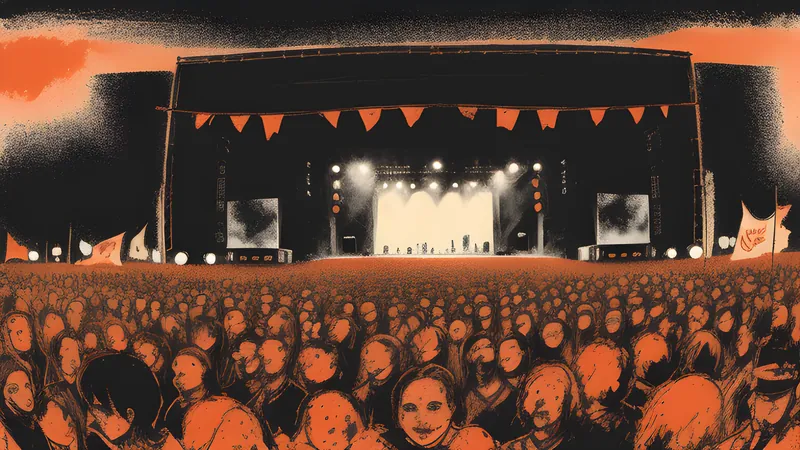
Hellfest drops roughly a quarter of a million metalheads into this postcard. Sixty thousand a day, black-clad and sunburnt, funnelled through a town that on the other 361 days sells wine and shows German coach tours the castle. The incongruity is the first thing anyone tells you about Hellfest, and it is genuinely the whole story — the festival, the fight over it, and the slow armistice that followed. If Wacken is a farming hamlet that adopted metal as its own, Hellfest is the tale of a town that did the opposite for years, dug in against it, and then quietly worked out how much the invasion was worth.
The site, and the wine country it sits in
Get the geography straight, because it explains everything. Clisson sits about 30 kilometres south-east of Nantes, deep in vineyard country. The festival occupies a flat expanse on the edge of town — around 20 hectares of what used to be the unremarkable Val-de-Moine site, where the whole thing started life. There is no mountain backdrop, no coast. Just fields, the heat shimmer of a Loire-Atlantique June, and rows of vines that end where the fencing begins.
June in this part of France is the gamble. It can be a merciful 22 degrees and it can be a punishing 35, the sun coming down flat on a treeless plain with 60,000 bodies and no shade to speak of. Hellfest in a heatwave is an endurance event; the water points and the misting stations are survival infrastructure, not luxuries, and the crowd’s first casualty is always the person who thought they could headbang through an afternoon on the Altar stage without drinking anything. Pack for a desert and pray for cloud.
The wine-country setting is not incidental colour. It is the reason the festival was controversial and the reason it now matters so much locally. This is not a region that had any cultural frame for a hundred thousand people in Cannibal Corpse shirts. The clash was real, and for a while it was ugly.
The town that fought it, and then didn’t
Ben Barbaud and Yoann Le Nevé launched Hellfest in 2006, salvaging it from the wreckage of Fury Fest, an earlier hardcore festival that had run from 2002 to 2005 and collapsed financially. The origin story people love: the very first Fury Fest gig in June 2002 pulled 400 people to watch Agnostic Front at the Val-de-Moine sports complex. From that, in twenty years, a festival that sells sixty thousand passes before it has even announced who is playing.
The growth was near-vertical. Seven thousand in 2003, twenty-one thousand by 2004, thirty thousand in 2005 under the old Fury banner. Then Hellfest proper, climbing every year until it hit the ceiling of the site and the crowd cap. And every step of that climb, a slice of Catholic and conservative France was trying to shut it down.
The opposition was organised and it named names. Philippe de Villiers, the local aristocrat-politician of the neighbouring Vendée, branded it a “satanic festival”. Christine Boutin, a Catholic-conservative minister, lobbied the Kronenbourg brewery over its involvement. In 2009 conservative groups leaned on the sponsors hard enough that Coca-Cola pulled out. In 2010 the Associations Familiales Catholiques took Hellfest to court, demanding the festival bar under-18s and hand over the titles of the songs to be performed so they could be vetted. On 14 June that year a judge threw the demand out. Metal had won a legal precedent, which is a very metal thing to have on the record.
What is interesting — the thing a fact-checker’s timeline misses — is how the war ended. It ended in euros. Sixty thousand people a day have to sleep somewhere, eat something, buy fuel and bread and beer and Muscadet. The town that spent years refusing to say the word Hellfest in its own tourist literature slowly noticed that the festival had become, by a distance, the biggest economic event of its year. The campsites fill the fields. The bakeries triple their orders. The Nantes hotel trade books out for a 30-kilometre radius. A place that could not culturally metabolise metal turned out to be perfectly capable of banking it. The reconciliation was economic first and emotional second, and there is no shame in that — plenty of scenes have been saved by a town realising the weirdos spend money.
The cathedral: what the money built
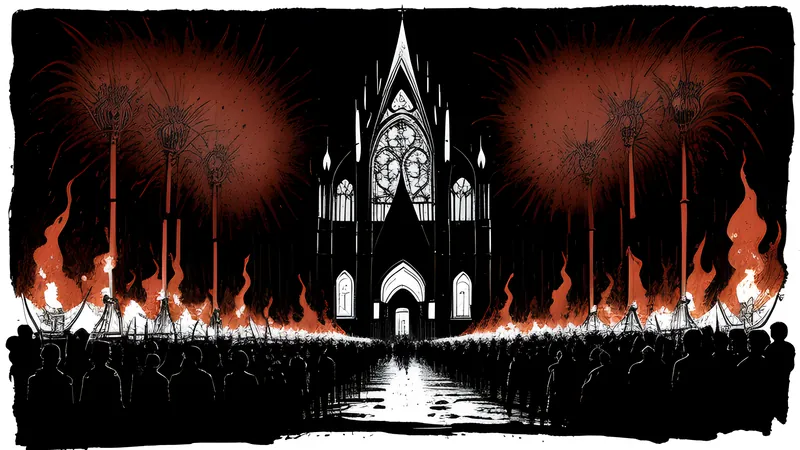
Here is where Hellfest earns the nickname. Most festivals put up scaffolding, hang a banner, and tear it down on Monday. Hellfest builds a cathedral to loud, and increasingly it does not take it down at all.
Walk in and the scale of the production design hits before the sound does. Monumental sculpture everywhere — gargoyles, inverted crosses, medieval bestiary creatures rendered in iron and welded steel, gothic ironwork gates you pass under to reach the stages. The imagery is drawn straight from metal’s own century of borrowing from cathedrals and grimoires, and the Clisson site treats it as an open-air museum rather than a backdrop. The sculptor Jean-François Buisson is one of the invisible architects here: his Hellfest Tree and the Hellfist — a giant metal fist thrown up at the sky, the concert gesture frozen into permanent sculpture — have become the site’s landmarks.
The six stages carve the vast church of metal into chapels. Mainstages 1 and 2 sit side by side for the big-tent bookings, alternating so the sound never stops. Then the specialist rooms: the Warzone for punk and hardcore, kept slightly apart with its own grubby character; the Valley for stoner and doom, the slow heavy end of the spectrum where a Roadburn regular would feel at home; and the Temple and Altar tents for the extreme stuff, black metal and death metal, staged with the full theatrical apparatus of flame and gloom. Programming runs six stages deep across four days, north of 180 bands in a strong year, and the curation is genuinely catholic in the lowercase sense — hard rock through to the most punishing extreme metal on the planet, all under one enormous constructed sky.
The permanence is the newest twist. Since 2025 the grounds carry an official name, the Hellfest Festival Park, and parts of it open to visitors outside festival season. The sculptures stay up year-round. The wine town that once wanted the festival gone now has a permanent metal monument on its edge, drawing day-trippers to a fibreglass gargoyle in October. That is the reconciliation made physical.
The crowd, and the standout hours
Hellfest’s crowd is French to its bones and international at its edges — Germans, Brits, Spaniards, Scandinavians who have run out of festivals closer to home. It skews a shade older and a shade more devout than a general-admission rock crowd; these are people who planned the year around this, bought a blind four-day pass in the July before, and treated the November lineup reveal as a bonus. The sold-out-in-minutes ritual has become part of the identity. You commit to Clisson before you know a single band, which tells you the festival has become the draw over any headliner.
The music that lands hardest at Hellfest tends to be the music the site was built for. A doom set on the Valley stage in the late afternoon, the sound thick as the heat, is one of the great festival experiences in Europe — that stage has hosted the slow-riff royalty year after year, and the crowd for it is knowledgeable in a way that raises the whole thing. The Warzone late at night, punk and hardcore hammering out into the vineyard dark, is where the festival keeps its pulse and its sense of humour. And the mainstage reunions and farewells — the heritage acts a festival this size can afford to book and a crowd this loyal turns out for — supply the communal thunderclaps, forty thousand voices going up at once under the ironwork. Hellfest woven together is a spectrum: the plodding heaviness of the Valley, the speed of the Warzone, the pageantry of the Temple, all running at once, and the skill is in building your own path through it.
Getting in, getting there, getting out alive
The logistics are, mercifully, some of the best-solved in European festivals, because the site is tethered to a real town with real transport. Fly or take the TGV to Nantes. From there the regional TER train runs to Clisson all day and most of the night, a 15-to-30-minute hop, and the Loire-Atlantique regional fare is capped at about five euros a trip — one of the great transport bargains in festival-going. Shuttles run from Clisson station and from Nantes airport straight to the gates. There is a free carpooling platform if you would rather share a car through the vineyards.
Camping opens the Wednesday before and is included in the pass — the classic option is a field and your own tent, with a paid Easy Camp upgrade if you want a bed and a roof already pitched for you. The campsites are their own society, a temporary metal town in the fields, and they are where a lot of the festival’s actual life happens between sets. If tents are not your religion, Clisson and Nantes hotels exist, but they book out early and the train makes staying in Nantes genuinely viable.
Budget honestly. The four-day pass is the cheap part relative to what a comparable weekend costs at Copenhell or the Anglo festivals; France keeps Hellfest reasonable at the gate. It is the everything-else — travel to Nantes, four days of eating and drinking on site, the beer, the merch you will absolutely buy — that adds up. Corporate money has crept in as it has everywhere; the site is bigger and slicker than the scrappy early editions, and the sponsors that once fled under Catholic pressure are long back. Purists grumble that the thing has professionalised. It has. It also runs like clockwork now, and the clockwork is why sixty thousand people can be moved in and out of a town of seven and a half thousand without the whole thing falling apart.
The verdict
Hellfest is for the committed. If you want a broad, sunny, sing-along festival with a bit of everything, this is the wrong field — the programming is deep metal first and the June heat is a genuine test. But if the six-stage spectrum is your music and the cathedral-to-loud spectacle is your idea of a good time, there is nothing else quite like standing under Buisson’s ironwork with a plastic cup of the local Muscadet, watching a doom band flatten a French vineyard at thirty degrees.
Go for the production design, which no other festival matches. Go for the depth of the bill. Go, above all, for the strangeness of the place — a devout little wine town that fought metal in the courts, lost, and then built it a permanent monument once it counted the takings. Skip it if extreme metal leaves you cold or if you wilt in heat with no shade. Otherwise, buy the blind pass in July, learn the Nantes train, and find out why the loudest place in France every summer is a village that once tried to have it banned.
Related Content