Heilung: Amplified History as Spectacle
Bones, antlers, throat-singing and a warning that this is a ritual rather than a rock show
Contents
Some live acts you review. Heilung you survive, and then spend a week trying to explain to people who were not there. They call what they do “amplified history,” and the phrase is exact — this is music built from the sounds, texts and objects of the European Iron Age and Viking Age, amplified into a full ritual spectacle of bones, antlers, spears, smoke and a hundred voices. It is one of the most extraordinary things happening on European stages, and it sits at the strange, thrilling intersection where music becomes theatre, ceremony and something close to collective trance.
I write about Heilung under the spectacle banner rather than as a straight band review because that is honestly what they are — a spectacle in the fullest sense, closer to the Nordic gatherings and staged rituals I cover elsewhere on this desk than to a normal concert. What they build in a field or a hall is an experience with its own internal logic, and the only responsible way to describe it is to take that logic seriously.
Who and what Heilung are
Heilung formed in 2014, built around a trio: Kai Uwe Faust, a Danish tattoo artist deeply versed in Nordic tradition and the primary source of the guttural throat-singing and ritual leadership; Christopher Juul, a Danish producer and musician who handles the sonic architecture; and Maria Franz, a Norwegian-born singer whose clear, soaring voice provides the counterweight to Faust’s growl. The name is German for “healing,” and the project’s stated aim is exactly that — a kind of sonic and ritual healing drawing on the shared pre-Christian heritage of northern Europe.
Their material is built from genuine historical sources. Lyrics are drawn from runic inscriptions, ancient artefacts, historical texts and reconstructed languages — Old Norse, Proto-Germanic, the words found on real objects and stones. The instruments are ritual objects: drums made with human and animal materials, rattles of bone, horns, and percussion assembled from the stuff of the ancient world. This is meticulously researched work, and Heilung are open that it is interpretation rather than reenactment. They present the past as inspiration for something new, and the seriousness of the sourcing is a large part of why the result carries such weight.
The opening warning
Every Heilung ritual begins the same way, and it tells you everything about their intent. The performers gather at the front of the stage and speak an opening ceremony — a call to remember that everyone present shares a common ancestry, that the audience and performers are kin, an invocation asking the gathering to remember it is all one people. It functions as a threshold. The house lights are already low, the stage set with antlers and hides and standing figures, and the invocation draws a clear line between the ordinary world outside and the ritual space you are about to enter.
It is a genuinely effective piece of stagecraft, and it does real work. By framing what follows as a ceremony rather than a gig, Heilung change how the audience behaves. People fall quiet. Phones, mercifully, mostly go away. The usual restless energy of a crowd settles into something more like reverence, and the show that follows can build in a way that would be impossible in a normal chattering room.
The records, and how the sound is built
Heilung’s studio catalogue is small and deliberate: Ofnir in 2015, Futha in 2019, and Drif in 2022, along with a widely seen live album and film, Lifa. Each record has a slightly different centre of gravity. Ofnir is the raw, foundational statement, all deep drums and Faust’s throat-singing. Futha leans further into Maria Franz’s voice and a more feminine, flowing quality, drawing on sources connected to women and fate in the old cosmology. Drif widens the geographic net, reaching beyond the strictly Nordic into a broader ancient-European palette, with texts from further afield.
The way Juul assembles these tracks is worth understanding, because it is what makes Heilung sound modern despite the ancient materials. He works like a producer building a dense, layered soundscape — stacking drums, voices, field recordings, drones and ritual percussion into something cinematic and immersive. The result has more in common with ambient and cinematic production than with traditional folk recording, and that studio craft is why the music lands with audiences raised on big, produced sound. Heilung are ancient in their sources and thoroughly contemporary in their methods, and the tension between those two things is a lot of where their power comes from.
The spectacle itself
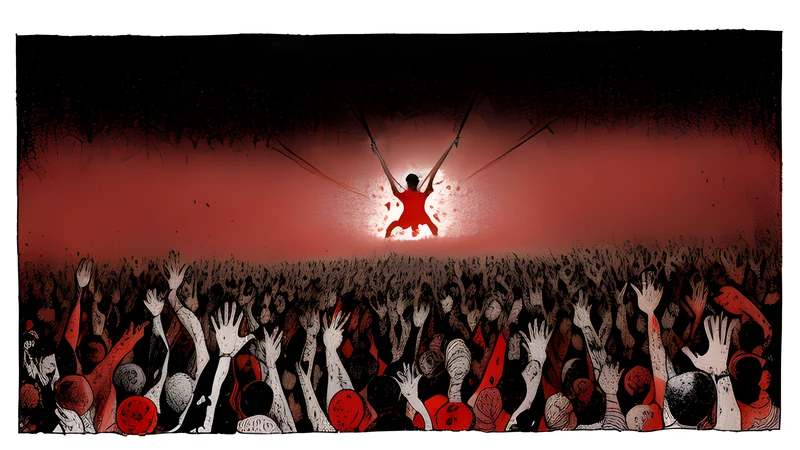
What follows the invocation is close to indescribable, and I will try anyway. The stage fills with performers — the core trio expanded by a small army of warriors and dancers in elaborate costume, antlered and painted, moving with choreographed ritual purpose. Faust throat-sings from somewhere impossibly deep in his chest; Franz’s voice rises over the top like light through smoke; the drums build slow, enormous, hypnotic rhythms that you feel in your sternum. Spears clash. Figures process. The whole thing accumulates over ninety minutes into a state that a lot of the audience describe, without embarrassment, as transcendent.
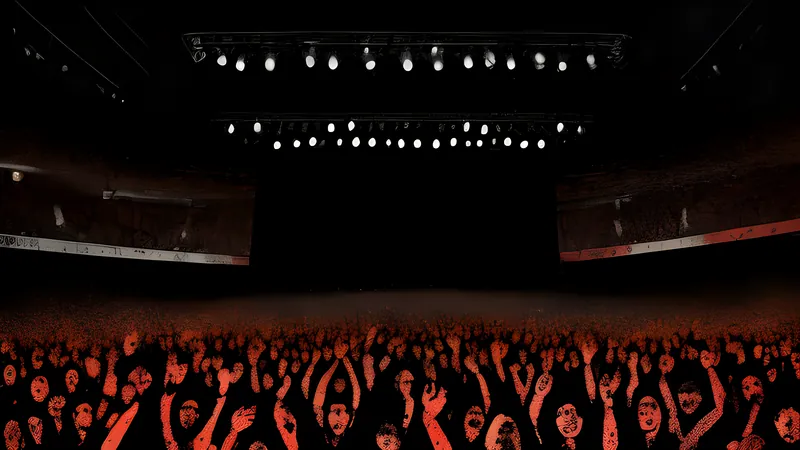
The scale is part of the point. A recorded Heilung track is atmospheric and strange; live, the same material becomes overwhelming, because the visual ritual and the physical volume and the sheer number of bodies on stage combine into something the recording only sketches. This is music that was always meant to be an event, performed in the round with fire and movement, and the studio versions are best understood as documents of a live art rather than the main text. The rooms that suit them are the big, resonant, ceremonial ones — a space like Christiania’s Den Grå Hal is exactly the kind of cavernous, atmospheric hall where a Heilung ritual can properly breathe.
The Nordic ritual lineage
Heilung did not appear from nowhere. They are the most spectacular expression of a broader Nordic and European appetite for ritual, folk and the reconstructed ancient past — the same current that carries Wardruna and a growing field of related acts. Where Wardruna are austere and contemplative, focused on the sound and the instruments, Heilung push all the way into theatre, adding the visual and physical dimension of full ritual performance. The two projects are cousins, drawing on overlapping sources and audiences, and between them they have built the modern Nordic ritual-music scene into a genuine live sector.
That scene overlaps in turn with the participatory, immersive gatherings that are such a feature of Nordic culture — the burns, the folk festivals, the reconstructed markets and staged rites where the line between performer and participant deliberately blurs. Heilung sit naturally in that world; their shows share its DNA of collective, embodied, ceremonial experience, and a lot of their most devoted audience move fluidly between a Heilung ritual and the wider culture of Nordic participatory events.
The politics of the ancient
Any project drawing this heavily on pre-Christian European heritage has to navigate a genuine minefield, because the same imagery and mythology have been appropriated by ugly political movements. Heilung are alert to this and have been consistent and unambiguous in rejecting it. Their message is explicitly one of shared human ancestry and connection across all peoples, and the opening invocation’s insistence that everyone present is kin functions partly as a deliberate inoculation against the narrow, exclusionary reading that has attached itself to Norse symbolism elsewhere. The band frame the ancient past as common human inheritance rather than the property of any one group, and they have been clear that anyone trying to recruit their music into a hateful agenda has misunderstood it entirely.
This matters, and it is to their credit that they address it head-on rather than pretending the problem does not exist. A lesser act might have left the imagery ambiguous and let the audience sort it out. Heilung draw the line themselves, at the top of every show, which is one more reason the project feels trustworthy in a territory where trust is hard to earn.
It is worth being honest about the risk the whole enterprise runs, because ambition on this scale can tip into self-parody. A show built on antlers, throat-singing and ritual invocation is one bad decision away from looking ridiculous, and plenty of lesser acts working similar territory do exactly that. What keeps Heilung on the right side of the line is total commitment and genuine craft — the performers believe in what they are doing, the sourcing is real, the staging is meticulous, and there is not a wink of irony anywhere in it. Sincerity at this intensity could easily fail; that it succeeds, night after night, shows how seriously the trio take their own strange proposition.
Who turns up
The Heilung audience is one of the more interesting crowds in European live music, because it refuses to sort into a single tribe. On any given night you will find metalheads who came via the black-metal and Nordic-folk pipeline, standing alongside people from the pagan and neo-shamanic scenes, alongside curious concertgoers who saw a clip online and had to witness it in person, alongside families and older listeners who own nothing else remotely like it. The music’s lack of an obvious genre home turns out to be a strength: it belongs to no scene, so everyone can claim it. That breadth is part of why Heilung have scaled so fast, from a curiosity playing early festival slots to a headline act filling major venues and drawing some of the largest, most rapt crowds on the circuit. Word of mouth does the work, because the show is genuinely difficult to describe and almost impossible to oversell — the people who have been become evangelists, and the ones who have not keep hearing that they simply have to go.
Ritual, safety and joy
The crucial thing to say, because the imagery invites misunderstanding, is that a Heilung ritual is joyful and completely safe. The antlers and bones and warrior costumes can look forbidding in photographs, and the deep historical sourcing can sound heavy, but the actual experience is warm, communal and life-affirming. The opening invocation sets the tone: this is about connection, shared heritage and healing, an audience of strangers briefly made kin. People leave these shows elated rather than disturbed, and the atmosphere in the room is one of collective wonder.
That combination — genuinely profound, impeccably staged, and generous rather than menacing — is why Heilung have become the phenomenon they are. They take material that could easily curdle into either fantasy kitsch or grim posturing and turn it into something dignified, moving and open-hearted. It is amplified history in the truest sense: the deep past made present, loud, and shared, for ninety extraordinary minutes, with a field full of people who walked in as an audience and walk out feeling like they took part in something. There is nothing else quite like it, and everyone I know who has experienced it says the same thing — go, and let it work on you.
Related Content