Gimle: Roskilde's Year-Round Venue
The loud little institution that keeps a festival town honest the other fifty-one weeks
Contents
Say “Roskilde” to anyone outside Denmark and they picture a muddy field, a naked run, and 130,000 people losing their minds in front of the Orange Stage for one week at the end of June. Fair enough. That week is the reason the town has a place in the world’s imagination at all. But a festival is a spike, and a spike is a bad way to keep a music culture alive. Fifty-one weeks a year the tents are down, the volunteers are back at their desks, and the question of where anyone in Roskilde actually goes to see a band on a wet Tuesday in November has a single, unglamorous, essential answer. That answer is Gimle.
A youth house that refused to grow out of it
Gimle started in 1972 as a youth and culture house, the kind of publicly backed community venue that Danish cities were building all through that decade to give teenagers somewhere to be that was not a car park. Most of those places drifted into being all-purpose community centres — table tennis, evening classes, a stage used four times a year. Gimle went the other way and became a proper concert venue, and it has held that line for half a century. Today it carries the formal status of a regionalt spillested, a regional venue, one of a network of rooms across Denmark that receive state and municipal support specifically to programme live music that the market alone would never sustain. That designation is the quiet backbone of Danish live music, and it is why a city of fifty thousand people can support a stage that books touring bands every week of the year.
The regional-venue system is worth understanding, because it explains why a room like this can take risks. Gimle does not have to sell out every night to survive. It has a mandate: present live music, develop local talent, take a chance on the act that has three hundred monthly listeners and a good reason to be heard. That mandate is the difference between a venue and a bar with a stage, and you can hear it in the programming.
Musicon: a concrete factory that learned to sing
For decades Gimle lived on Helligkorsvej in a fairly ordinary building. The move that defined the modern venue came around 2010, when it relocated to Musicon, the old Unicon concrete-element factory on the southern edge of Roskilde. The city had bought the industrial site and set about turning it into a creative district — skate bowls, studios, the Ragnarock museum of pop and rock and youth culture with its gold-clad box of a building, workshops, and Gimle as the live-music anchor.
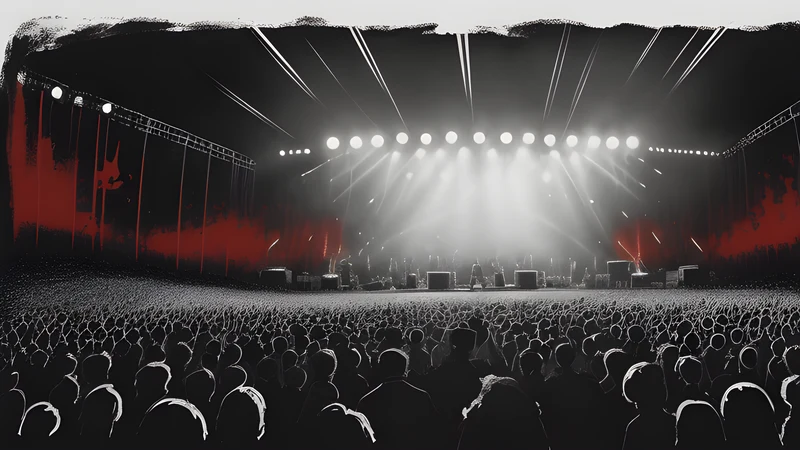
There is something right about a loud-music venue sitting inside a concrete factory. The bones of the place were built to be indestructible, and a room that once cast structural beams turns out to handle a wall of guitars without complaint. The main hall holds somewhere around six hundred people, with a smaller room for the club shows and the local bills. The sightlines are honest — a flat floor and a stage set at a sensible height, so the short punter at the back can still see a drummer’s hands. It is the scale where live music does its best work: big enough to feel like an event, small enough that the band can see the whites of your eyes.
The Musicon setting also solved the eternal Danish venue problem, which is space. A city-centre room is trapped by its footprint. Out on the old factory site there was room to breathe — load-in that does not involve carrying flightcases up a medieval alley, an outdoor area for the summer shows, neighbours who are studios and skateparks rather than people trying to sleep. If you want to see what a well-run mid-size regional room looks like, this is the template, and it stands comparison with the best of the Copenhagen circuit, from Pumpehuset’s old waterworks to the loud back rooms I grew up in.
The festival connection, and why it matters
You cannot write about Gimle without addressing the elephant in the field. Roskilde Festival is one of the great cultural institutions of Northern Europe, a non-profit that gives essentially all of its surplus away to charity and cultural work, run by an army of tens of thousands of volunteers. That volunteer culture does not evaporate when the festival ends. It pools, and some of it pools in Gimle.
The two organisations are legally separate, and it is worth being precise about that rather than romanticising a merger that does not exist. What they share is an ecosystem: the same city, the same overlapping pool of people who believe that music is something you build rather than something you buy, the same instinct that a good scene needs somewhere to happen all year and not only in a spike of summer madness. When the festival’s programmers are hunting for the next Danish act to put on a small daytime stage, some of those acts have already cut their teeth on Gimle’s floor. The venue is a feeder and a proving ground, and in a country this size, feeders are everything.
I have always thought the healthiest way to understand Roskilde-the-town is to hold the festival and the venue in the same frame. The festival year is the fireworks; Gimle is the pilot light that keeps burning so the fireworks have something to catch on. A town that only had the June explosion would be a theme park. A town with a working regional venue is a place where a fourteen-year-old can see a band, decide that is what they want to do with their life, and have somewhere local to fail in front of forty people until they get good.
What it is actually like to be in the room
The character of Gimle is the character of a volunteer-heavy Danish venue, which is a specific and recognisable thing. The bar staff are often the kind of people who are there because they love it, and it shows in small ways — the sound engineer who genuinely cares whether the vocal sits right, the door person who knows the regulars, the sense that the building is run by people rather than processed by a chain. The crowd skews to the local mix a university-adjacent town produces: students, lifers, the middle-aged couple who have been coming since the venue was on Helligkorsvej and will keep coming until they physically cannot.
The programming is broad by design, which is the regional-venue mandate doing its job. A death-metal bill one week, a singer-songwriter the next, a hip-hop night, a touring post-punk act working its way across Scandinavia, a local showcase where the whole point is that nobody has heard of anyone on the poster yet. That breadth is a feature. It means the room never calcifies into a single tribe, and it means a curious teenager can wander in on a whim and discover a genre they did not know existed.
If you are travelling and you have built your Danish trip around the festival week, a night at Gimle is the corrective that tells you what the town is like when it is being itself. Take the train out from Copenhagen — twenty-odd minutes to Roskilde station, then a walk or a short bus to Musicon. Go early, catch the opener, drink the reasonably priced beer, and watch a full room give its attention to a band that three hundred people have heard of. That is the base state of live music, the thing the festivals are built on top of.
The economics nobody sees from the crowd
It is easy to stand in a full room and assume the full room pays for itself. It rarely does, and understanding why is the key to valuing a place like Gimle properly. A touring mid-size band costs real money — the fee, the backline, the crew, the hotel, the van diesel across a country of bridges and ferries. Sell six hundred tickets at a Danish price point and the maths can work for the headline act on a good night. Sell out is the exception, though, and the venue’s whole calendar is padded with the nights that do not sell out: the local showcase, the genre experiment, the touring act on the way up whose draw is fifty people and a hope. Those nights are the mandate, and they lose money by design.
That is the entire argument for the regional-venue system, and it is an argument Denmark has decided to win. Public support covers the gap between what a healthy programme costs and what a small city’s ticket sales can bear, which frees the venue to book for the culture rather than only for the till. The result is a room that can say yes to the band that deserves a stage before it deserves a crowd. Every established Danish act you have heard of played rooms like this when nobody had heard of them, and somebody chose to lose a little money putting them on. Multiply that decision across fifty years and you have a music culture. That is what your ticket, and your taxes, are quietly buying.
The volunteer layer sits on top of the public money and makes it go further. People who run the bar, work the door, load the gear and mind the desk for the love of it are the difference between a venue that survives on its subsidy and one that thrives past it. It is the same civic instinct that powers the festival up the road, scaled down to a room you can cross in twenty paces, and it is the reason a Roskilde night feels built rather than sold.
The point of a place like this
There is a temptation, when you love the big rooms and the big festivals, to treat venues like Gimle as the minor leagues — a place bands pass through on the way to somewhere that matters more. Get that backwards and you misunderstand the whole ecosystem. The regional venue is where the music culture is actually maintained: the room where local acts learn their craft, where touring bands can afford to play a small country’s smaller cities, where the audience for live music is grown one curious night at a time.
Copenhagen has the famous rooms and the harbour festival. Aarhus has its scene. But a healthy country needs music happening everywhere, and the capital cannot be the only place it happens; that is precisely what the regional-venue network exists to guarantee. Gimle is Roskilde’s contribution to that promise — a fifty-year-old youth house that grew up into a proper venue, moved into a concrete factory, and kept the lights on so that the town famous for one loud week could be a music town for all fifty-two. Go for the festival, absolutely. But if you want to know whether a place has a real scene, skip the spike and see what it does on an ordinary Tuesday. In Roskilde, on that Tuesday, the answer has a name.
Related Content