Ghost: Sweden's Theatre Kids Who Conquered Metal
How a masked Linköping band turned corpse paint into arena spectacle
Contents
A band spent almost a decade refusing to say their own names, then a Swedish court made them do it anyway. That is the strange spine of Ghost, the Linköping act that dressed heavy metal up in cathedral robes and pop hooks and rode the disguise all the way to the Grammy stage.
For years the pitch sounded like a student prank that got out of hand. One singer in the paint and mitre of a Satanic anti-pope, calling himself Papa Emeritus. Behind him a rank of Nameless Ghouls in identical masks and chrome, credited to nobody, interviewed only in silhouette. It should have been a novelty that burned out inside a tour cycle. Instead Ghost turned into one of the biggest metal bands Sweden has ever exported, and the story of how they did it is more interesting than the costumes suggest.
The man under the mitre
The band emerged around 2010 with Opus Eponymous, a debut that welded doom-metal atmosphere to melodies that owed as much to ABBA and Blue Öyster Cult as to anything with a growl in it. That was the trick from the start: songs about devils and rituals, delivered in a clean, almost churchy tenor, with choruses you could hum on the bus. The horror was set dressing. The craft underneath was pure Swedish pop songwriting, and Sweden has always been frighteningly good at pop songwriting.
The mastermind, we now know for certain, is Tobias Forge. He kept that quiet on purpose, cycling through a series of Papa Emeritus characters — a bit of lineage theatre where each “new” frontman was really the same man in a slightly different costume — before retiring the Papas for a character called Cardinal Copia. The joke was always that the anonymity was itself the show. You were meant to wonder. The band handed you a mystery and let the internet do the marketing.
The lineage conceit is worth dwelling on, because it is the cleverest bit of storytelling Forge ever built. Papa Emeritus I gave way to Papa Emeritus II, then III, each one supposedly the successor to the last, retired on stage in a mock ceremony at the end of an album cycle so the “new” Papa could take over for the next record. It gave the band a built-in narrative every couple of years, a reason for the imagery to evolve, and a way to refresh the merchandise without anyone feeling cheated. It was a soap opera the fans were in on, and it kept the mystery generating headlines long after the novelty of the masks alone would have faded. When Cardinal Copia arrived — a promoted underling rather than another Papa — it read as a genuine plot twist. Very few metal bands have thought this hard about serialised storytelling, and it is a large part of why Ghost held attention across a decade.
Forge grew up steeped in the same Scandinavian metal soil that produced acts like King Diamond and Mercyful Fate, the Danish godfather of corpse-paint theatre whose fingerprints are all over Ghost’s presentation. Where King Diamond played genuine occult menace, Forge played a wink. The imagery is blasphemous on the surface and camp underneath, closer to a Hammer horror film than to anything you would actually be scared of. That reading matters, because it is the reason a band with an upside-down cross on the drum riser can sell tickets to people who would never call themselves metalheads.
When the mystery went to court
The anonymity held right up until it became a liability. In 2017 four former Nameless Ghouls — led by Martin Hjertstedt, alongside Simon Söderberg, Mauro Rubino and Henrik Palm — took Forge to court in Sweden. The claim was money: they said they had been touring members owed a share of the band’s profits, some of them having played hundreds of shows, and they wanted the accounts opened for the years 2011 to 2016. Forge’s position was blunt. There was no legal partnership. Ghost was his project, the Ghouls were hired players, and the masks had never made them co-owners of anything.
The court sided with Forge. By late 2018 the former Ghouls had lost, and were ordered to cover his legal costs. The lasting consequence had nothing to do with the verdict. To fight the case, the disguise had to come off in public. The press printed Forge’s name, printed the plaintiffs’ names, and the whole anonymous conceit collapsed into a fairly ordinary story about a bandleader and his backing musicians falling out over cash. It is the least mysterious thing imaginable, and it happened to the most mysterious band in metal.
What impressed me is how little it hurt them. A lesser act would have been holed below the waterline the moment the trick was explained. Ghost carried on as if the reveal were simply the next act of the play, because by then the songs were doing the heavy lifting and the costume was a bonus. That is the tell of a real band rather than a gimmick.
Grammy, arenas, and the pop move underneath
The commercial proof arrived in 2016, when “Cirice” won the Grammy for Best Metal Performance. A Grammy is an odd trophy for a band built on horror-movie sacrilege, and the incongruity is the point. Ghost had smuggled genuinely heavy music into a room that normally keeps it at arm’s length, and they did it with a chorus.
By the time of Meliora and then Prequelle, Forge had leaned fully into the arena-pop instincts that were always lurking. “Square Hammer” is a stadium rock song wearing a devil mask. “Rats” struts like a lost eighties single. The 2018 records openly courted the kind of hooks you would expect from a Swedish chart producer, which is exactly what Forge’s background prepared him to write. The heaviness receded; the theatre grew. Live, the show became a full costumed production with set-piece staging, the Papa/Cardinal working the crowd like a lounge act possessed.
I have watched Danish crowds take to Ghost with real warmth, and it makes sense. Copenhagen audiences at rooms like the Royal Arena reward a band that commits to the bit and delivers songs underneath it. Ghost do both. The spectacle gives you something to look at; the writing gives you something to leave humming. Plenty of heavier acts manage only the first half.
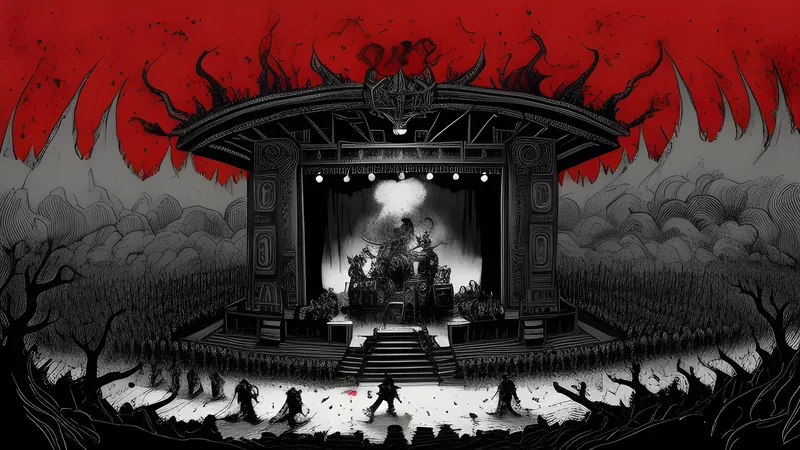
The live show is where all the strands pull together. A Ghost concert is staged like a black mass rewritten by a musical-theatre director — stained-glass backdrops, robed Ghouls in perfect formation, the Papa or the Cardinal sauntering down the stage to bless the front rows with a smirk. There is choreography. There are costume changes. Between songs the frontman plays a genial, faintly sinister master of ceremonies, cracking jokes about damnation in a way that keeps the whole thing warm rather than menacing. It is the least macho show in heavy music, and that is precisely why it pulls a broader crowd than most metal bands ever reach. Couples come. Parents bring teenagers. The horror is a costume everyone can see through, and the songs are strong enough to justify the ticket on their own.
That breadth of appeal is the commercial engine. A band that can play a metal festival on Saturday and a mixed-bill arena on Tuesday has twice the market of a group that only speaks to the faithful, and Ghost engineered that reach on purpose. The imagery is extreme enough to satisfy the metal crowd and camp enough to disarm everyone else.
Why the disguise worked
Strip away the incense and the argument for Ghost is straightforward. Sweden produces songwriters the way Denmark produces cyclists, and Forge is one of the sharpest of his generation. He understood something a lot of metal musicians resist: that a great chorus is not a compromise, and that horror imagery, played with a straight face and a private smirk, gives a pop song menace it could never buy honestly.
The masks solved a second problem too. They let a fairly slight, thoughtful bloke from Linköping become a larger-than-life frontman without the awkwardness of doing it as himself. The character carried the swagger so Forge did not have to. When the court finally forced his name into print, the machine was already too good to need the secret. If you want to hear where this instinct for spectacle-plus-craft sits in the wider Swedish scene, it rhymes with the bombast of Sabaton and the melodic discipline that runs through so much of the country’s metal — the theatre is the surface, and the songwriting is the reason it lasts.
Ghost were the theatre kids of Swedish metal, the ones who took the production seriously enough to win, and who understood that a good disguise is only worth wearing if there is something real behind it. There was. There is. The mitre just made you look.
It is worth saying plainly that the band divide metal opinion, and always have. Purists find them too polished, too pop, too knowing — a costume drama for people who want the aesthetics of heavy music without the weight of it. I understand the complaint and I still think it misses the point. Ghost never claimed to be the heaviest band in the room. They claimed to be the best show, and on that promise they deliver almost every night. A movement that can only reward brutality is a poorer movement for it, and Ghost proved there was a large, hungry audience for craft and theatre done at the highest level. That audience was always there. Forge just put on a mask and went to find them.
Related Content